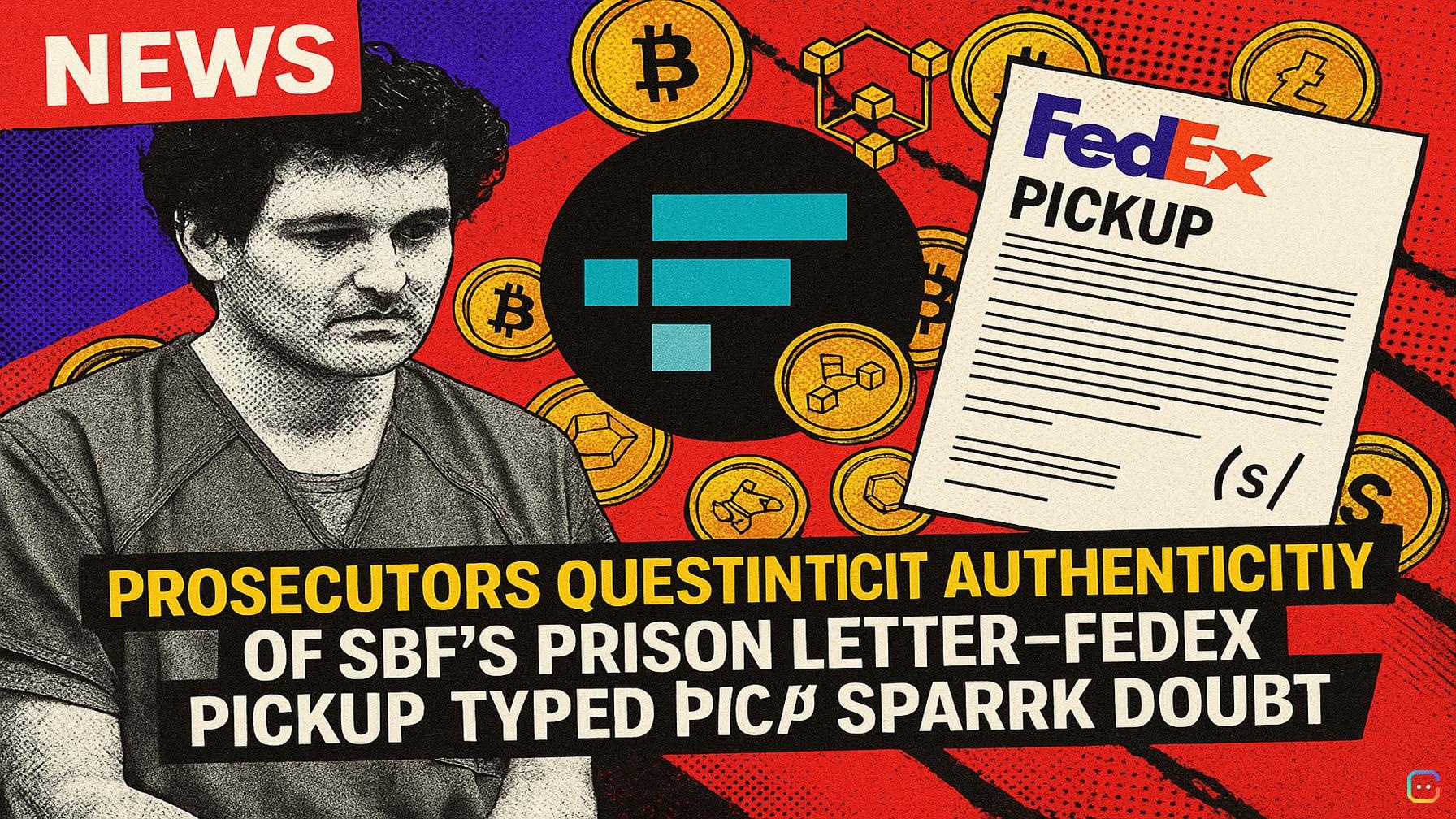
Federal prosecutors are casting doubt on a recent court filing allegedly sent from prison by former FTX CEO Sam Bankman‑Fried, saying evidence suggests the March 16 letter may not have come from behind bars at all.
In a filing, the government flagged several inconsistencies with Bureau of Prisons procedures that prohibit inmates from using private carriers. The envelope accompanying the letter reportedly misidentified the facility, FedEx tracking showed pickup from the Palo Alto/Menlo Park area, and the letter bore a typed “/s/” signature rather than a handwritten one. Prosecutors say those details give them “reason to doubt” the letter was actually mailed from prison.
The disputed letter—filed under Bankman‑Fried’s name—requested a one‑month extension, to April 16, to respond to a government brief. It warned that an expected transfer from FCI Terminal Island could leave him without access to legal materials, counsel or the courts for weeks while in transit.
That procedural skirmish has unfolded as Bankman‑Fried’s family increasingly goes public pressing for clemency. In a March 21 CNN interview, his parents Joseph Bankman and Barbara Fried described the prosecution as politically motivated and argued that his 25‑year prison sentence is excessive. Barbara Fried said she believed the Biden administration had tried to “destroy crypto,” and Joseph Bankman rejected comparisons between his son and Bernie Madoff, calling Sam “a pioneer” who “built billion‑dollar businesses in a new field.”
The family’s defense centers on reframing FTX’s collapse as a liquidity crisis rather than straight fraud. They assert that “all of the money was turned over” and that customers were ultimately repaid—with interest, they say. Joseph Bankman also characterized transfers to Alameda Research as internal borrowing within the platform. Bankman‑Fried fired his lawyers in early February and is currently representing himself.
Tensions over the family’s involvement surfaced in court filings. A March 16 letter submitted in Bankman‑Fried’s name was later revealed to have been written by his mother, a Stanford Law professor. U.S. District Judge Lewis Kaplan rejected that filing, saying she “lacks standing” because she is not counsel of record and had not appeared in the case; he also noted the letter gave no indication it had been served on prosecutors. Court staff reported receiving a voicemail from someone identifying herself as Fried; Kaplan reiterated that the court does not accept calls from litigants or family members. Still, the judge granted a short extension on his own to March 23 to give Bankman‑Fried’s lawyers an opportunity to seek relief properly.
Background and stakes
- FTX’s November 2022 collapse—once the exchange was valued at roughly $32 billion—exposed that customer funds were being used by Alameda Research. Prosecutors said about $8 billion in customer money was missing at the time of bankruptcy.
- A jury convicted Bankman‑Fried on seven counts, including fraud, conspiracy and money laundering. He is serving a 25‑year federal sentence.
- A central post‑conviction debate is whether customers were “made whole.” The FTX bankruptcy estate has recovered assets sufficient to repay many claims based on 2022 valuations, but critics say that ignores the subsequent crypto rally: had customers not been blocked from their assets, they might have benefited from later price gains.
- The estate sold an 8% stake in AI company Anthropic—originally a $500 million investment in 2021—for about $1.3 billion across two sales in early 2024; some observers note the stake would be worth far more at today’s valuations.
Political context and pardon prospects
Bankman‑Fried’s supporters have pointed to recent political developments as a potential path to clemency. The article notes President Donald Trump pardoned Binance founder Changpeng “CZ” Zhao in 2025, signaling a shift toward friendlier crypto policy in some corners of Washington. Since reactivating his X account in September, Bankman‑Fried has aligned his public messaging with themes championed by Trump and conservative allies—criticizing Biden‑era crypto enforcement and alleging prosecutorial overreach.
But momentum for a pardon is far from certain. Senator Bernie Moreno (R‑Ohio) was bluntly opposed, calling Bankman‑Fried a “piece of shit” and saying he “should go to jail for a long, long time.” And as of February, Trump indicated he had no current plans to offer a pardon.
Where this goes next
The authenticity dispute over the March 16 filing is a small but telling episode in the wider post‑conviction fight—one that mixes legal maneuvering, family advocacy, and high‑stakes political positioning. With Bankman‑Fried representing himself and tensions between family members and the court already public, further procedural scraps and public appeals are likely as his team (and his advocates) push for any available relief.
Read more AI-generated news on: undefined/news