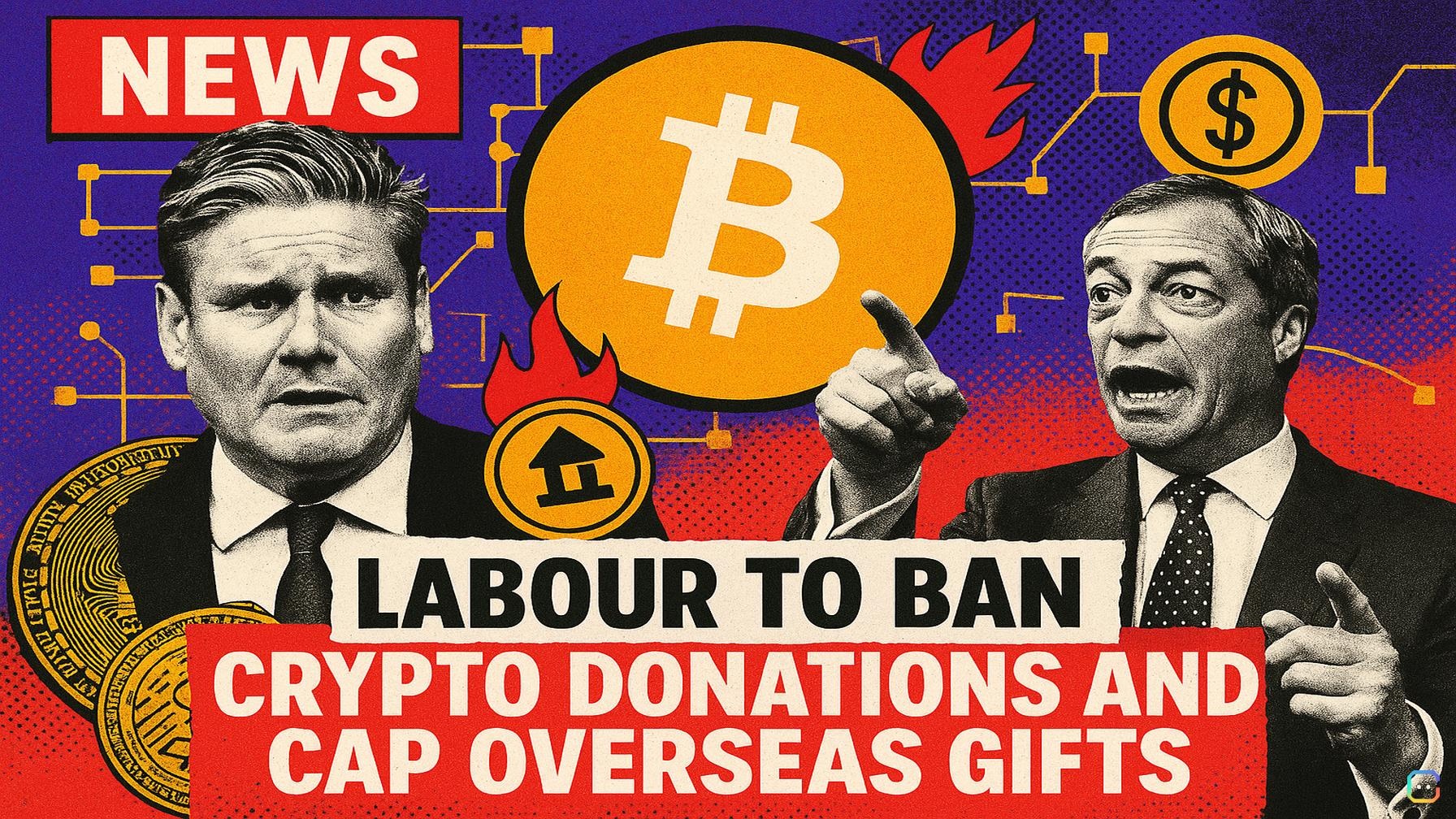
Nigel Farage’s public affinity for Donald Trump — and his embrace of gold and cryptocurrencies — is fast becoming a political liability that Labour hopes to exploit.
Why it matters for crypto readers
Farage is not just a political figure; he’s cultivated a business profile that includes selling gold bars, previously offering paid Cameo videos, and openly advocating for Bitcoin. This month he also invested £215,000 in Stack, a crypto company chaired by former chancellor Kwasi Kwarteng. Those commercial ties, especially to crypto, make him a focal point in a broader debate about political donations, anonymity and foreign influence — issues squarely in the remit of the crypto industry.
The new rules
Keir Starmer’s Labour announced two concrete moves designed to curb a specific flow of influence:
- A ban on political donations made in cryptocurrency.
- A £100,000 annual cap on donations from British citizens living abroad.
Communities secretary Steve Reed said the legislation will be backdated. The immediate target is Christopher Harborne (also known as Chakrit Sakunkrit), a British–Thai billionaire with crypto wealth who donated roughly £9m to Reform UK last year and a further £3m this month. Under the new cap he would be limited to less than one-hundredth of that monthly gift.
Political context
Labour frames the steps as both a way to limit Reform UK’s financial firepower and to highlight unconventional funding sources and potential conflicts of interest. The party argues that wealthy, often cross-border investors can profit from political volatility while bankrolling the politicians who create it — a point summed up by Labour MP Liam Byrne: “Populism isn’t just a political movement. It’s a business model.”
Why crypto is singled out
Cryptocurrencies pose distinct regulatory challenges for political finance: they can enable cross-border transfers and, unless carefully tracked, offer higher degrees of anonymity than traditional bank transfers. That makes them an appealing channel for donors who live outside the UK or want to obscure sources — and a headache for election integrity and transparency.
A longer-running problem
Critics note this isn’t a wholly new concern: questions about overseas donors and political influence have been raised for years. Labour’s move follows a string of controversies — including the conviction of Nathan Gill, once an associate of Farage, for taking Russian-linked payments — that have prompted calls to close loopholes governing foreign influence and party funding.
A paradox for Farage
There’s an ideological tension around Farage’s funding profile. Cryptocurrencies and gold are often championed by political libertarians as hedges against state monetary control — yet Farage’s platform tends toward social conservatism and strict immigration controls, positions at odds with classic libertarianism. That dissonance, plus the optics of wealthy backers and business ventures, gives Labour ammunition as it tries to sway undecided voters.
Bottom line
For the crypto sector, the UK’s measures are a reminder that political donations in tokens won’t remain unregulated indefinitely. For Nigel Farage and Reform UK, the clampdown on crypto-funded and large cross-border donations could blunt a major funding route and cast a spotlight on the party’s financial backers — an outcome that may be as damaging politically as it is strategically.
Read more AI-generated news on: undefined/news