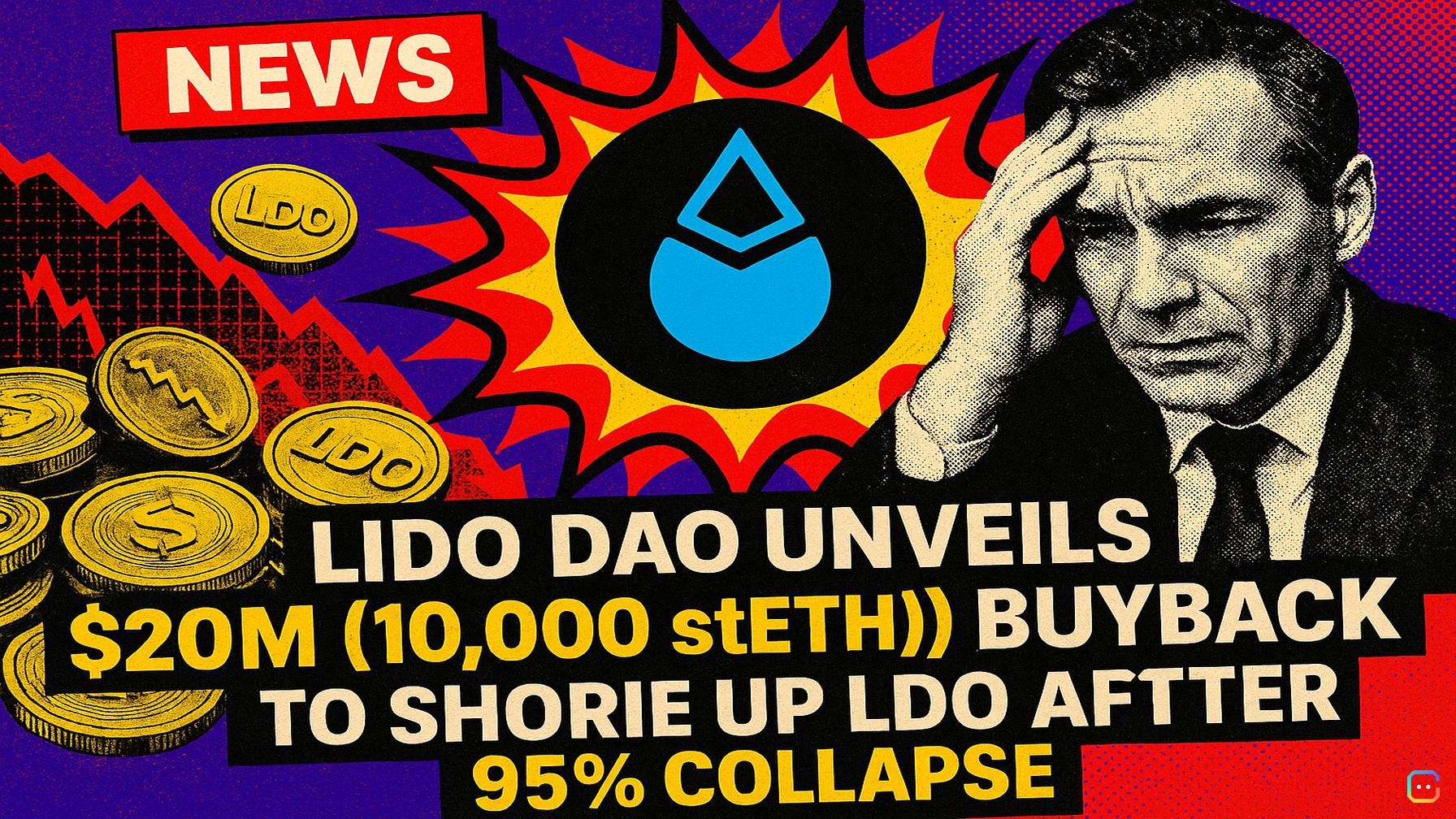
Lido DAO has put forward a $20 million buyback plan to shore up its governance token after a collapse that’s wiped out more than 95% of LDO’s value since 2021.
What’s proposed
- The Lido Ecosystem Operations team wants to use up to 10,000 stETH to buy LDO at what the proposal calls a “historically depressed valuation.” At ether near $2,000, 10,000 stETH equals roughly $20 million.
- Execution would be done in 1,000 stETH batches. Each batch requires a separate Easy Track governance motion and is subject to a three-day objection window. The Growth Committee can pace trades to avoid tipping off the market, and slippage is capped at 3% below the reference price.
Why Lido can’t just buy onchain
- Onchain liquidity for LDO is shallow: about $90,000 of depth at ±2%, per the proposal. That means big onchain purchases would move the market heavily.
- A single 1,000 stETH execution would exhaust available onchain liquidity multiple times over, so the DAO plans to route trades offchain via centralized exchanges and market-makers.
- The proposal authorizes the Growth Committee to place trades on exchanges that currently show more than $100,000 in depth—Binance, OKX, Bybit, Gate and Bitget—and to engage market-making partners on behalf of the Lido Ecosystem Foundation.
Price, supply and scale
- LDO hit an all-time low of $0.27 on March 7 and is trading near $0.30 today (CoinGecko), with a market cap of about $258 million.
- Down from its 2021 peak of $7.30, LDO has lost more than 95% of its value. Using the proposed buyback at current prices could remove roughly 65 million LDO — around 8% of circulating supply.
The DAO’s rationale
- The proposal frames the buyback as correcting a “significant dislocation” between LDO’s market price and Lido’s on-chain fundamentals.
- Key metrics cited: the LDO-to-ETH ratio sits near 0.00016, roughly a 70% discount to levels maintained over most of the past two years. Meanwhile, net protocol rewards have fallen only about 20% over that same period, costs have improved ~13% year-over-year, and Lido’s effective take rate rose to 6.11% from 5%. Lido still controls the largest share of staked ether—around 23% (DefiLlama).
Bigger picture: governance tokens and market repricing
- The proposal highlights a wider question for DeFi: markets have broadly repriced governance tokens that control fee-switches but don’t directly distribute protocol revenue. LDO’s 95% drop is extreme, but not unique among governance tokens in recent years.
- Lido is treating the disconnect as a buying opportunity. Whether a buyback can meaningfully re-anchor LDO to its protocol fundamentals depends on whether market participants ever start valuing governance tokens on those fundamentals again.
Bottom line
Lido’s buyback plan is a high-profile attempt to fix what the DAO sees as a mispriced token. The mechanics — offchain executions, staged Easy Track approvals and slippage limits — recognize the liquidity constraints. But the ultimate test is ideological as much as financial: can a governance token’s market narrative be reset by on-chain actors, or has the market permanently repriced these assets?
Read more AI-generated news on: undefined/news