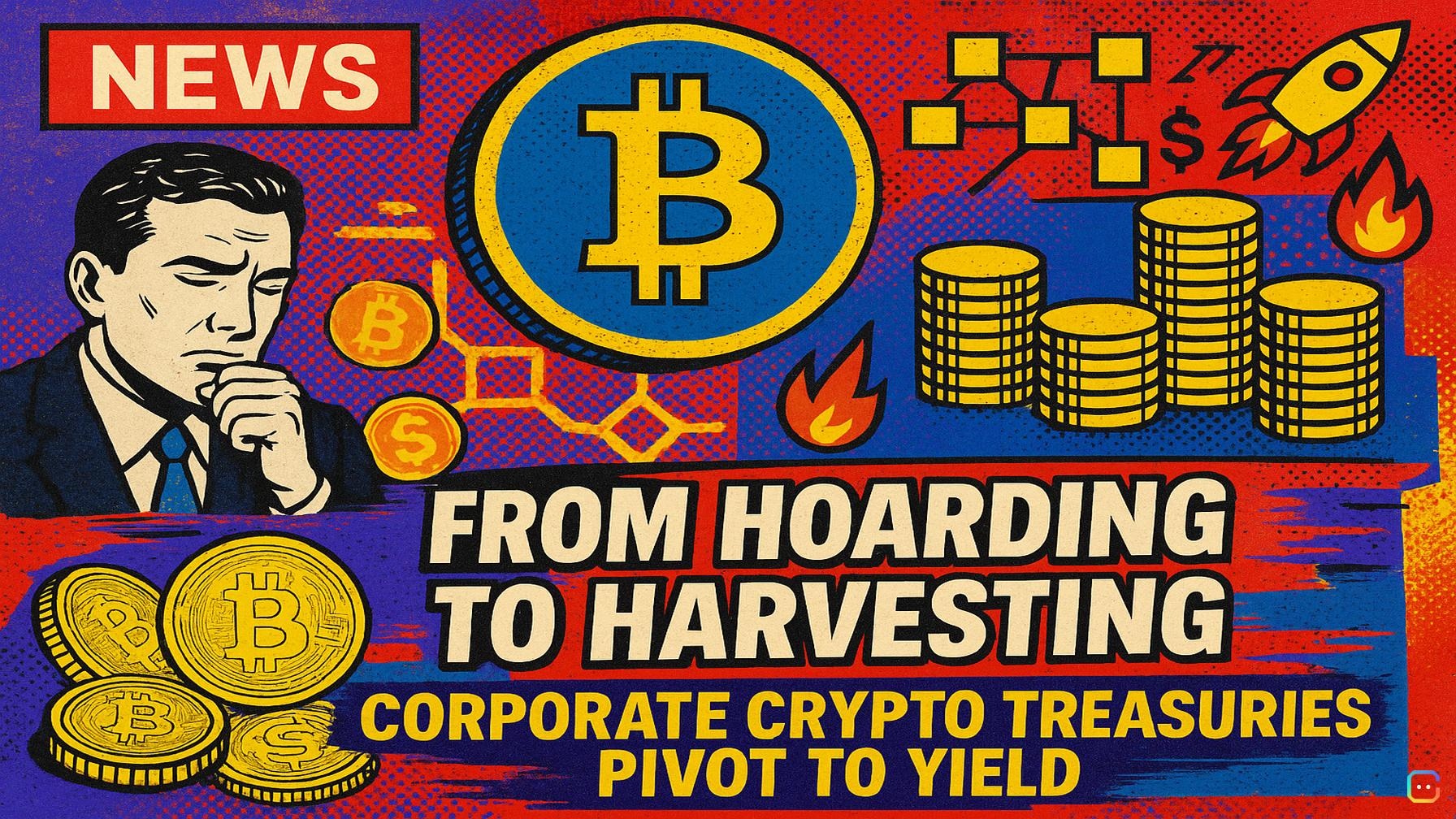
Headline: Digital-treasury playbook shifts from buy-and-hold to yield generation
By early 2026, more than 200 publicly listed companies reported holding digital assets—collectively managing over $115 billion on their balance sheets (DLA Piper, Oct 2025). The combined market capitalization of these firms climbed to roughly $150 billion by September 2025, nearly four times the prior year. Yet many still trade below the value of the crypto on their books. The message from investors is blunt: accumulation alone no longer justifies a crypto treasury.
Investors now demand capital discipline, repeatable income and transparent reporting. Management teams have reacted with buybacks and new metrics such as “BTC per share” to demonstrate the incremental value a treasury adds beyond token price (AMINA Bank Research, 2026). The sector is moving from passive accumulation—what some call “DAT 1.0”—to active yield-first strategies, or “DAT 2.0.”
Three distinct treasury models are emerging — each with different risk/return profiles, governance needs and technical demands
1) Protocol-native income: staking, Lightning and restaking
- What it is: Use crypto to support networks and infrastructure—staking tokens for consensus rewards, running Lightning routing channels for fee income, or engaging in restaking where staked ETH secures additional services.
- Why it matters: Native yields are attractive because they’re tied to protocol economics, and institutional-grade infrastructure can capture a premium over retail staking rates.
- Examples: Bitmine Immersion Technologies reported over 3 million staked ETH by early 2026, with $9.9 billion total holdings and about $172 million in annualized staking revenue (SEC Filing, Mar 2026). SharpLink Gaming put $200 million of ETH into restaking via EigenCloud, chasing higher yields by securing applications from AI workloads to identity services (SEC Filing, 2025).
- Risks and needs: Technical security, smart-contract and validator risk, and robust operational controls. Restaking especially requires careful governance to limit cascading exposures.
2) Market-driven income: trading, options and arbitrage
- What it is: Convert the treasury into a trading engine—funding-rate arbitrage, basis trades, option-writing and other market-neutral income strategies.
- Why it matters: These tactics can produce steady revenue independent of outright price appreciation, but they turn the treasury into a trading operation.
- Example: A major Japanese-listed firm holding more than 35,000 BTC at end-2025 generated roughly $55 million in bitcoin income via options and saw operating profit jump >1,600% year-on-year. Yet it recorded a large net loss because of non-cash mark-to-market accounting effects under local rules (TradingView; Kavout, 2026). That gap highlights how operational cash vs. reported earnings can diverge—and why transparency and governance matter.
- Risks and needs: Requires trading expertise, 24/7 monitoring, sophisticated risk controls and governance. Finding and compensating talent is a key constraint.
3) Productive balance-sheet capital: borrowing, stablecoins and private credit
- What it is: Use crypto as collateral to borrow (often non‑recourse), receive stablecoin liquidity, and deploy that capital into higher-yielding short-duration private credit or real-economy lending.
- Why it matters: This preserves long-term crypto exposure while generating recurring interest income—combining potential capital gains with predictable cash yield.
- Mechanics: Borrow against holdings, lend the proceeds into diversified credit portfolios, manage liquidity and underwriting like a bank. This approach benefits from existing lending platforms and institutional-grade stablecoins.
- Requirements and risks: Needs institutional lending infrastructure, strong credit underwriting, governance and counterparty due diligence. Leverage is controlled but still creates liquidity and counterparty risk.
- Stablecoin role: By 2026 stablecoins are increasingly core to institutional plumbing—supporting cross-border payments and T+0 settlement (Foley & Lardner, Jan 2026). Coinbase Institutional projected that stablecoin market cap could reach $1.2 trillion by 2028 (Coinbase Institutional, Aug 2025), improving the viability of credit-deployment strategies.
Hybrid examples and diversification
- Firms are experimenting with mixes of the above. Galaxy Digital, for example, combines a digital-asset treasury with institutional services—collateralized lending, advisory and infrastructure—and posted a record adjusted gross profit of over $730 million in Q3 2025 (Mint Ventures Research, 2025). It has also repurposed its Helios mining facility into an AI compute campus under long-term contracts—showing how non-crypto, uncorrelated revenue streams can strengthen treasury resilience.
Takeaway: yield, governance and operational discipline now trump headline holdings
- Price appreciation alone is no longer a credible treasury strategy. Markets are rewarding firms that convert crypto exposure into sustainable income streams with clear governance and risk controls.
- There’s no single “right” model—successful treasuries will blend approaches to match risk appetite, skills and infrastructure. But the direction is clear: passive hoarding won’t cut it. Yield generation, transparency and disciplined execution are becoming the primary metrics by which the market values companies with digital-asset exposure.
- The winners won’t necessarily be the biggest holders; they’ll be the most disciplined operators.
Important notice
This piece is for informational and thought-leadership purposes and is aimed at businesses, professional counterparties and institutional market participants. It is not investment or financial advice, nor a recommendation to buy, sell or hold any asset. Digital assets are volatile and regulatory regimes continue to evolve. Past performance is not indicative of future results. Sources and forward-looking projections cited herein are third-party research and not endorsements. Seek independent professional advice before making any investment decision.
Read more AI-generated news on: undefined/news