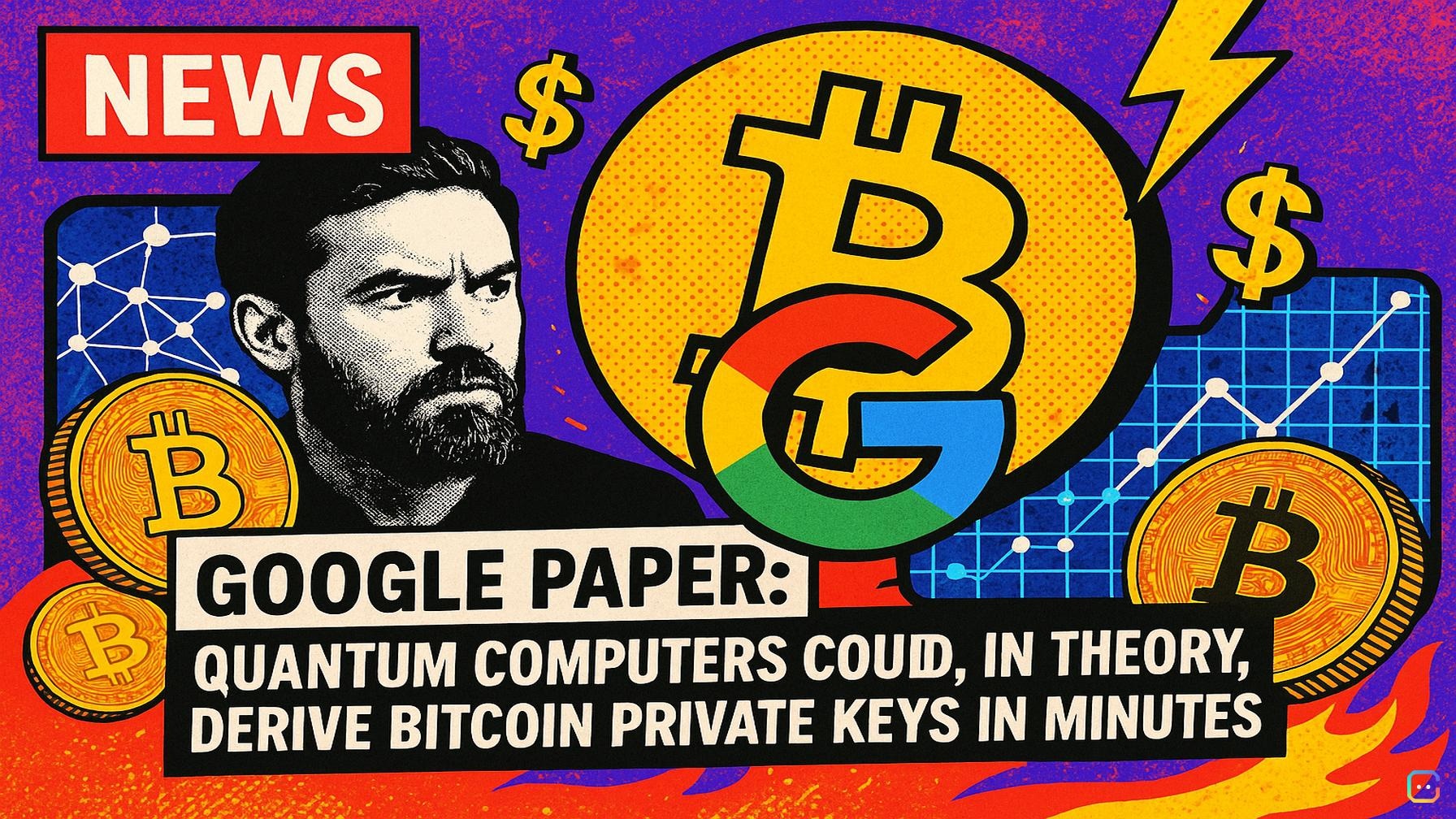
Headline: Why Google’s quantum paper should worry Bitcoiners — a clear, non-technical explainer
This week Google published a paper showing that a quantum computer could, in theory, derive a Bitcoin private key in about nine minutes — a result with implications for Ethereum, other tokens, private banking, and potentially any system that relies on public-key cryptography.
Here’s what that actually means, in plain terms, and why crypto people are right to be alarmed.
What quantum computing really is (and isn’t)
- It’s not just a faster CPU or a giant server farm. Quantum computing is a different kind of machine that exploits physics at the atomic scale.
- Classical computers store information as bits — tiny switches that are either 0 or 1. Every file, every transaction, every message is just patterns of those on/off states shuffled around rapidly.
- Quantum computers use qubits. A qubit can be 0, 1, or both at the same time — a property called superposition. That’s not “switching quickly” between states; the qubit genuinely occupies multiple states simultaneously until measured.
The hardware and the weirdness
- Most leading designs (including Google’s) use a superconducting metal loop cooled to roughly 0.015 degrees above absolute zero. At that temperature the current in the loop can exist in a quantum state and flow “both ways” at once.
- Quantum behavior disappears as soon as the system interacts with its environment — air molecules, heat, vibrations. This loss is called decoherence. To sustain quantum states long enough to compute, machines need huge dilution refrigerators, extreme shielding, vacuum isolation, and careful engineering.
- Even then qubits are fragile. Error correction is the central technical challenge to scaling these systems.
Why quantum machines scale differently
- Two classical bits can be in one of four possible states at a time; two qubits can represent all four states simultaneously. Every added qubit doubles the number of simultaneous states:
- 3 qubits → 8 states
- 10 qubits → 1,024 states
- 50 qubits → over a quadrillion states
- The other key quantum trick is entanglement: measuring one qubit immediately constrains the state of another, allowing the machine to coordinate across the huge space of possibilities.
- Quantum algorithms use interference: wrong answers cancel out and correct ones reinforce, so the system collapses to the right answer with high probability. This isn’t brute-force speed — it’s a fundamentally different approach to searching and factoring.
Why this is terrifying for encryption and crypto
- Public-key cryptography depends on an asymmetry: computing a public key from a private key is easy (milliseconds), but reversing that — finding the private key from the public key — is infeasible using classical computers (it could take millions or even longer than the age of the universe).
- Quantum algorithms such as Shor’s can collapse that asymmetry. They don’t blindly try every key; they exploit quantum parallelism and interference to find the right key far more efficiently.
- Google’s paper lowered resource estimates and argued that a quantum machine could recover a Bitcoin private key in minutes, not centuries, under certain conditions. That’s a big reduction from prior assumptions and puts key-sensitive systems on notice.
- The risk stretches beyond Bitcoin to Ethereum, other tokens, private banking infrastructure and any system relying on current public-key cryptography. The article notes roughly 6.9 million Bitcoin addresses are already exposed (i.e., have revealed public keys) and could be at risk.
Caveats and context
- Google’s result is theoretical and depends on many engineering hurdles being overcome — long-lived qubits, massive error correction, and reliable, large-scale quantum hardware are still hard.
- But the paper’s key contribution is showing the attack requires fewer resources than previously thought, tightening the timeline and increasing urgency for crypto defenses.
What comes next
- This is the first piece in a series. The follow-up will explain step-by-step how a quantum attack on blockchain keys would work, what Google’s paper specifically changed, and what that could mean for the millions of Bitcoin already exposed.
Bottom line: Quantum computers aren’t just faster machines — they use different physics to solve certain problems in a fundamentally new way. That makes them a real and escalating threat to the public-key cryptography that underpins cryptocurrency security. Crypto projects, exchanges, and users should be paying attention and planning migrations to quantum-resistant options.
Read more AI-generated news on: undefined/news