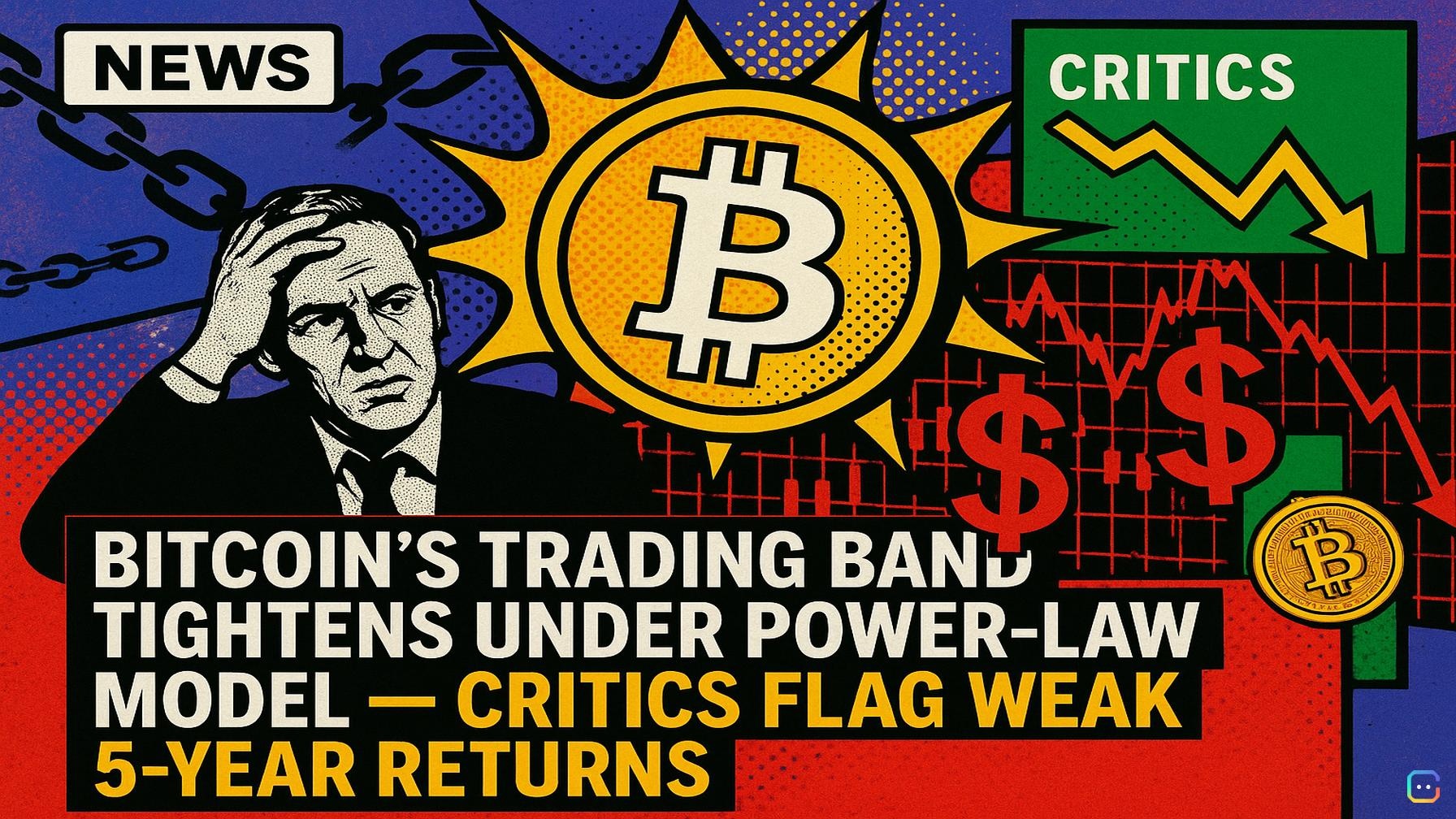
Bitcoin’s volatility appears to be cooling, according to one market model — but skeptics point to underwhelming multi-year returns.
Adam Livingston, writing on X, says Bitcoin’s price swings are “dampening” and that the “funnel is closing,” signaling a move toward equilibrium around its long-term power-law center. Livingston put the crypto about −0.94σ below that center, calling it “below trend and below fair value.” He argued the narrowing range implies that spectacular blowoff tops are becoming less common and deep crashes are losing severity as the market matures.
Putting numbers behind that view, Livingston highlighted a compression in Bitcoin’s trading band: the 5.3σ range seen in 2011–2013 has reportedly tightened to roughly 1.4σ in the 2021–2025 window. He also pointed to the power-law model’s resilience through major events — the 2022 market crash, the FTX collapse, the 2024 recovery, the 2025 top and the current drawdown — and noted the model’s R² rose to 0.961, indicating a strong statistical fit to price history.
Not everyone is convinced this maturing market narrative makes Bitcoin a superior long-term hold. Peter Schiff emphasized five-year returns in a contrasting take: Bitcoin up 12% over five years versus a 57.4% rise in the Nasdaq, 59.4% for the S&P 500, 163% for gold and 181% for silver. “If the appeal of Bitcoin is its superior long-term performance, why should anyone keep HODLing it?” he asked, framing the debate around relative performance versus traditional assets.
The two viewpoints capture the current tension in crypto markets: a technical argument for lower volatility and greater structural maturity, versus a skeptical look at Bitcoin’s returns compared with stocks and precious metals.
Read more AI-generated news on: undefined/news