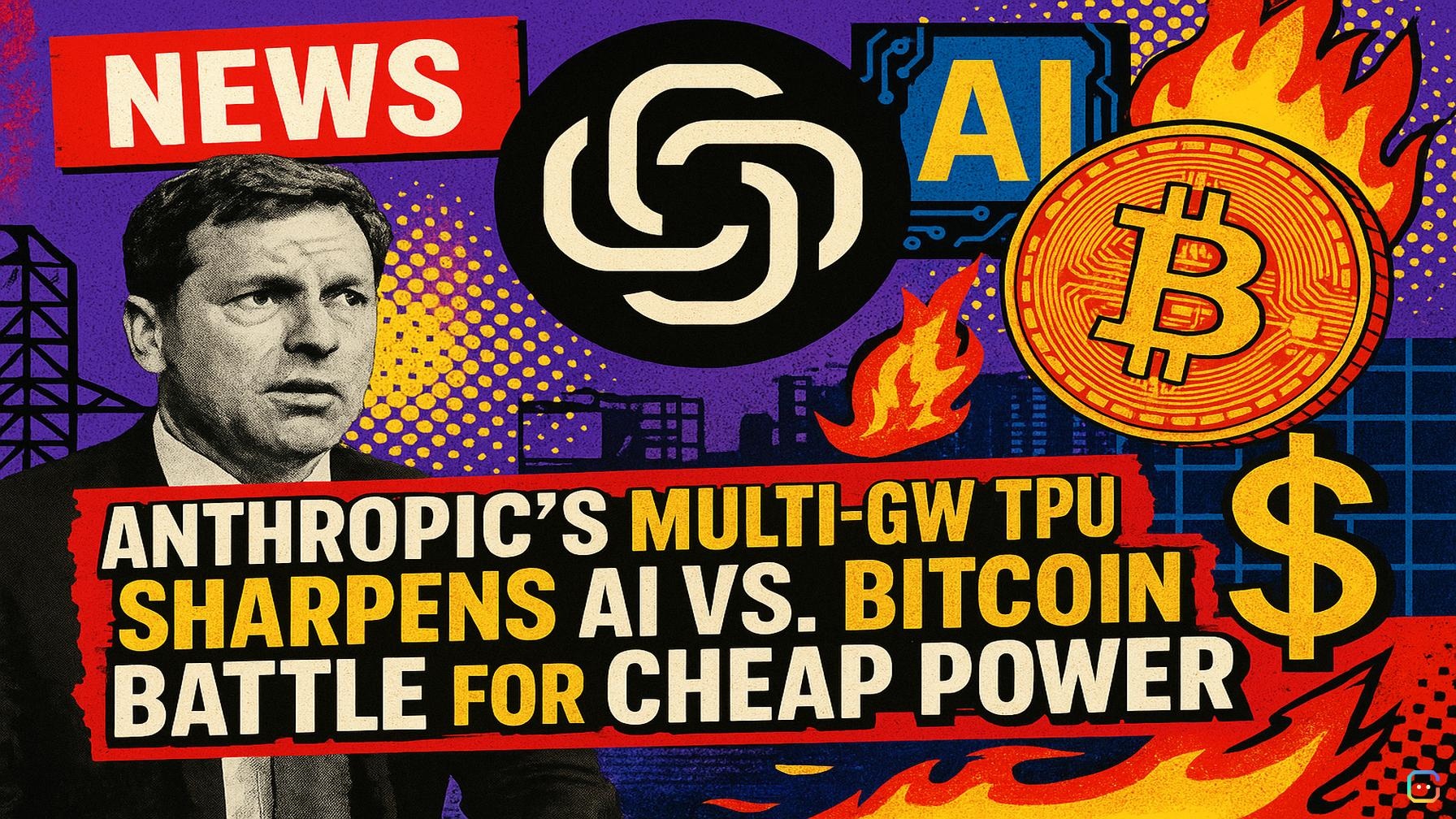
Headline: AI eats into miners’ cheapest fuel — Anthropic’s multi-gigawatt TPU deal sharpens the battle for power
Anthropic’s new pact with Google and Broadcom for “multiple gigawatts” of next‑generation TPU capacity — coming online beginning in 2027 — is a watershed moment for the scramble over cheap, large‑scale power. The company called the commitment its largest yet as its revenue accelerated to a $30 billion annual run rate from $9 billion at the end of 2025. But the broader implication is clear: high‑density AI compute is now a direct rival to bitcoin mining for the same scarce infrastructure — grid capacity, land and permitting, cooling systems, and low‑cost electricity.
Key numbers to watch
- Anthropic: “multiple gigawatts” of TPU compute with Google and Broadcom, online starting 2027.
- Revenue: Anthropic said it reached a $30 billion annual run rate from $9 billion at end‑2025.
- Bitcoin miners’ global draw: Cambridge estimates roughly 13–25 GW of continuous power, depending on hardware assumptions.
- OpenAI: reported to have raised $122 billion last week and has called compute a “strategic moat,” building across five cloud providers and four chip platforms.
- Miner behavior: Riot, MARA and Genius Group disclosed selling more than 19,000 BTC from treasuries last week.
- Network strength: Bitcoin hashrate continues to set records, exceeding 1 zettahash per second.
Why this matters for miners
AI buildouts increasingly require the very same things bitcoin operations do — contiguous land, high‑capacity grid connections, heavy‑duty cooling and the cheapest possible electricity. Anthropic’s ability to secure multiple gigawatts in one agreement, on top of its existing footprint across AWS Trainium, Google TPUs and Nvidia GPUs, underlines how fast AI demand can swallow regional capacity. When a single AI customer can lock in predictable, long‑term contracted revenue for gigawatt‑scale capacity, the economics can quickly outcompete the volatile and difficulty‑sensitive returns of bitcoin mining.
How miners are responding
- Some miners are pivoting to hosting AI compute: Core Scientific repurposed much of its capacity via a deal with CoreWeave.
- Others have expanded AI/HPC services: Iris Energy and Hut 8 report growing non‑mining revenue.
- Treasury sales: Large BTC sales from mining companies suggest mining revenue alone is under strain at current prices and difficulty levels.
The economics in plain terms
A gigawatt devoted to mining earns revenue that swings with bitcoin price and network difficulty. The same gigawatt leased to an AI customer typically yields contracted, predictable cash flow. With bitcoin trading around the levels cited in recent commentary (the article referenced $69,000), difficulty near record highs and industrial energy prices rising as AI and other industries compete for grid capacity, AI rentals can often deliver higher, more stable returns.
Outlook: not extinction, but transformation
This isn’t the death knell for bitcoin mining. The network’s hashrate and activity remain robust. But the winners in the next cycle may look less like pure energy plays and more like infrastructure landlords — companies that run large, low‑cost power platforms and monetize them by both mining bitcoin and leasing capacity to AI and high‑performance compute customers. For miners and investors, the strategic question is becoming: operate to mine, or monetize the asset base by hosting AI compute that can’t be built fast enough to meet demand.
Read more AI-generated news on: undefined/news