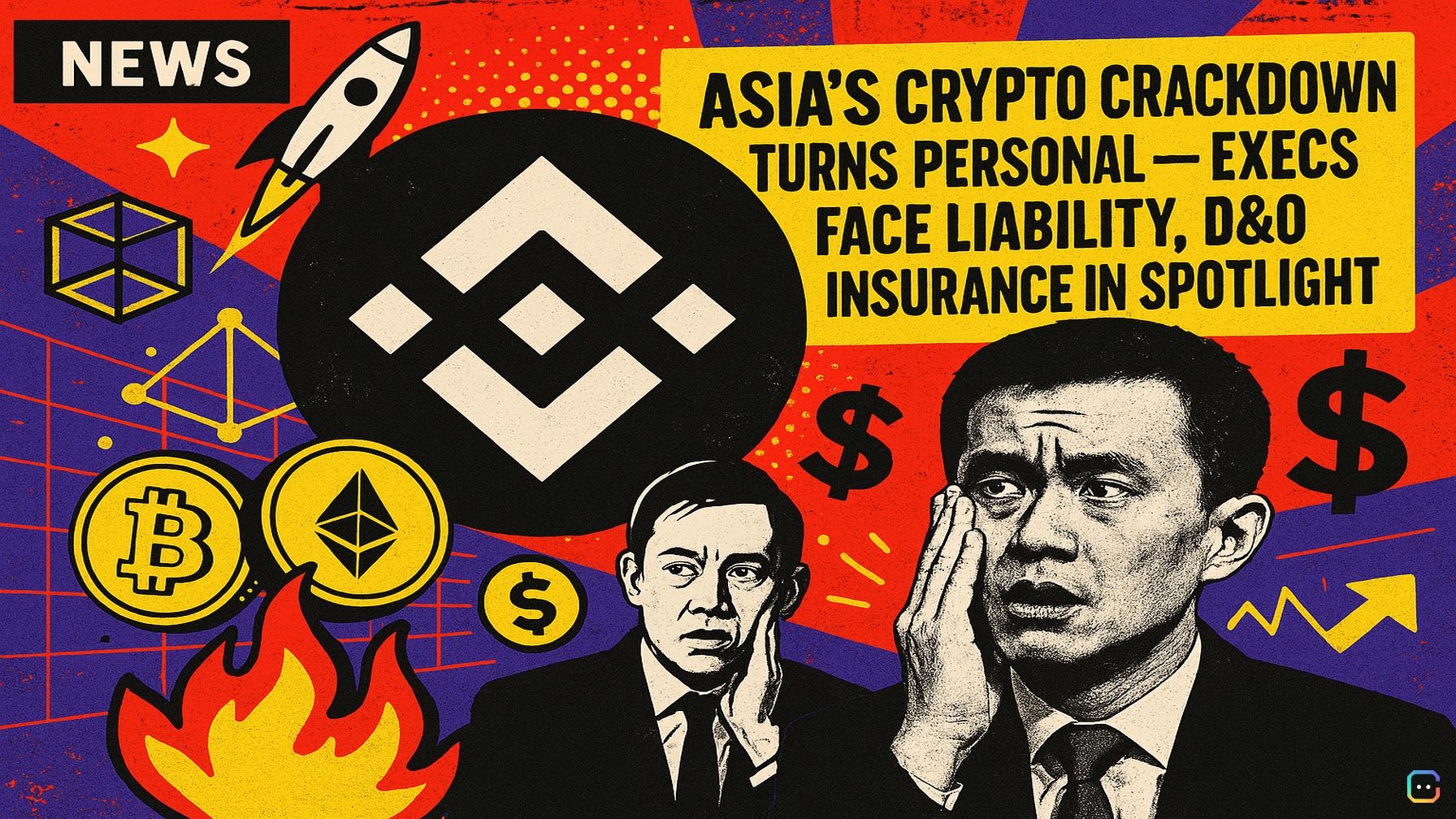
Crypto Long & Short — Asia’s digital-asset crackdown makes accountability personal
Welcome to Crypto Long & Short. This week’s briefing looks at how new rules across Asia are forcing platform operators and asset managers to rethink governance and personal liability — and why directors’ and officers’ (D&O) insurance is suddenly front‑and‑centre.
Expert briefing — Bob Williams, Lockton Companies (Asia/Pacific)
Regulators in Hong Kong, Singapore and South Korea have moved from broad market rules toward clearer lines of personal accountability for senior management. The practical upshot: firms must revisit custody models, internal controls and their D&O risk-transfer arrangements.
- Hong Kong (SFC, August 2025): The SFC issued a circular tightening expectations for senior management around custody of client virtual assets — reinforcing governance, controls and oversight as personal responsibilities. A live consultation is also considering whether virtual asset managers can rely on non‑SFC regulated or offshore custodians. Insurers currently price and underwrite virtual‑asset risk based largely on the prescriptive standards required of SFC‑regulated custodians and platforms. If alternative custody models are allowed, parity in security, resilience and insurance requirements will be essential; otherwise firms that already invested to meet Hong Kong standards could be disadvantaged and investor protection goals may be weakened.
- Singapore (2025): The Monetary Authority of Singapore expanded licensing to cover digital token service providers serving overseas customers. Key‑person competency and fitness are now core admission gates — putting senior management competence and oversight squarely under regulatory scrutiny. That raises personal exposure for directors and officers; D&O coverage is therefore an important protective layer against claims tied to governance or oversight failures.
- South Korea (Digital Asset Basic Act, June 2025): The proposed bill would formalize issuance, trading and distribution rules and introduce new governance for listing/delisting. The law would raise compliance burdens across trading platforms and service providers, amplifying the need for D&O protections against regulatory investigations, litigation and enforcement actions.
What this means: Across these markets, regulators are tightening frameworks while explicitly making senior management more accountable. Firms should proactively review governance, custody arrangements and insurance programs. D&O insurance is no longer a back‑office checkbox — it’s a core risk‑management tool in an increasingly regulated digital asset landscape.
Informed perspectives — Haidy Grigsby, Tennessee Bureau of Investigation
Crypto frauds aren’t just targeting the uninformed — experienced investors and retirees are increasingly falling victim to sophisticated social‑engineering schemes. A recent case involved a retired trader contacted via social media by someone posing as a connector to crypto opportunities. The scam followed a now‑familiar playbook:
- Initial contact via text/LinkedIn/social channels, then a shift to encrypted apps (WhatsApp, etc.) to isolate communications.
- The target is flattered, brought into “exclusive” trading groups, and asked to open accounts on legitimate exchanges and use self‑custody wallets — often via Web3 browser windows inside trusted apps, which masks the exit from a genuine platform.
- Victims are directed to fraudulent trading sites that mimic real markets but only allow a single daily trade. Returns are faked by the operators; early small withdrawals are staged (often funded from other victims) to build trust.
- When victims try to withdraw larger sums, operators create new excuses — regulatory holds, tax prepayments, liquidity checks — and demand more funds.
These scams are designed to exploit trust and familiarity with real infrastructure. Convincing victims the relationship is a fraud is difficult; many refuse to accept they were deceived until it’s too late. FBI data show losses grow with age, reflecting larger accumulated wealth among older victims. Collected “evidence” (phone numbers, websites, IDs) is often fake or AI‑generated. If you suspect you’ve been targeted: stop communication immediately and report to local law enforcement, IC3.gov and Chainabuse.com.
Market snapshot — Francisco Rodrigues
Institutional adoption of crypto continues to expand, but technology, protocol and geopolitical risks persist: protocol exploits, state‑sponsored attacks and system interruptions remain active threats.
Chart of the week: Hyperliquid’s HIP‑3
- Launch week (Oct 2025): ~ $115 million/week
- Peak: $17.8 billion/week
- Current share: consistently ~35–40% of total protocol volume
- Composition: HIP‑3 is largely TradFi in practice — Commodities drive roughly 60% of HIP‑3 volume; pure crypto categories are about 12%
- Trend: Aggregate protocol volume (core + HIP‑3) has declined since an early March 2026 peak, with HYPE token price following that trend.
For more analysis and daily updates, visit coindesk.com and coindesk.com/institutions.
Authors and sources
- Expert column by Bob Williams, Lockton Companies (Asia/Pacific)
- Informed perspective by Haidy Grigsby, Tennessee Bureau of Investigation (based in part on FBI IC3 2025 Internet Crime Report)
- Market roundup by Francisco Rodrigues
Disclaimer: Views expressed here are those of the authors and do not necessarily reflect CoinDesk, Inc. or its affiliates.
Read more AI-generated news on: undefined/news