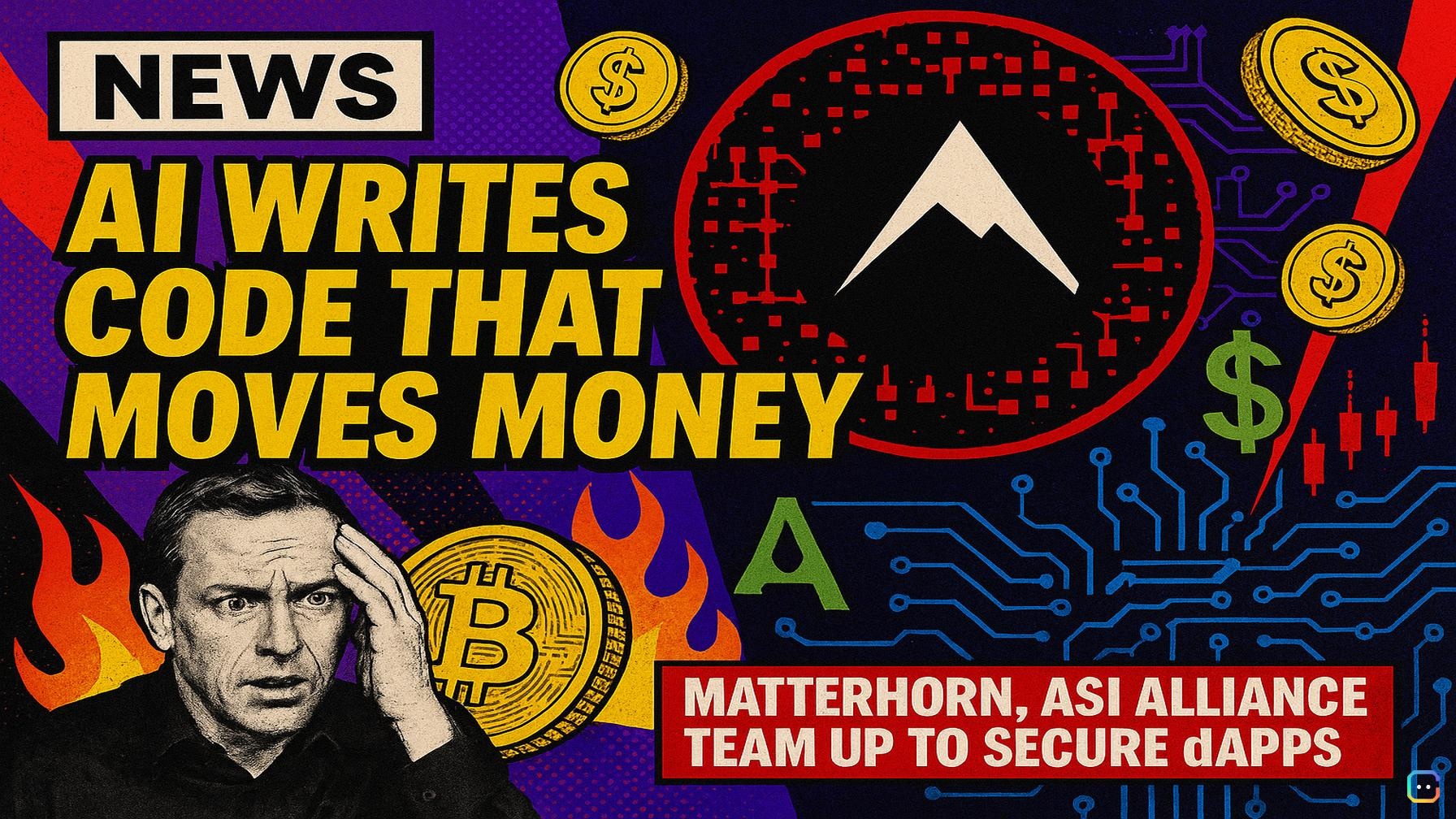
AI is starting to write the code that moves money on blockchains — and a new collaboration aims to make that process safer.
Matterhorn, a developer platform, and the Artificial Superintelligence (ASI) Alliance announced an initiative this week around “vibe coding,” a Matterhorn feature that turns plain-language app descriptions into full smart-contract code instantly. The approach dramatically speeds development and lowers the barrier to building decentralized apps (dApps), but it also raises a major risk: AI can produce flawed or insecure smart contracts that attackers can exploit.
“We're at the beginning of a world where dApps become 'just Apps', commonplace like the websites and apps we use today,” Matterhorn said. “Every other tool in this space is racing to ship code faster. We think that's the wrong race. The builders who build dApps that handle real money and real users need a platform they can trust, and this partnership is how we build it.”
How the partnership works
- Matterhorn will integrate with ASI:Chain, the blockchain network from the ASI Alliance — a decentralized AI collective that includes Fetch.ai, SingularityNET, and CUDOS — to give developers a single environment to build, audit, and deploy dApps.
- Developers will be able to connect third-party auditors via the platform and use automated AI “agentic” tools to review code before deployment. Matterhorn founder Abhinav Ramesh stressed they’re working with outside security auditors and automated tools, but cautioned: “We have AI agents as well that do agentic audits, but we absolutely don’t recommend doing just that for mainnet applications.”
- The teams are creating “blessed templates” designed for safer contracts and languages amenable to formal verification. Matterhorn is also integrating ASI:Cloud to provide the compute power AI systems need to generate and analyze code for MeTTa, the ASI:Chain programming language.
A clear-eyed warning
Matterhorn is explicit that speed doesn’t equal safety. “We are a strong enabler for builders who want to build on Web3,” Ramesh said. “There are absolutely no guarantees of any kind from the Matterhorn team on safety or security.” The platform aims to make audits and safer patterns easier, not to eliminate risk.
Why this matters now
AI agents are increasingly being trialed in crypto for tasks as sensitive as managing wallets, executing trades, and performing on-chain financial operations. That shift is prompting new tooling and research to control the risks when autonomous systems handle real funds.
SingularityNET’s chief innovation officer Khellar Crawford framed the problem bluntly: much of the industry still relies on a “patch-and-pray” approach — writing contracts in languages ill-suited to complex concurrency and hoping auditors catch bugs. By contrast, projects like F1R3FLY and ASI:Chain use a “correct-by-construction” architecture based on Rho calculus. “We don’t guess if an application is safe, we mathematically prove it using spatial behavioral types,” Crawford told Decrypt. “Before a single line of code ever touches the live network, the math itself guarantees that there will be no deadlocks, no race-condition exploits, and no leaked funds.”
Bottom line: Matterhorn and the ASI Alliance are betting that combining AI-assisted development, formal methods, and integrated auditing will accelerate dApp growth while reducing risk — but they acknowledge that builders still must be diligent, and no platform can promise absolute security.
Read more AI-generated news on: undefined/news