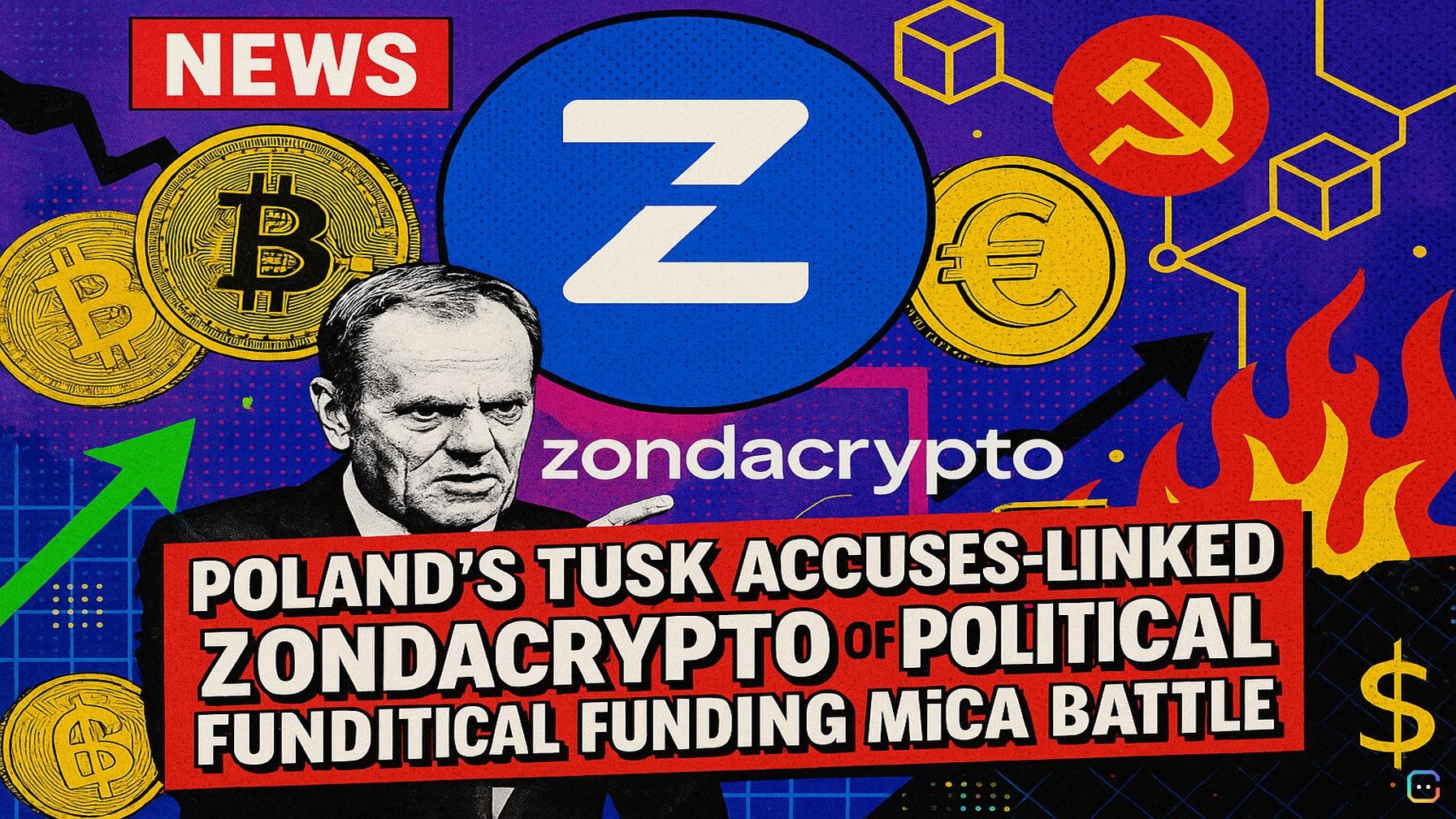
Poland’s prime minister, Donald Tusk, has accused a Russia-linked cryptocurrency platform of financing his political opponents — a claim that has turned the country’s crypto debate into a national-security flashpoint.
Speaking in the Sejm ahead of a parliamentary vote on overturning a presidential veto, Tusk said investigators from Poland’s internal security agency uncovered links between the crypto exchange Zondacrypto and “Russian money,” including actors he described as connected to the “bratva” (a term for Russian organized crime) and Russian security services. He said the platform has “sponsored political and social gatherings in Poland and champions very particular political factions,” naming politicians from the former ruling Law and Justice party and the far-right Confederation.
Tusk pointed to Zondacrypto’s role as a “significant sponsor” of a Conservative Political Action Conference-style event in Rzeszów in March 2025, where U.S. politician Kristi Noem publicly supported President Karol Nawrocki’s presidential campaign. Framing the vote as a test of state security, Tusk warned the crypto market is “extremely vulnerable to manipulation by foreign services, intelligence organizations, and criminal enterprises,” and on X cast the issue bluntly as a choice between “Russian money and services versus the security of the state and citizens.”
The political dispute centers on whether Poland should adopt the EU’s Markets in Crypto‑Assets (MiCA) framework and how. President Nawrocki has twice vetoed government efforts to transpose MiCA into Polish law — most recently in February — saying the bills were flawed and would harm consumers and smaller firms. Those vetoes, and a parliamentary failure earlier in December 2025 to overturn one, have left Poland as a MiCA outlier: without enabling national legislation, Polish exchanges and wallet providers lack a domestic route to obtain the MiCA authorizations now being issued elsewhere in the EU. That puts Warsaw’s crypto industry at a competitive disadvantage compared with peers in member states that are already licensing platforms under MiCA rules.
Zondacrypto has not issued a detailed public response to Tusk’s latest accusations. The president’s office says it is not opposed to crypto regulation in principle, but rejects the government’s approach. For now, the controversy highlights a wider tension playing out across Europe: how to balance rapid digital-asset innovation and market access with concerns about foreign influence, party financing and national security.
As EU members move ahead with MiCA licensing and enforcement, Poland’s fight could set an important precedent for how countries police the intersection of political financing, organized‑crime risk and crypto regulation.
Read more AI-generated news on: undefined/news