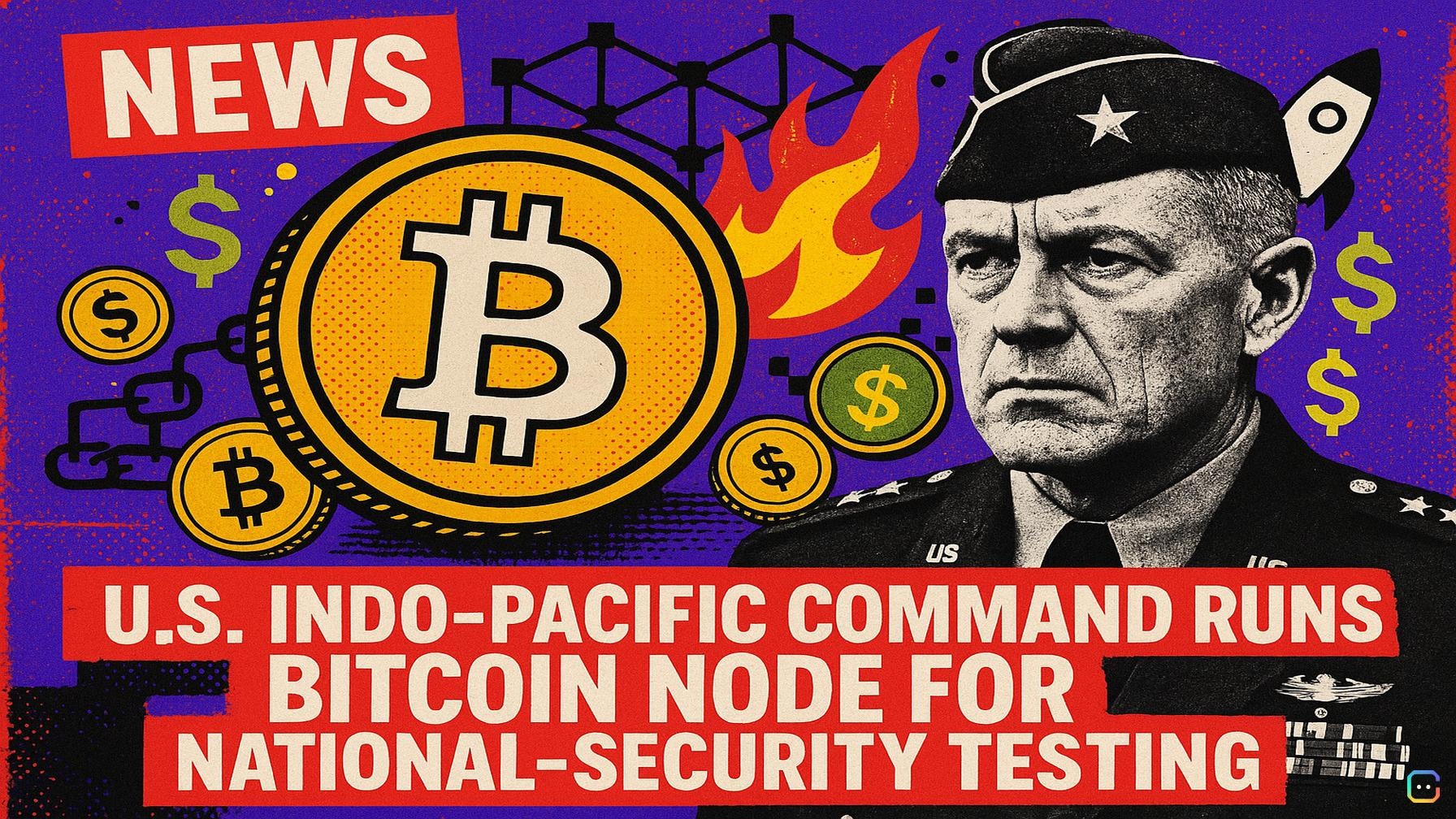
A senior U.S. military commander has confirmed that the Pentagon is actively participating in Bitcoin’s peer-to-peer network — not by mining, but by running a live node for national-security testing.
Admiral Samuel Paparo, commander of U.S. Indo‑Pacific Command (INDOPACOM), disclosed the activity during a House Armed Services Committee hearing Wednesday, a day after telling the Senate Armed Services Committee that Bitcoin holds “incredible potential” as a tool for American “power projection.” Responding to Rep. Lance Gooden, Paparo said: “We have a node on the Bitcoin network right now. We’re not mining Bitcoin. We’re using it to monitor, and we’re doing a number of operational tests to secure and protect networks using the Bitcoin protocol.”
A Bitcoin full node stores the complete blockchain history, enforces the network’s rules, and relays validated transactions across the decentralized network. Unlike miners, nodes don’t earn rewards or require specialized hardware; they exist to independently verify the network state rather than relying on third parties. As of early 2026 there are an estimated 15,000–20,000 publicly reachable full nodes, with the true total likely higher because many nodes sit behind firewalls.
Technically, one additional node among tens of thousands doesn’t threaten Bitcoin’s decentralization. But the public confirmation that a U.S. combatant command — the organization responsible for military operations across the Indo‑Pacific and the theater of strategic competition with China — is participating in the network is notable. Bitcoin has long been pitched as a system designed to resist takeover by powerful states; a major U.S. military command actively testing the protocol reframes the cryptocurrency as part of national-security practice and geopolitical posture.
Paparo’s remarks signal a new, explicitly strategic angle on crypto: beyond private finance and speculation, Bitcoin infrastructure can be used for monitoring, resilience testing, and other operational experiments that may inform defense planning. Whether this will shift broader policy, accelerate military-grade blockchain research, or affect geopolitical tensions around digital assets remains to be seen — but the move makes clear that crypto now sits on the radar of U.S. military planners.
Read more AI-generated news on: undefined/news