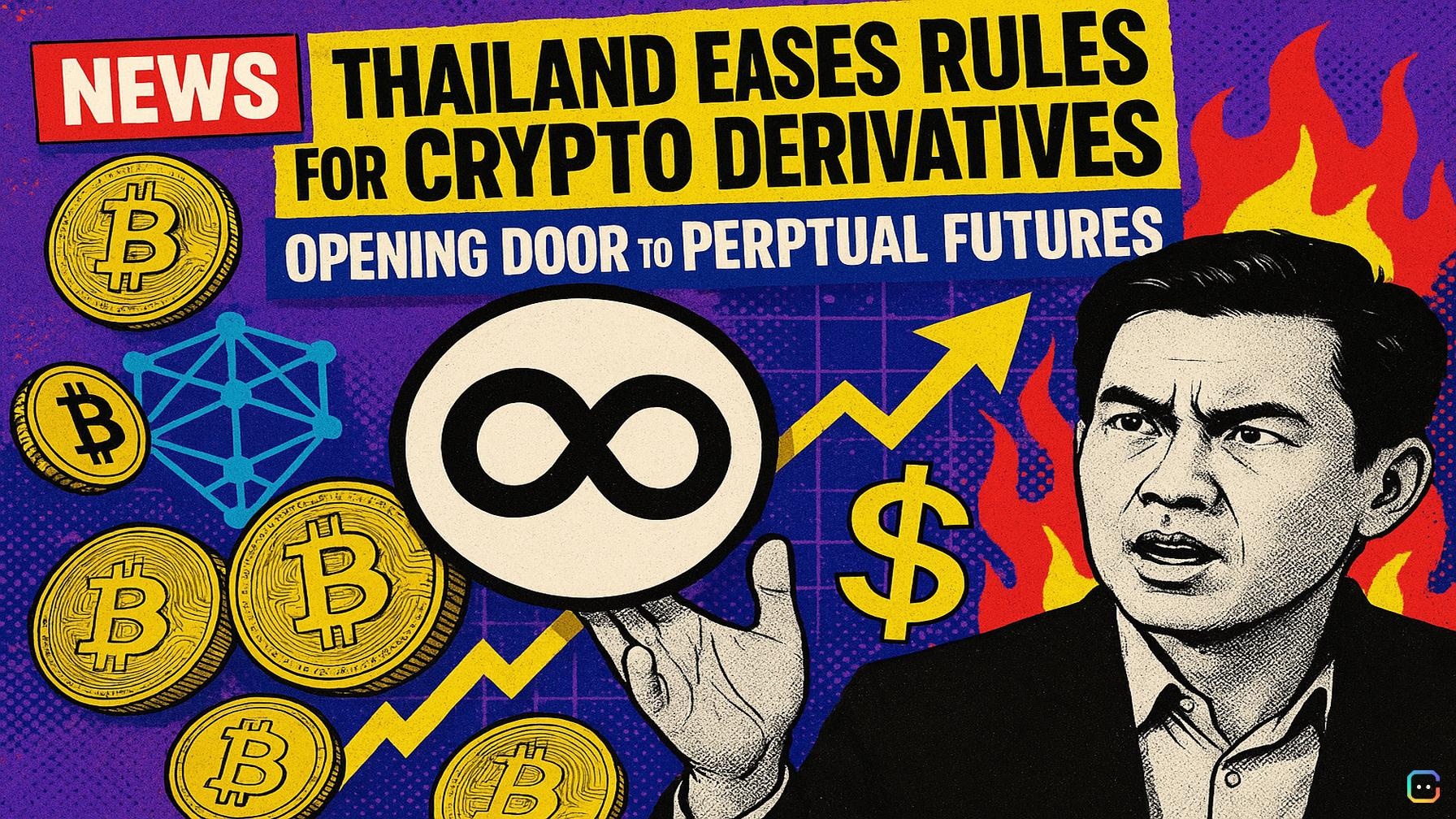
Thailand is moving to make it easier for crypto firms to offer derivatives as global momentum for perpetual futures builds.
What’s changing
- The Securities and Exchange Commission of Thailand has proposed allowing licensed digital-asset companies to apply directly for derivatives licenses, without the current requirement to create a separate legal entity. The proposal is open for public comment until May 20.
- Under today’s rules, crypto firms must form a distinct entity to offer derivatives — a costly, time-consuming barrier the SEC’s revision would remove. Firms would still face heightened requirements on conflict-of-interest controls and regulatory oversight.
Why it matters
- The change would lower structural hurdles for exchanges and wallets to roll out futures to Thai retail investors, potentially accelerating 24/7, multi-asset trading products in the market.
- The SEC frames the move as giving investors more tools to manage risk and diversify portfolios, while also saying the rules will align Thailand’s derivatives exchanges and clearing houses with international standards — signaling ambitions beyond simple deregulation.
Global context: derivatives momentum
- Exchanges have been moving aggressively. Earlier this year Kraken and Coinbase launched perpetual futures tied to equities for non-U.S. users as part of a broader push toward round-the-clock multi-asset trading.
- Blockchain.com recently added perpetual futures trading inside its self-custody wallet, letting users take leveraged positions using Bitcoin as collateral without moving funds to a third-party exchange. Built on the Hyperliquid network, it offers access to 190+ markets with leverage up to 40x.
- In the U.S., a senior Commodity Futures Trading Commission official said the agency is working toward enabling crypto perpetual futures and could act within weeks. Meanwhile, Kraken parent Payward has agreed to acquire Bitnomial, a U.S.-regulated derivatives venue to position for offering perpetuals to American clients once approvals are secured.
Regulation and oversight: expansion with guardrails
- Thailand’s proposal is part of a broader package of regulatory moves. Earlier this year the SEC proposed tighter scrutiny of the funders behind crypto firms — indicating the push to expand market access will be coupled with more stringent oversight.
- The licensing revamp therefore represents a balancing act: wider retail access to derivatives products, paired with stronger controls on conflicts and market governance.
What’s next
- The consultation window closes on May 20. The final shape of the rules will depend on industry feedback and how Thai regulators weigh the trade-offs between innovation and investor protection.
Bottom line
If adopted, Thailand’s revisions could speed local offerings of perpetual futures and other derivative products, aligning the country more closely with global flows in crypto derivatives while keeping a sharper regulatory eye on market participants.
Read more AI-generated news on: undefined/news