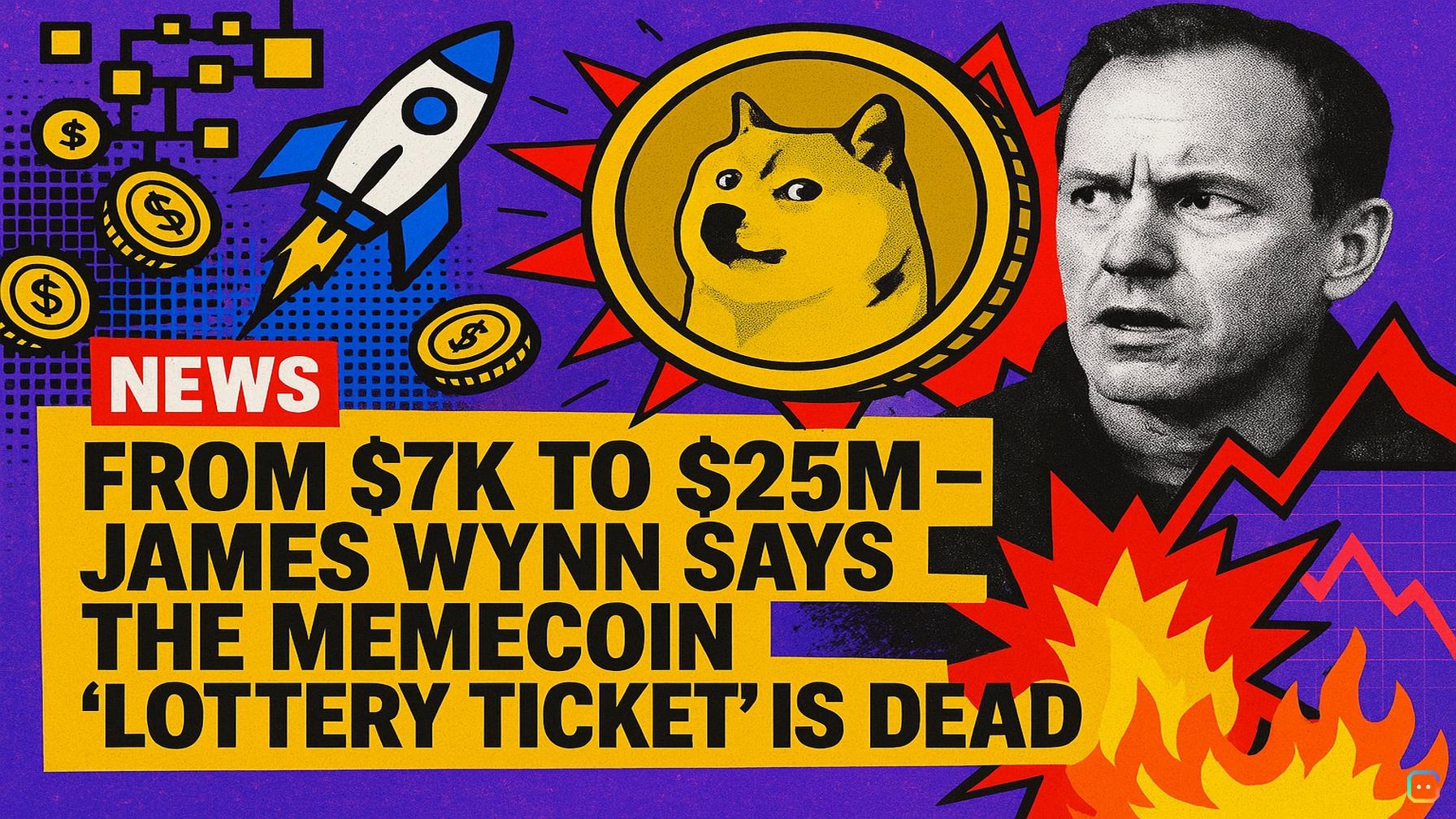
Meme mogul James Wynn says the memecoin “lottery ticket” is gone — and the market that made him famous has changed for good.
Wynn, the high-leverage trader who famously turned a roughly $7,000 PEPE stake into about $25 million before later blowing up close to $100 million on Bitcoin and memecoin positions, told his 36,000+ followers on X that the era of easy, outsized returns in memecoins is finished. “I’m pretty sure meme coins are dead, I’m pretty confident they’ll never really come back,” he wrote, arguing the space is now saturated and structurally geared toward insiders.
From breakout trader to cautionary example
Wynn rose to prominence in 2023 after parlaying small memecoin positions into tens of millions and then using those gains for aggressive, highly leveraged directional bets. He reportedly amassed between $80 million and $87 million via 20x–40x leverage on Hyperliquid at one point, even running a 40x Bitcoin long with notional exposure near $1.25 billion that briefly showed about $100 million in unrealized profit before cascading liquidations wiped much of it out.
That pattern repeated in May 2025: Wynn opened a 40x BTC long near $107,993, which was progressively liquidated as BTC slid under $106,330 and then toward $104,150. Reports put his losses at nearly $100 million in less than a week — one of the largest documented on-chain wipeouts. He later returned to Hyperliquid, selling roughly $4.12 million in HYPE tokens and re-entering with a new 945 BTC 40x long (~$99.7 million).
Why Wynn says memecoins are finished
Wynn’s central claim is that memecoins have transitioned from a lopsided opportunity for retail speculators into a heavily engineered market where supply mechanics and launch designs extract value for early insiders and whales. “Going from a few K into a million dollars is like winning the lottery now. Borderline impossible,” he argued, describing current memecoins as “profit-making machines for people at the top.”
Community and market reaction
Reaction across the crypto community was mixed. Some users dismissed Wynn’s take as sour grapes, while others saw his bearish call as a contrarian buy signal. More measured voices in the space drew a distinction: memecoins themselves aren’t dead, they said — the “easy money” structure that allowed low-effort launches to blow up overnight is what’s gone.
Data and design changes back the shift
Analysts tracking the sector point to a clear polarization. Research highlighted by 0x资讯 suggests total memecoin market cap leapt from roughly $20 billion in 2024 to a projected peak near $140 billion, but the gains concentrated in a few blue-chip names such as Dogecoin, Shiba Inu and PEPE. Many lower-quality tokens were effectively zeroed out.
Examples cited:
- Dogecoin’s market cap topped about $60 billion during the last cycle, with DOGE rallying to roughly $0.428, cementing it as a structural large-cap crypto rather than a pure meme play.
- PEPE — the token that made Wynn famous — has shown a more range-bound, mature market. As of early 2026, PEPE traded near $0.0000043, down roughly 64% year-to-date but still supported by around $600 million in 24-hour volume.
Observers also point to tokenomics and launch mechanics as key changes. Larger supplies, controlled issuance, and “utility” or extraction mechanisms have shifted odds away from random, explosive windfalls toward outcomes that favor insiders and communities able to sustain long-term holder bases.
What’s next?
Wynn concedes the sector needs to evolve — he just isn’t sure how. Whether the future belongs to DOGE-scale brands, utility-wrapped memes, or entirely new cultural formats, one thing is clear: the free lunch that allowed rapid, near-random 100x outcomes between roughly 2017 and 2024 appears to be over. Ironically, Wynn himself was both a product and a driver of the reflexive, whale-driven flows he now criticizes — a reminder that the memecoin economy was built as much by its biggest winners as by its later victims.
Read more AI-generated news on: undefined/news