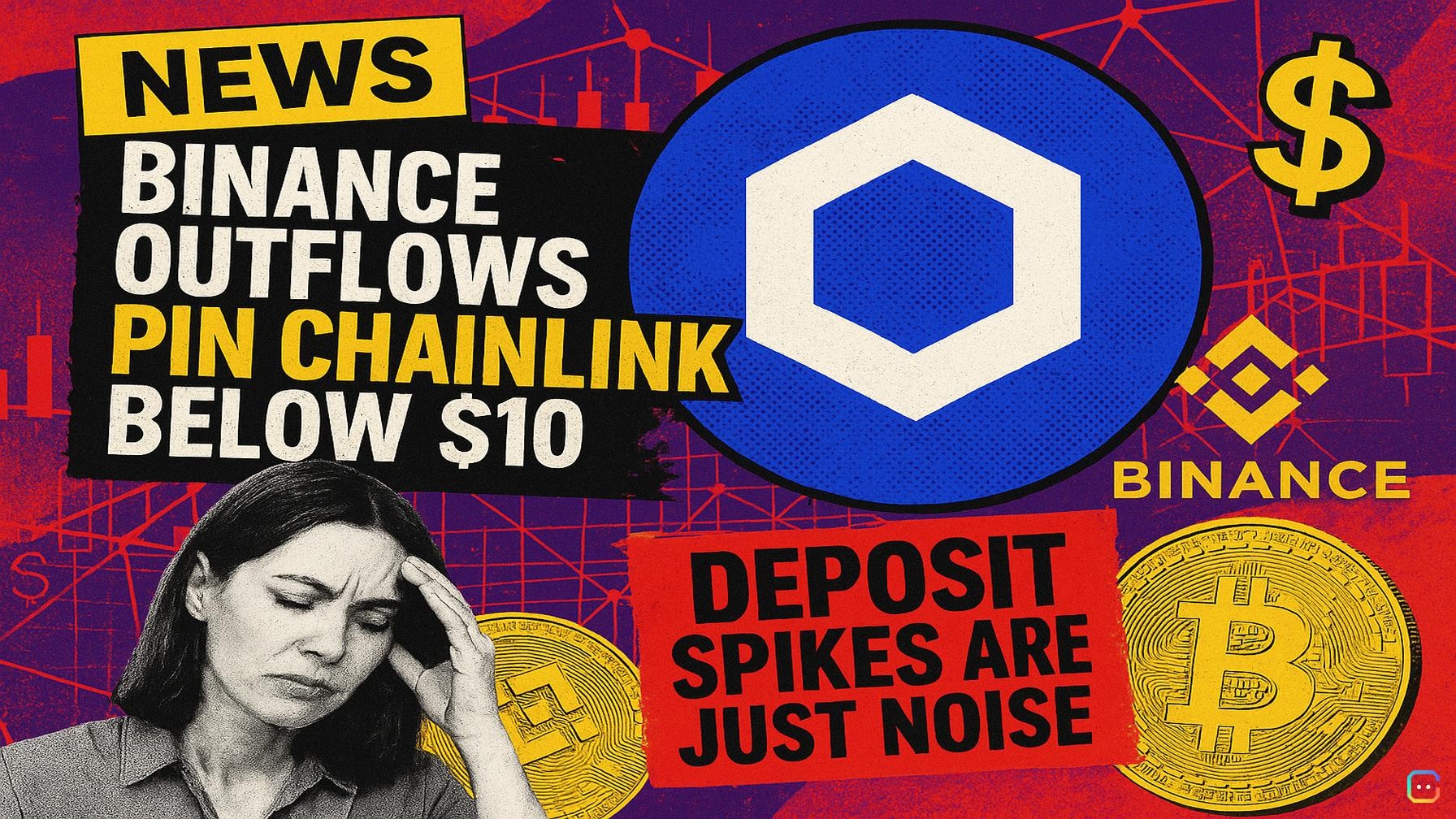
Chainlink (LINK) remains stuck below $10 as selling pressure and broad market uncertainty keep price pinned beneath a ceiling that has capped every recent recovery attempt. While the short-term price action looks bleak, exchange flow data highlighted by analyst MorenoDV reframes the weakness: what appears as volatile inflows is actually noise riding on a long-term structural outflow from Binance — and that changes how traders should read the market.
Why Binance matters
- Binance currently holds roughly 85.1 million LINK (about $766 million), equal to roughly 66.4% of the 128.26 million LINK parked across all exchanges. That concentration means moves on Binance often set the tone for the entire exchange market; extreme netflow days there aren’t necessarily broad-market behavior but Binance-specific imbalances.
- Binance reserves peaked near 145 million LINK during the 2022–2023 highs and have since tracked a clear descending channel. Reserves now sit near the lower boundary at about 85 million. The dominant trend over the multi-year period is coins leaving the exchange; occasional deposit spikes are temporary interruptions, not trend reversals.
Inflows are mostly noise, outflows are the signal
- MorenoDV’s breakdown shows that inflow spikes on Binance tend to cluster around volatile price moments and are more often followed by weaker closes over the next one to three days than by gains. That pattern suggests deposits arrive ahead of selling or redistribution, not accumulation.
- A common behavior: LINK gets deposited to Binance briefly and then withdrawn to self-custody wallets or other venues rather than being converted into exchange sell orders. The net result is persistent structural outflows from Binance with intermittent inflow bursts layered on top — the outflow is the meaningful signal.
Price structure and technical context
- On the weekly chart, LINK remains in a prolonged downtrend from the late-2024 highs near $30. It trades near $9, a level that repeatedly acted as support throughout 2025 and 2026 and is now the focal point of a compressed range.
- LINK is trading below the 50-, 100-, and 200-week moving averages, all sloping downward. The 50-week sits near $14 and the 100-week near $15.5 — the main resistance levels bulls must reclaim to argue for a structural trend reversal.
- The market is currently compressed between roughly $8.50–$9.50. That compression can be a base-building phase (equilibrium between buyers and sellers) — but the technical bias remains bearish until key resistances are reclaimed.
Key levels and what to watch
- Immediate support: $8.50 — holding this keeps a longer-term accumulation range intact.
- If $8.50 breaks, expect the 2023 consolidation zone around $6–$7 to come into play.
- A reclaim of $10.50 would be an early sign buyers are pushing back; sustained reclaim of $14–$15.5 (50–100 week MAs) would be needed to confirm a structural reversal.
- Monitor Binance reserve and netflow data: continued structural outflows would remain a headwind for sustained rallies, while a durable stop to outflows or systematic inflows could change the narrative.
Bottom line
Short-term price weakness in LINK is not just random selling — it’s unfolding against a clear structural trend of Binance reserves shrinking. Temporary deposit spikes have proven to be noisy and often precede selling, whereas the persistent outflow from Binance is the market’s true signal. Traders should watch $8.50 support, resistance around $10.50, and whether Binance’s reserve trend reverses to reassess the broader outlook.
Read more AI-generated news on: undefined/news