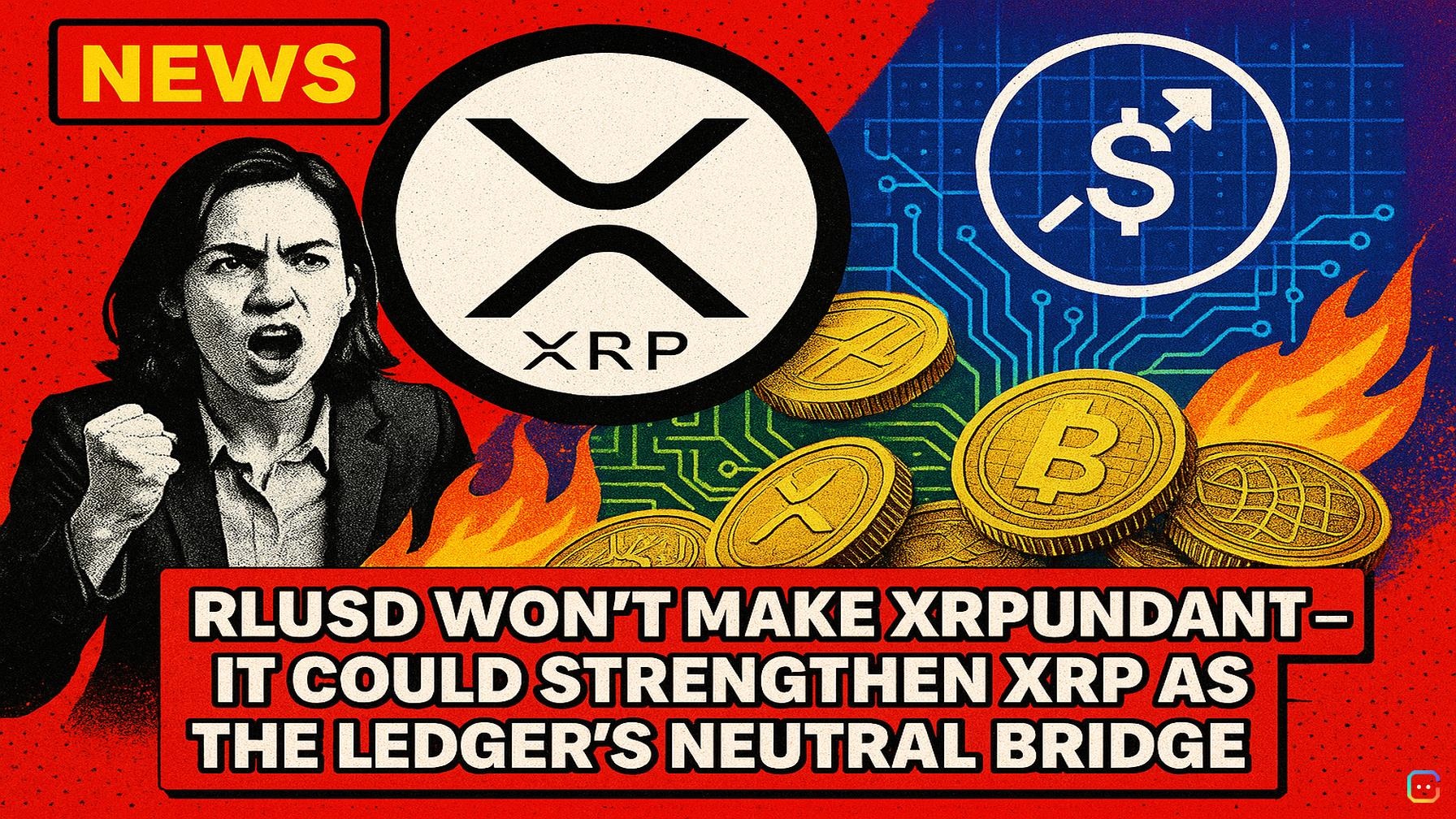
Debate in the XRP community: does Ripple’s new RLUSD stablecoin make XRP redundant? XRP bull Jake Claver says no — and argues the opposite may be true: RLUSD could actually strengthen XRP’s role by bringing more institution-friendly dollar liquidity onto the XRP Ledger.
In a thread on X, Claver framed the two assets as complementary tools built for different jobs. RLUSD, he wrote, is “a compliant digital dollar” designed for institutions that want a bank-backed, one-to-one dollar substitute on-ledger. XRP, by contrast, is the neutral bridge or routing asset that lets value flow between fragmented markets and currencies.
“RLUSD is not the finish line. It is the front door,” Claver wrote. His point: institutions will come to the ledger for a compliant dollar, and once there they’ll start asking bigger questions — tokenizing securities, settling trades instantly, eliminating multi-day settlement windows.
Why a separate bridge asset still matters
Claver used a simple market analogy to explain why a neutral asset matters. In an old trading port, merchants rarely carry exactly what another merchant wants. To make a trade you often change your goods twice or more; as the number of goods grows, the number of required trading pairs explodes. Markets therefore benefit from a “money changer” who sits in the middle and reduces friction.
On the XRP Ledger, Claver says, XRP plays that money-changer role. For example, a user swapping a tokenized Treasury bill for a euro stablecoin might only see one asset go in and another come out, but underneath the transaction the routing path can flow through XRP. “The trader never sees the XRP step. Asset goes in, the one they want comes out. XRP sits quietly in the middle making it work,” he wrote.
Three reasons RLUSD won’t replace XRP, per Claver
Claver laid out three limitations that, in his view, stop RLUSD from becoming the ledger’s universal bridge asset:
- Issuer risk: RLUSD has an issuer and is backed by bank reserves, so it carries counterparty, legal and operational risk if that issuer runs into trouble. XRP is not issued by a single company and cannot be switched off by one party.
- Neutrality and censorship-resistance: Regulated stablecoins must obey sanctions, blacklists and regional compliance rules and can freeze tokens or block users. That may be appropriate for a compliant dollar product, but Claver argues it is less suitable for a base-level routing asset that needs to be globally neutral.
- Liquidity mechanics: Liquidity pools require two distinct assets. A dollar stablecoin can sit against euros, tokenized Treasuries or other instruments, but it cannot be both sides of a market. A global routing layer needs an asset that is liquid, neutral, free of issuer risk and battle-tested — qualities Claver attributes to XRP.
Claver also noted that many future use cases won’t end in dollars at all: tokenized Treasuries moving into euro funds, lending in non-dollar currencies, or purely asset-to-asset transfers are examples where a dollar coin wouldn’t be an appropriate middle asset.
Bottom line
Claver’s argument reframes RLUSD as an on-ramp for institutions to enter the XRP Ledger ecosystem rather than as a replacement for XRP. By bringing regulated dollar liquidity on-chain, RLUSD could increase demand for trading, tokenization and instant settlement — all of which rely on a neutral routing layer.
At press time, XRP traded at $1.2628.
Read more AI-generated news on: undefined/news