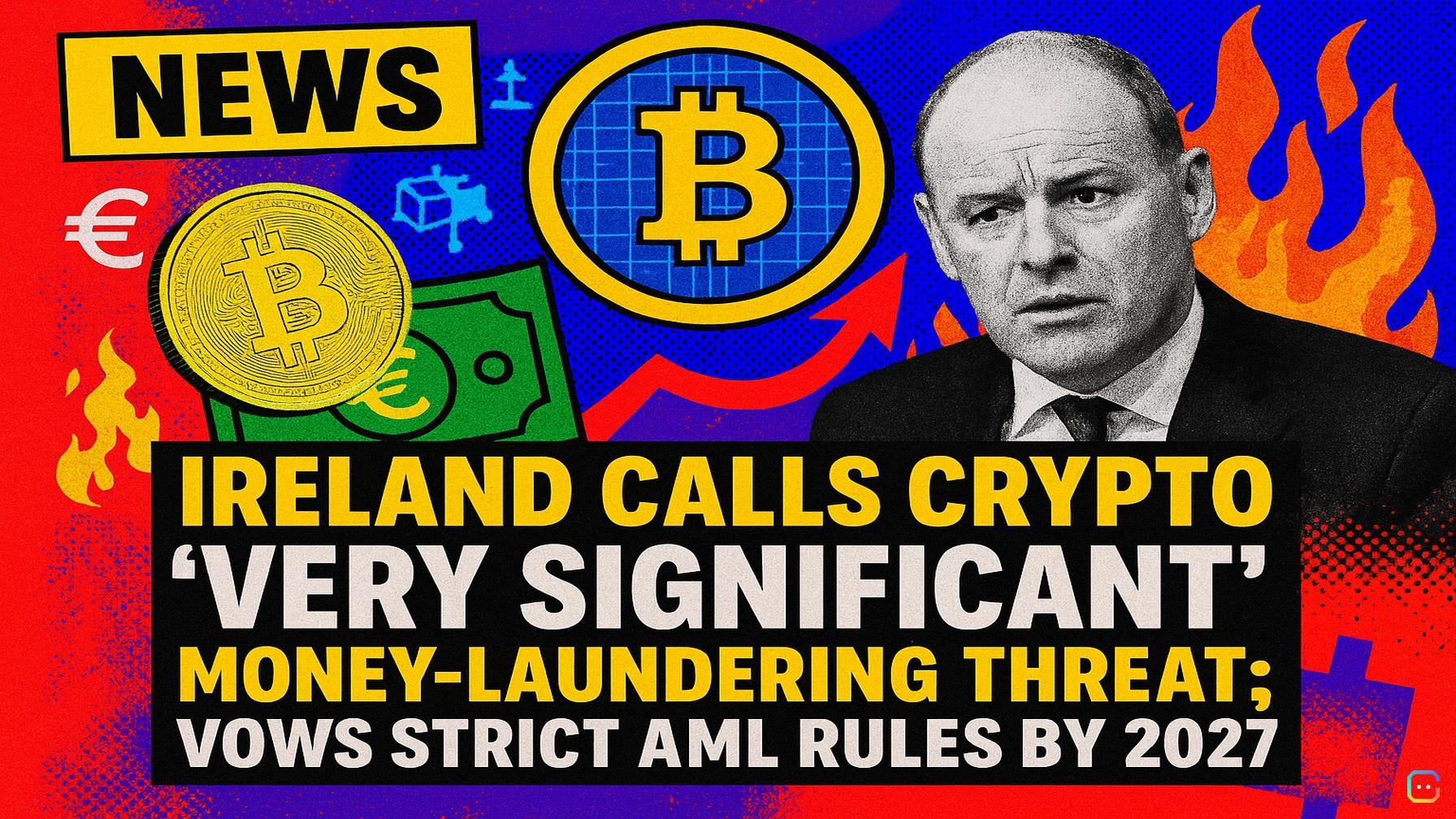
Ireland brands crypto a “very significant” money‑laundering and terrorism‑financing threat and has pledged tough new standards by mid‑2027.
In its freshly released National Risk Assessment — the first government review in seven years to examine digital‑asset threats — Ireland’s Department of Finance warns that rising crypto fraud, prosecutions, and other financial‑crime activity tied to digital assets are driving an urgent need for stronger oversight.
Why regulators are worried
- Crypto is now seen as a conduit not only for money laundering and terrorist financing but also for sanctions evasion, tax avoidance, and corruption risks involving regulators or sector officials.
- Fragmented international rules and activity in less‑regulated corners like decentralized finance add to enforcement gaps.
- Despite EU membership, Ireland still lacks some of the legal and regulatory measures adopted elsewhere to tackle these risks.
What’s changing
- Under an implementation plan attached to the assessment, Irish authorities intend to set industry standards for accepting crypto‑related activity as a source of funds by the second half of 2027. This is part of a broader push to tighten anti‑money‑laundering and counter‑terrorist‑financing (AML/CFT) controls across the financial sector.
Key data and recent enforcement
- The Central Bank of Ireland found roughly 10% of the population had invested in crypto as of December 2025, underscoring digital assets’ growing domestic footprint.
- Enforcement is already increasing: in November 2025 the Central Bank fined Coinbase Europe Ltd. about $24 million for AML/CFT breaches, citing failures to promptly report deficiencies in its transaction‑monitoring system.
- The assessment also flagged growing use of crypto in payments tied to corruption; Ireland moved earlier to curb political exposure to digital tokens, with a 2022 proposal to bar political parties from accepting cryptocurrencies such as Bitcoin, Ether and privacy coins.
Global context
Ireland’s review comes as regulators worldwide tighten AML supervision of crypto. Examples:
- Zimbabwe this year placed crypto firms under the Reserve Bank via Statutory Instrument 99 of 2026, requiring registration as Virtual Asset Service Providers and full financial‑crime controls.
- Industry standards are rising: a May 2026 Chainalysis preview found nearly 47% of organizations entering the market in 2026 adopted alerting settings that would have ranked among the top 10% most stringent in 2020. Chainalysis also found consistent monitoring of direct exposure to illicit funds but persistent weaknesses in detecting indirect exposure — where funds pass through intermediary wallets — with alert thresholds often set 10–20x higher for indirect flows tied to ransomware, scams, darknet markets, fraud and sanctioned jurisdictions.
What this means for the market
Irish authorities are signaling that crypto compliance will be a policy priority through 2027 and beyond. Exchanges, custodians, and DeFi platforms operating in or serving Irish customers should expect stricter source‑of‑fund rules, closer scrutiny of transaction monitoring and increased pressure to plug gaps around indirect flows and cross‑border coordination.
Read more AI-generated news on: undefined/news