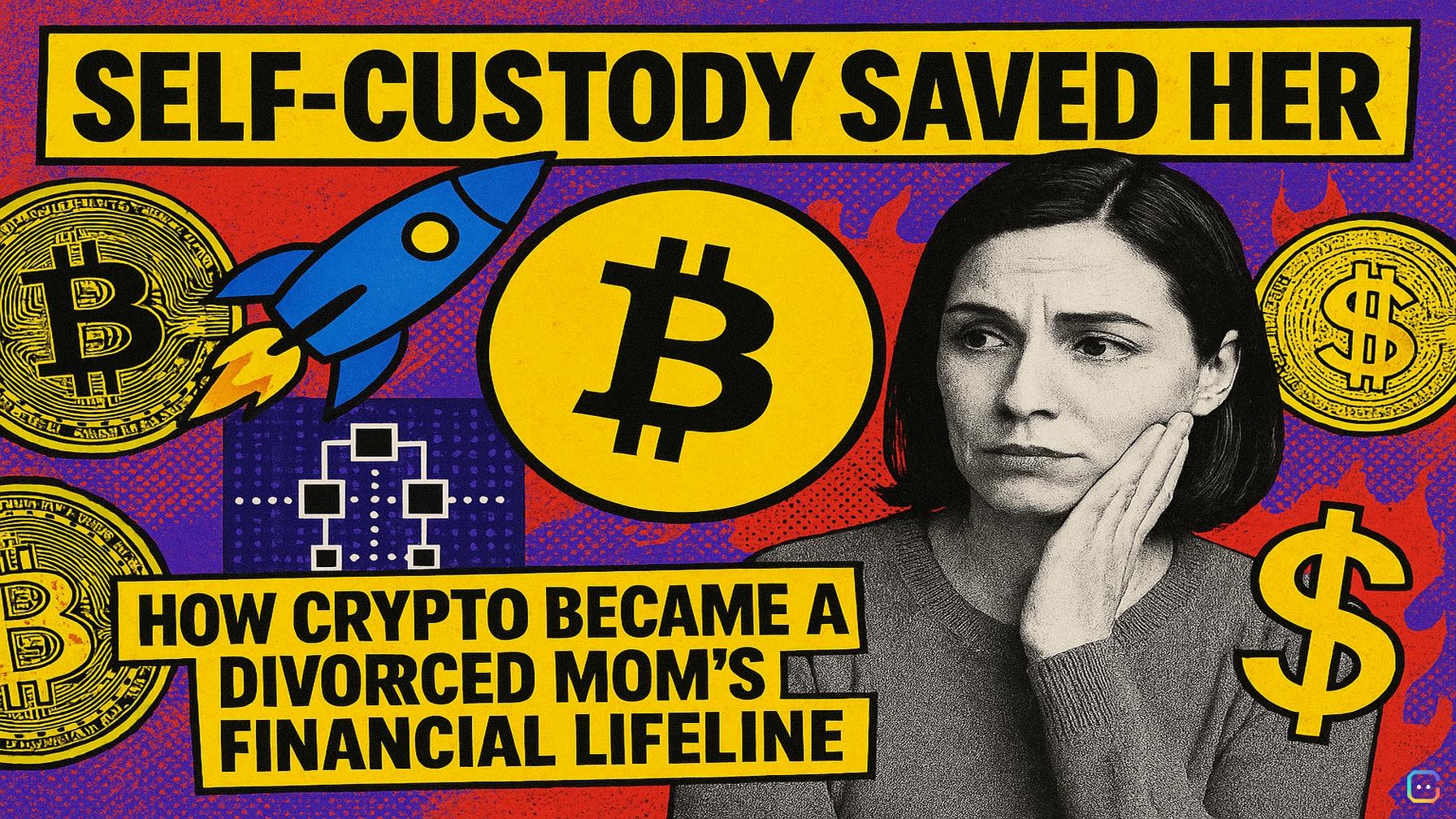
When a Fort Worth mother walked into her local bank clutching a wad of cash to catch up on missed mortgage payments, she expected a routine deposit. Instead she left unbanked and shocked. The teller told her anti-money-laundering rules made the transaction problematic, and to her surprise the bank also informed her she hadn’t been listed as an account owner for at least a decade. She was turned away.
Karin — who asked that her last name be withheld because of ongoing legal matters involving her ex-husband and their four children — says that experience crystallized how vulnerable she’d become during a bitter, years‑long divorce. “I was unbanked, which is kind of scary because I'm a middle-class housewife in America,” she told Decrypt. “It's kind of like you're this invisible person.”
Crypto became her lifeline. Karin moved savings into a self-custodial wallet — private keys only she controlled — and says the ability to hold assets outside traditional, identity‑linked banking gave her a level of financial independence she otherwise lacked. At one point in the court fight, she even secured a judge’s approval to use profits from crypto trading to pay her children’s tuition.
Court documents show the case grew contentious when Karin was ordered to liquidate cryptocurrency she had stored on a centralized exchange so assets could be split. She refused, arguing the crypto was a critical safety net. Her argument succeeded in part because the transparency of blockchains made the funds auditable: once she demonstrated to opposing counsel and the judge how to verify transactions with a block explorer, they accepted that the coins hadn’t been moved.
“I remember thinking, ‘At least I have something,’” she said. “The fact that there were private keys, and only I had the keys, gave me that ability to be so bold and stand up for myself.”
Karin’s story illustrates how crypto’s technical features — self-custody and public ledgers — can intersect with family law and financial abuse. She described a marriage in which her husband managed most accounts and credit; when she left, her credit cards were maxed and she had only $56 of available credit. Without a working credit record, services like car rentals and hotels refused her, forcing friends to “front” costs on their cards so she could repay them in stablecoins.
The support she found wasn’t just personal. Karin has participated in work with the National Cryptocurrency Association (NCA), a nonprofit founded and funded by Ripple via a two-year, $50 million grant aimed at helping Americans understand practical crypto use. NCA president and Ripple chief legal officer Stu Alderoty told Decrypt the organization wants to challenge the stereotype of crypto as a “bro” industry defined by FOMO and get-rich-quick rhetoric. “The thing that really makes my skin crawl is any jargon that suggests that this is an industry and a technology only for crypto bros,” Alderoty said.
Beyond individual stories, advocates point to larger social impacts. Paul Wong, director of special projects at the Stellar Development Fund, highlighted a humanitarian use case: SDF helped build an aid distribution system in Ukraine with a U.N. agency that directs funds to individuals — often women — in a way that limits physical risk and avoids routing money through joint accounts where it might be diverted. “When you distribute universal basic income to a woman, it’s not going to some joint account where, historically, a man has used it for purposes other than the family,” Wong told Decrypt.
Karin also found practical support and sympathy through online crypto communities, including pseudonymous users on Crypto Twitter who offered guidance. For her, crypto wasn’t about speculative wealth — it was “literally safety and stability for my kids,” she said.
Two decades earlier, Karin had given up law school for marriage. Today she’s on a different path: after battling the legal system while relying on crypto to preserve her family’s financial wellbeing, she’s been accepted to law school and will begin this fall.
Her case raises questions for the broader crypto ecosystem and the legal system: How should courts treat self-custodied assets? How can attorneys and judges be trained to understand blockchain evidence? And importantly, can crypto be part of a toolkit to help people — especially those facing financial abuse — regain control over their lives? Karin’s experience suggests the answers are evolving, and that crypto’s real-world applications may be less about headlines and more about everyday resilience.
Read more AI-generated news on: undefined/news