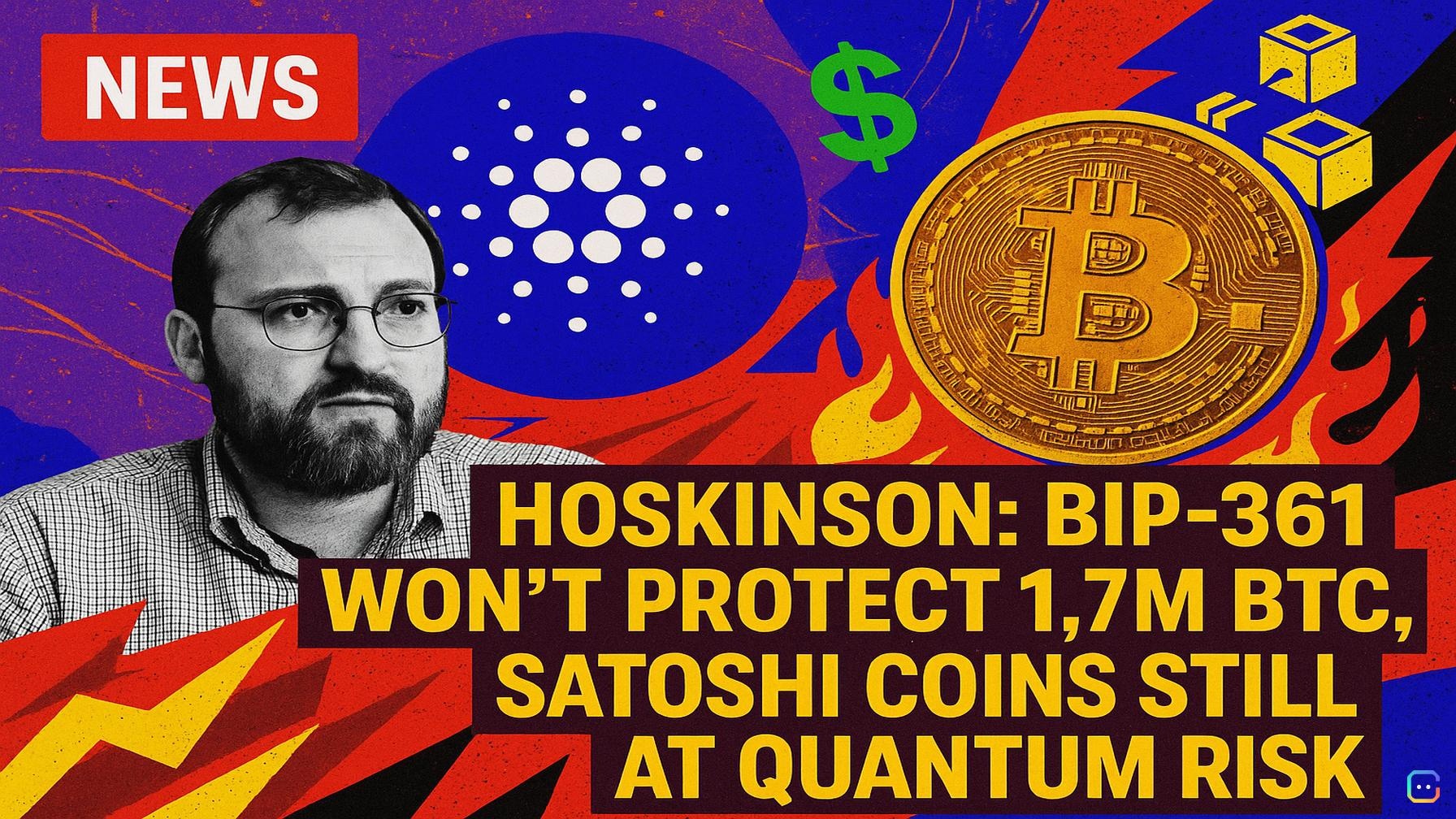
A high-profile Bitcoin upgrade aimed at shielding coins from future quantum attacks would still leave a big chunk at risk, Cardano founder Charles Hoskinson warns.
What BIP-361 proposes
- BIP-361, a Bitcoin Improvement Proposal, would roll out over several years to migrate coins to quantum-resistant addresses. The plan’s authors say it could “save” up to about 34% of Bitcoin’s supply—more than 7 million BTC, roughly $536 billion—by freezing coins that don’t move to new key types.
- The proposal is staged in three phases: first, blocking inflows to vulnerable addresses; second, freezing legacy coins; and third, a recovery window intended to allow owners to reclaim Bitcoin that missed earlier deadlines.
Hoskinson’s critique
- Charles Hoskinson says the recovery phase is misleading. He argues BIP-361 would still leave up to 1.7 million BTC—about $127 billion—irretrievable because those coins predate the BIP-39 seed phrase standard (i.e., coins from 2013 and earlier).
- At least 1.1 million of those early coins are widely attributed to Satoshi Nakamoto, Arkham Intelligence data suggests—valued at roughly $82 billion.
- “That’s a lie,” Hoskinson said of claims that all legacy funds could be recovered. “You could recover some of the 8 million Bitcoin, but 1.7 million are not under this scheme. All of the 2013 Bitcoin and before.”
A measured endorsement
- Despite his criticism, Hoskinson called BIP-361 “not a bad proposal” and acknowledged why it exists: without some mitigation, he warns, those coins could be stolen once quantum computers are powerful enough. “Because if they don’t do this, that money will be stolen in the 2030s. That’s a fact,” he said.
Why this matters now
- “Q-Day,” the point at which quantum computers could break current Bitcoin cryptography, has moved closer to mainstream attention. In March, Google set a 2029 target for migrating its infrastructure to post-quantum cryptography—a high-profile signal that quantum threats might arrive sooner than many expected.
- BIP-361 is an early attempt within the Bitcoin community to handle a hard future risk: how to update a system whose core security assumptions could be undermined by new computing capabilities.
Governance and cultural friction
- Hoskinson also used the conversation to criticize what he sees as Bitcoin’s resistance to governance and innovation. He said on-chain governance—used by networks like Cardano, Polkadot and Tezos—would make coordinated upgrades easier. “If you had on-chain governance, you could solve it,” he said, adding in a joking aside, “We’re shitcoiners, we don’t have good ideas. Only you guys have good ideas.”
- The remark highlights a deeper tension in crypto: balancing decentralized conservatism against the need for adaptive change when existential technology risks arise.
Bottom line
BIP-361 aims to tackle a potentially catastrophic long-term threat, but prominent voices like Hoskinson argue it won’t fully protect the oldest, most valuable dormant coins—some of which are believed to be Satoshi’s. As quantum timelines tighten and major tech players set post-quantum targets, the debate over how—and who—can safely update Bitcoin is likely to intensify.
Read more AI-generated news on: undefined/news