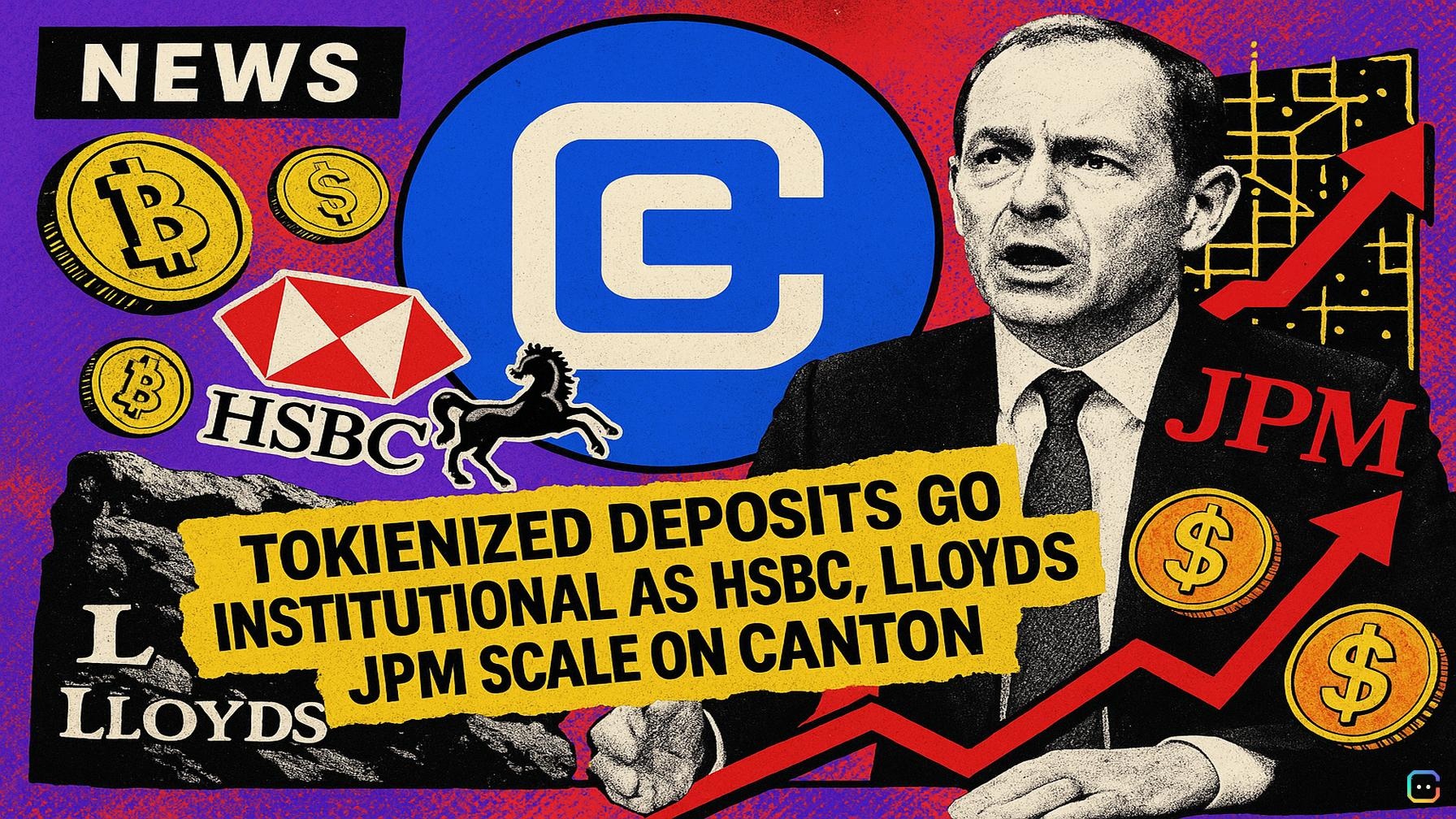
Tokenized bank deposits are fast becoming the institutional standard for on-chain cash as major banks move from pilots to production on the Canton Network.
What’s happening
- HSBC recently completed a pilot simulating issuance and atomic settlement of its Tokenised Deposit Service on Canton.
- Lloyds Bank issued tokenized sterling on Canton and used those tokens to buy a tokenized gilt from Archax.
- JPMorgan’s Kinexys unit is planning a phased integration that will bring JPM Coin natively to Canton through 2026.
All three projects use Canton, the blockchain created by Digital Asset. The network bills itself as the only public layer one built specifically for institutional finance, combining configurable privacy, atomic composability, and regulatory controls in a single infrastructure layer.
Why tokenized deposits matter
Digital Asset’s Chief Product Officer Bernhard Elsner stresses that tokenized deposits are structurally different from stablecoins. “Tokenized deposits are a digital representation of a commercial bank deposit on a blockchain or other DLT platform. Unlike many other digital assets, these tokens are the bank’s own liability to the holder, carrying the same legal status as a pound or dollar sitting in a traditional deposit account,” he said.
Key implications:
- Legal status and protections: A tokenized deposit is a depositor’s claim on a regulated bank—subject to capital requirements, supervisory oversight, KYC/AML, and in most jurisdictions, deposit insurance.
- Contrast with stablecoins and wrapped assets: Stablecoin holders are creditors of private issuers with recourse to reserve pools; wrapped assets depend on wrapper contracts and custodial arrangements.
- Practical use: That legal certainty makes tokenized deposits suitable for parking working capital, not just routing payments, as Elsner put it: “For institutional cash management, that’s the difference between an instrument you can park working capital in and one you can only route through.”
How Canton enables institutional use
Canton’s architecture is designed to keep tokenized deposits within the legal and operational framework of the issuing bank. On Canton, a tokenized deposit is a direct, regulated bank liability—not a wrapped claim or IOU—and “never leaves the legal and operational framework it was issued under,” Elsner said. That continuity gives institutions confidence to use these tokens for treasury and cash-management workflows.
Interoperability and atomic settlement
A major commercial claim for Canton is true interoperability and atomic Delivery-versus-Payment (DvP). Elsner argues that lack of interoperability is more than a nuisance—it's a structural barrier to scale. “Interoperability is absolutely critical to institutional adoption, otherwise these assets will remain trapped in fragmented silos and unable to reach meaningful scale,” he said.
Most existing DvP setups rely on intermediaries, prefunding, or sequential steps, introducing latency and residual settlement risk. Canton’s model allows the securities leg and the cash leg to settle in a single atomic transaction across different applications without a bridge in the middle. “Settlement risk isn’t managed. It’s eliminated at the infrastructure level,” Elsner said. HSBC’s pilot simulated this type of atomic settlement while keeping the deposit token inside the issuing bank’s framework.
Adoption and scale
Canton is already being tapped by major market infrastructures: the DTCC has chosen Canton to tokenize U.S. Treasuries, and LSEG’s Digital Settlement House has also adopted it. As reported by crypto.news, Canton processes over $350 billion in tokenized value daily in 2026, with the DTCC, LSEG, and JPMorgan all using it as primary settlement infrastructure.
Stablecoins and tokenized deposits will coexist
Elsner is clear that tokenized deposits and stablecoins are complementary, not mutually exclusive. “Stablecoins optimize for reach and liquidity, while tokenized deposits optimize for balance sheet integrity and regulatory certainty,” he said. He expects both asset types to expand in parallel as institutions choose the instrument that best fits each workflow.
JPMorgan’s own description aligns with this positioning: Naveen Mallela has called deposit tokens a “practical, yield-bearing alternative” for institutions that want speed and security without leaving the banking system.
Bottom line
Institutional demand for on-chain cash is moving from experimental to operational, and tokenized deposits—backed by regulated banks and settled natively on purpose-built infrastructure like Canton—are emerging as the preferred instrument where regulatory certainty and balance-sheet treatment matter. At the same time, stablecoins remain attractive for liquidity and reach, meaning both will likely play complementary roles in the digital finance stack going forward.
Read more AI-generated news on: undefined/news