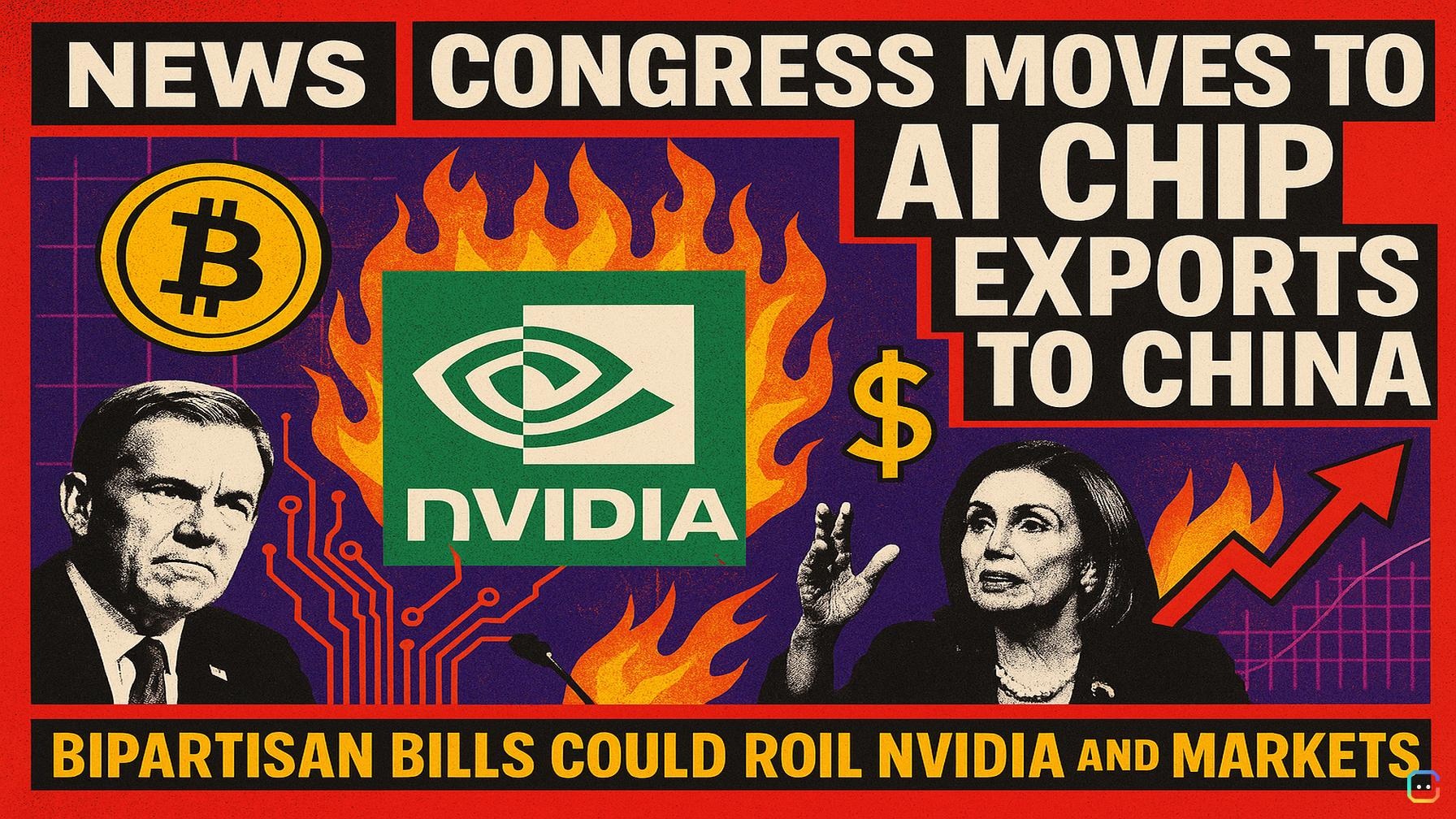
Congress moves to tighten control over AI chip exports to China, advancing two bipartisan bills that would give lawmakers new teeth to police high-end semiconductor sales.
On April 23 the House Foreign Affairs Committee approved two measures aimed squarely at preventing advanced U.S. AI chips from bolstering rival military and intelligence capabilities. The duo — the AI Overwatch Act and the Chip Security Act — passed the committee with overwhelming bipartisan support and mark a direct congressional challenge to the Trump administration’s current export posture.
What the AI Overwatch Act would do
- Sponsored by Committee Chair Rep. Brian Mast, the bill would grant the House Foreign Affairs Committee and the Senate Banking Committee a 30-day review window to block export licenses for advanced AI chips destined for China, Russia, Iran, North Korea, Cuba and Venezuela — modeled after congressional oversight of arms sales.
- It would also suspend existing export licenses to those countries until the administration submits a detailed plan showing how the chips will not be used to enhance foreign military or intelligence capabilities. “We are in an AI arms race, and it’s important that we know where the AI arms dealers are selling,” Mast said.
- A companion Senate bill already has bipartisan co-sponsors, including Senators Jim Banks and Elizabeth Warren.
What the Chip Security Act would do
- This bill attacks the problem at the hardware level. It would require exported advanced chips to include a technical mechanism that can verify their physical location, and it would obligate exporters to notify the government if a chip shows up somewhere it shouldn’t.
- Lawmakers say these provisions close a crucial verification gap: while the U.S. can vet initial buyers, it currently lacks reliable ways to confirm chips aren’t later diverted to unauthorized facilities, including military or intelligence sites.
Why this matters for markets and firms
- Semiconductor export rules already have tangible market consequences. Nvidia disclosed roughly $5.5 billion in expected charges in April 2025 after the government required export licenses for certain H20 chips sold to China — a reminder that export controls reverberate across AI-related markets and assets.
- Nvidia’s CEO Jensen Huang warned recently that China operates “ghost” datacenters with enough capacity to compete with U.S. frontier AI — comments that have complicated the company’s lobbying against tighter export curbs. Huang has personally lobbied lawmakers arguing that broader use of U.S. chips in China ultimately benefits American firms’ global dominance.
Political pushback and next steps
- The bills face high-level opposition. White House AI adviser David Sacks publicly opposed the AI Overwatch Act on X, sharing commentary that the measure would handicap the administration’s ability to position the U.S. strategically versus China. Rep. Mast pushed back, saying those talking points echoed materials circulated by Nvidia.
- If enacted, the measures would represent a substantial transfer of export-control authority from the executive branch to Congress. But both bills must still clear the full House, pass the Senate and be signed by the president — a path likely to encounter continued resistance from the White House despite the committee’s bipartisan backing.
Bottom line: Congress is signaling it wants a bigger role in policing AI chip exports, combining oversight and technical controls to prevent diversion. The legislation could reshape how U.S. firms sell chips abroad and would have immediate implications for markets tied to AI and semiconductors if it becomes law.
Read more AI-generated news on: undefined/news