Headline: Sui suffers three mainnet halts in 48 hours after v1.72 upgrade bug — post-mortem pins cascade to gas-charging edge case
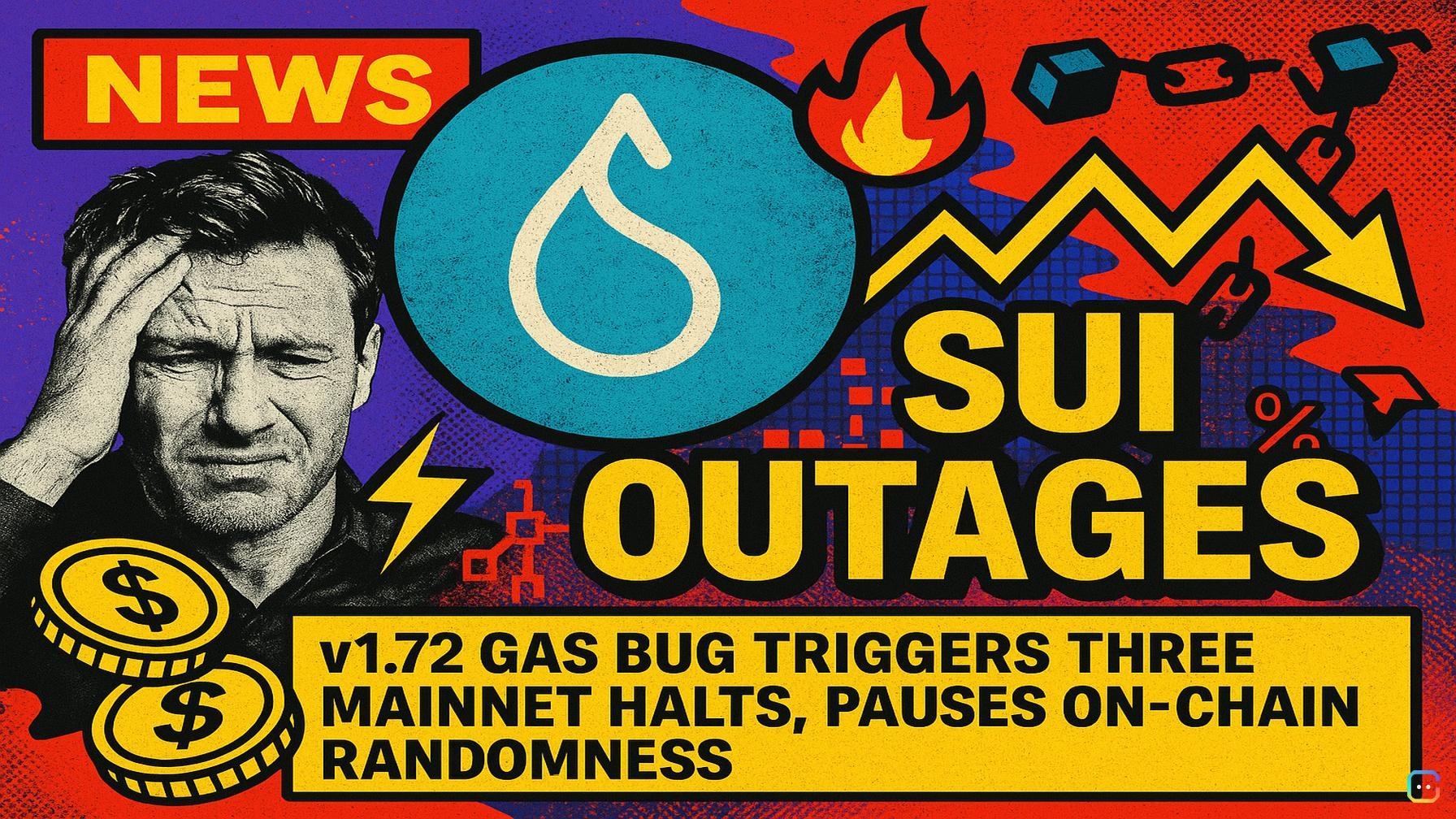
Sui’s mainnet went down three times across May 28–29 after a new feature in the v1.72 release exposed an edge case in the Layer-1’s gas-charging logic, the Sui Foundation said in a post-mortem published Sunday. Each attempted fix either triggered or revealed the next failure, producing a 48-hour period of instability that briefly paused randomness-dependent apps and shook SUI’s price.
What happened (timeline)
- May 28, ~7:00 a.m. PT — First outage begins and lasts nearly seven hours. A rare interaction between the new address-balance feature and legacy coin objects caused validators to crash with an underflow error. The problem appeared when a transaction was canceled for insufficient funds but the gas-charging routine still attempted to spend those same funds.
- May 28, ~1:30 p.m. PT — Core developers restore the network with an interim fix that resolves the most common failure mode but carries “a known issue with a low probability of causing a halt.” The team chose speed to bring mainnet back quickly while a stronger patch was prepared.
- May 29, ~5:00 a.m. PT — A second outage begins when a masked variant of the same bug (an insufficient-funds error overridden by another cancellation reason) bypasses the interim patch. A more robust fix is deployed and adopted by validators around 9:40 a.m. PT.
- After the restart — A third halt follows: restarting validators to apply the robust fix dropped participation in the protocol that bootstraps on-chain randomness below the required threshold, which correctly disabled randomness. A latent bug then failed to persist that disabled state to disk, so validators were unaware randomness was off at the next restart. The next epoch change stalled for nearly six hours as randomness-dependent transactions piled up in a paused queue.
Technical context — coins, gas, validators, randomness
- Coin objects: On Sui, a user’s balance is represented by discrete coin objects (think of them as banknotes with individual IDs) rather than a single account number. Payments combine and split these objects as needed.
- Gas logic: The new address-balance feature interacted with the legacy coin model in an edge case that let gas accounting attempt to spend funds already canceled for insufficient balance, causing underflows and validator crashes.
- Validators: These are the network nodes that process transactions and maintain consensus. Crashing validators and restarts affected participation thresholds for certain protocol subsystems.
- On-chain randomness: Sui uses an on-chain randomness protocol to generate unpredictable values that apps (lotteries, certain games, random NFT mints) rely on. When randomness disabled itself because validator participation fell under the required threshold, those applications could not proceed.
Impact and fallout
- No user funds were at risk during the outages, and no committed transactions were reverted, the foundation said.
- SUI’s market price fell roughly 8% during the cascade to a low of $0.90 and was trading near $0.90 on Monday, leaving the token down about 19% for the week, according to CoinDesk.
- The incidents mark the third major reliability event since Sui’s 2023 mainnet launch, following a two-hour transaction scheduling bug in November 2024 and a six-hour consensus divergence in January 2026.
Why it matters
The episode highlights the fragility that can arise from adding new balance-management features to an existing coin model, and how quick remediation choices can create cascading risks. It also underscores the operational sensitivity of on-chain randomness and participation thresholds — critical for developers building chance-based dApps on Sui.
Sui’s core team prioritized restoring service quickly, then pushed a stronger fix, but the chain of interdependent bugs shows how complex upgrades can produce unexpected failure modes across validation, gas accounting, and ancillary subsystems like randomness.
Read more AI-generated news on: undefined/news