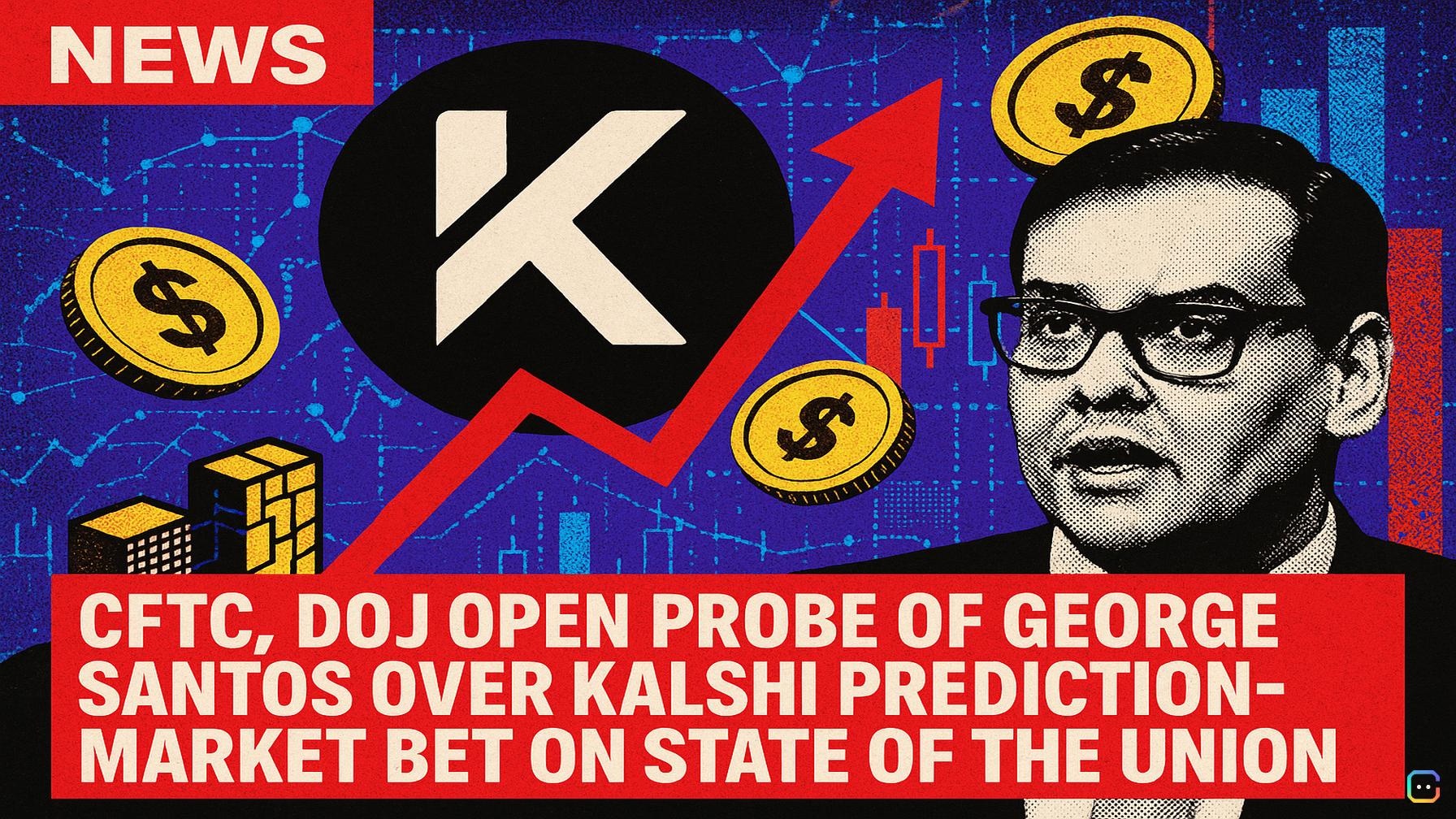
Federal regulators have opened an investigation into former U.S. Representative George Santos over suspicious trading in a Kalshi prediction market contract that reportedly referenced his own appearance at this year’s State of the Union, according to the Justice Department and reporting from the Wall Street Journal.
What happened
- In late February, Kalshi — a regulated prediction market exchange — alerted the Commodity Futures Trading Commission (CFTC) and the Justice Department about suspected trading activity, people familiar with the referral told the WSJ.
- Prosecutors say Santos placed a bet on a Kalshi contract that asked whether he would appear at the president’s annual address to Congress that month. Sources close to the probe say Santos wagered that he would not attend; he ultimately did not appear.
- The CFTC has opened a probe, and the DOJ is also involved after receiving Kalshi’s referral.
Santos’ response and background
- Santos denied the allegations on X, saying, “My legal team is in contact with the DOJ to see what is going on. The accusation is preposterous, and I look forward to supplying any information asked of me to any agency that inquires.”
- The former congressman was expelled from the House in 2023 and pleaded guilty to federal charges in 2024; President Donald Trump later commuted his sentence.
Why this matters to crypto and markets
- Prediction markets — many of which operate on or alongside crypto infrastructure and speculative platforms — are regulated by the CFTC but have surged in popularity, creating new opportunities and legal gray areas.
- Regulators and prosecutors are scrambling to keep up with suspicious betting that can touch lawmakers, government insiders, and tech employees who may have advance access to market-moving information. Several states have already banned trading in some prediction markets.
Other recent enforcement examples
- In April, prosecutors charged U.S. Army Special Forces soldier Gannon Ken Van Dyke with illegally betting on the ouster of Venezuelan leader Nicolás Maduro; Van Dyke has pleaded not guilty.
- Last month, prosecutors alleged a Google employee, Michele Spagnuolo, traded on a Polymarket contract that allowed wagers on who would be the most searched person of 2025.
As prediction markets grow and crypto-native platforms expand their product sets, cases like this underscore the regulatory and legal risks around trading on events tied to one’s own actions or privileged information. Regulators appear to be moving quickly to investigate and set boundaries.
Read more AI-generated news on: undefined/news