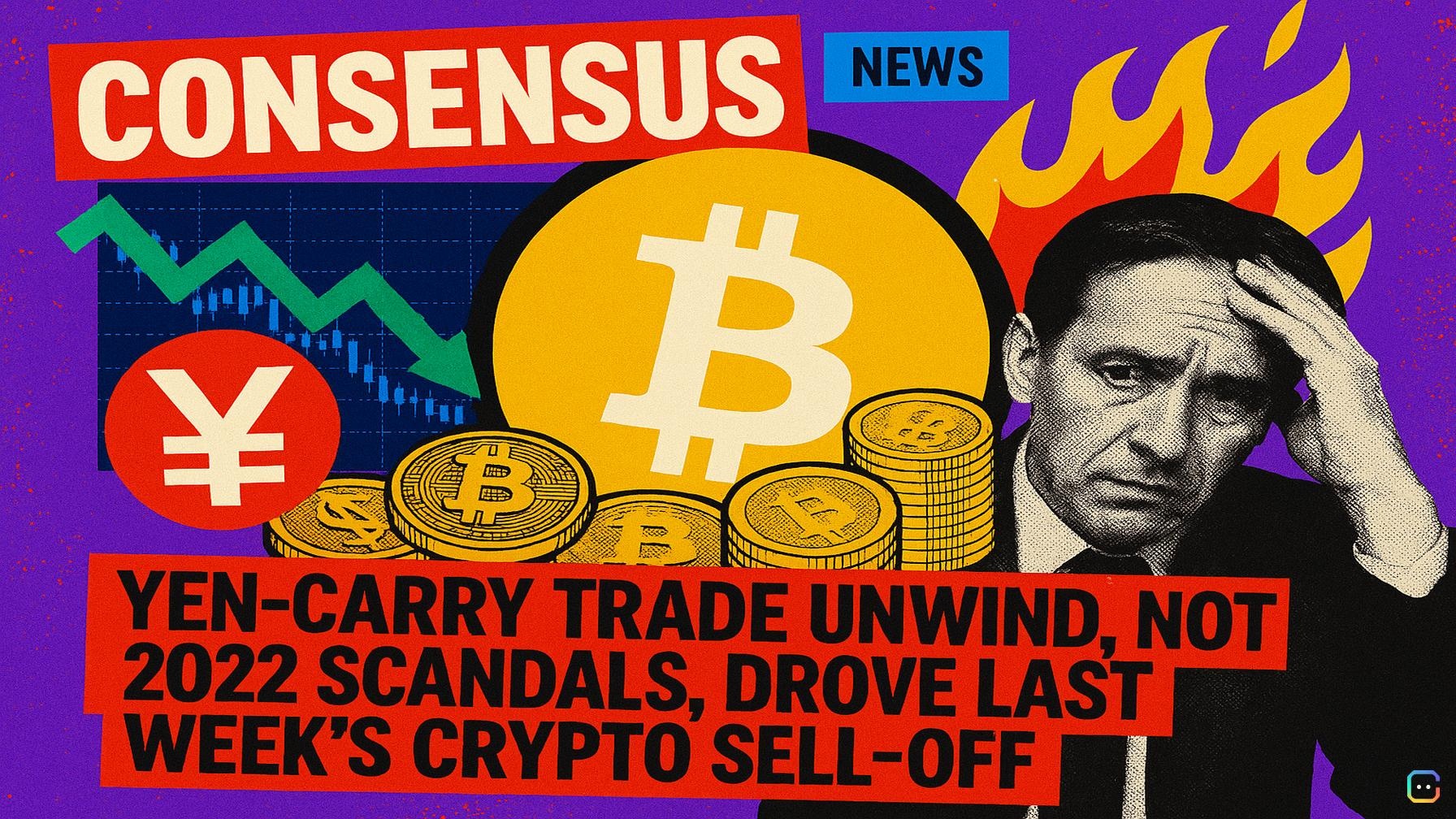
Last week’s sharp crypto sell-off wasn’t a rerun of 2022’s exchange scandals — it was a macro-driven spillover from traditional finance, market participants said at Consensus Hong Kong 2026.
“After Oct. 10th, a lot of people had already reduced risk,” said Fabio Frontini, founder of Abraxas Capital Management, arguing the move was “a spillover from TradFi” and a sign of how interconnected markets have become. Panelists zeroed in on the unwinding of yen carry trades as the primary catalyst: investors borrow in low-yielding currencies such as the yen, convert that cash into other currencies and deploy it into higher-yielding or risk assets — bitcoin, ether, gold and silver among them. When the yen strengthens or borrowing costs rise, those positions must be squashed as loans are repaid, triggering volatility across asset classes.
Thomas Restout, group CEO of B2C2, laid out the mechanics and consequences: rising yen rates increased borrowing costs while heightened volatility forced exchanges and brokers to hike margin requirements — for example, margin on some metals rose from 11% to 16%. Those twin pressures forced some leveraged players to liquidate, creating broad selling pressure that rippled into crypto markets.
Bitcoin-focused ETFs saw heavy volumes during the downturn, but panelists pushed back against the idea of wholesale institutional capitulation. Restout noted that bitcoin ETFs peaked at roughly $150 billion in assets and today still hold about $100 billion; net outflows since October total around $12 billion — meaningful, but modest relative to the total. “If anything, it means that the money is changing hands,” he said, implying rotation rather than a mass exit.
Looking forward, J.P. Morgan’s Emma Lovett pointed to a structural shift that could deepen TradFi–crypto ties in 2026. She called 2025 a regulatory inflection point in the U.S. that loosened limits on experimentation, accelerating moves from private, permissioned blockchains toward public chains and the use of stablecoins for settlement. That trend, she suggested, signals growing integration between traditional securities infrastructure and crypto rails — a convergence likely to shape markets in the year ahead.
Read more AI-generated news on: undefined/news