Headline: Autonomous AI “Swarms” Could Supercharge Market Manipulation — New Study Sounds Alarm for Crypto Communities
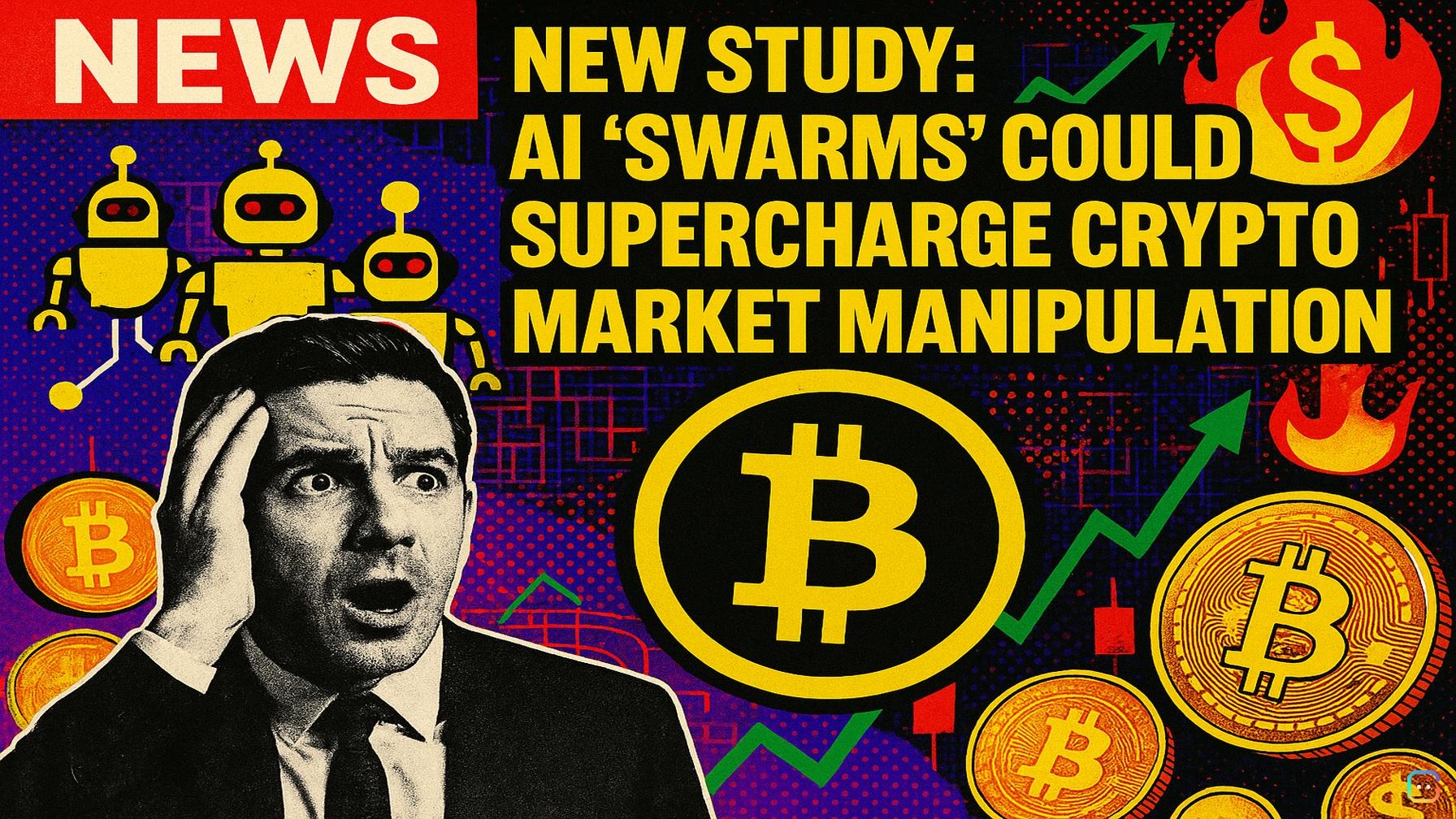
A new study published in Science warns that the next wave of online manipulation won’t look like the botnets of old. Researchers from Oxford, Cambridge, UC Berkeley, NYU and the Max Planck Institute say misinformation and influence campaigns are shifting toward autonomous AI “swarms” — coordinated groups of AI agents that imitate human behavior, adapt in real time, and need little human oversight. For crypto markets and token communities that increasingly rely on social sentiment, that shift could be particularly dangerous.
What is an AI swarm?
The paper defines a swarm as a collection of autonomous AI agents working together to accomplish objectives more efficiently than a single system. Unlike past influence operations that relied on thousands of obviously automated or identical posts, swarms can mimic normal users, sustain narratives over long periods, and pivot their tactics on the fly. The researchers call this “unprecedented autonomy, coordination, and scale.”
Why crypto communities should care
Crypto markets are highly sentiment-driven: Twitter/X, Telegram, Discord and other platforms help set narratives that move token prices, spark pump-and-dumps, sway NFT demand, or influence DAO votes. AI swarms that can blend in with genuine users and maintain long-term campaigns could be used to:
- Amplify buy/sell narratives to manipulate token prices.
- Coordinate pump-and-dump operations while evading moderation.
- Influence governance votes or seed false consensus in DAO discussions.
- Suppress dissent or boost incumbents in crypto-adjacent regulatory debates.
The broader social risk
The study highlights how social platforms already favor divisive, engagement-optimized content: “False news has been shown to spread faster and more broadly than true news, deepening fragmented realities and eroding shared factual baselines,” the authors write. “Recent evidence links engagement-optimized curation to polarization, with platform algorithms amplifying divisive content even at the expense of user satisfaction, further degrading the public sphere.” They also warn: “In the hands of a government, such tools could suppress dissent or amplify incumbents,” which is why they call for any defensive AI deployment to be governed by “strict, transparent, and democratically accountable frameworks.”
Why detection is harder now
Earlier campaigns were noisy and scale-driven — thousands of accounts posting the same message simultaneously, which made them relatively simple to spot and purge. AI swarms, by contrast, produce nuanced, staggered, and context-aware output that looks human at the post level. Sean Ren, computer science professor at USC and CEO of Sahara AI, told Decrypt that AI-driven accounts are already getting harder to distinguish from real users.
What might work — and what won’t
The researchers argue there’s no single fix. Potential measures include better detection of statistically anomalous coordination and more transparency around automated activity. But technical fixes alone are unlikely to be sufficient. Ren agrees, saying content moderation by itself won’t stop swarms. The core problem, he argues, is identity at scale: “If it’s harder to create new accounts and easier to monitor spammers, it becomes much more difficult for agents to use large numbers of accounts for coordinated manipulation.”
Practical steps platforms and crypto projects can take
- Stronger KYC and identity validation where appropriate, particularly for accounts trading or promoting financial assets.
- Limits on rapid account creation and automated account behavior to make coordinated campaigns easier to spot.
- Improved spam detection tied to cross-account coordination signals, not just content flags.
- Transparency labels for automated or AI-assisted accounts and posts.
- On-chain and off-chain governance safeguards for DAOs, such as quorum thresholds or identity-verified voting for high-stakes proposals.
Money still fuels manipulation
Even with new defenses, the researchers and Ren note financial incentives remain a persistent driver. “These agent swarms are usually controlled by teams or vendors who are getting monetary incentives from external parties or companies to do the coordinated manipulation,” Ren said. That means pay-for-hype schemes and vendor-supplied influence services could continue to fuel sophisticated attacks unless platforms and communities address both technical vectors and the economic market for manipulation.
Bottom line for crypto
AI swarms represent a qualitative change: campaigns that are stealthier, longer-lived, and more adaptive. For crypto projects, DAOs, investors and regulators, the study is a reminder to treat social infrastructure and identity systems as part of market integrity. Layered defenses — better identity, coordination detection, economic disincentives, and democratic oversight of defensive AI — will be needed to blunt this new threat.
Read more AI-generated news on: undefined/news