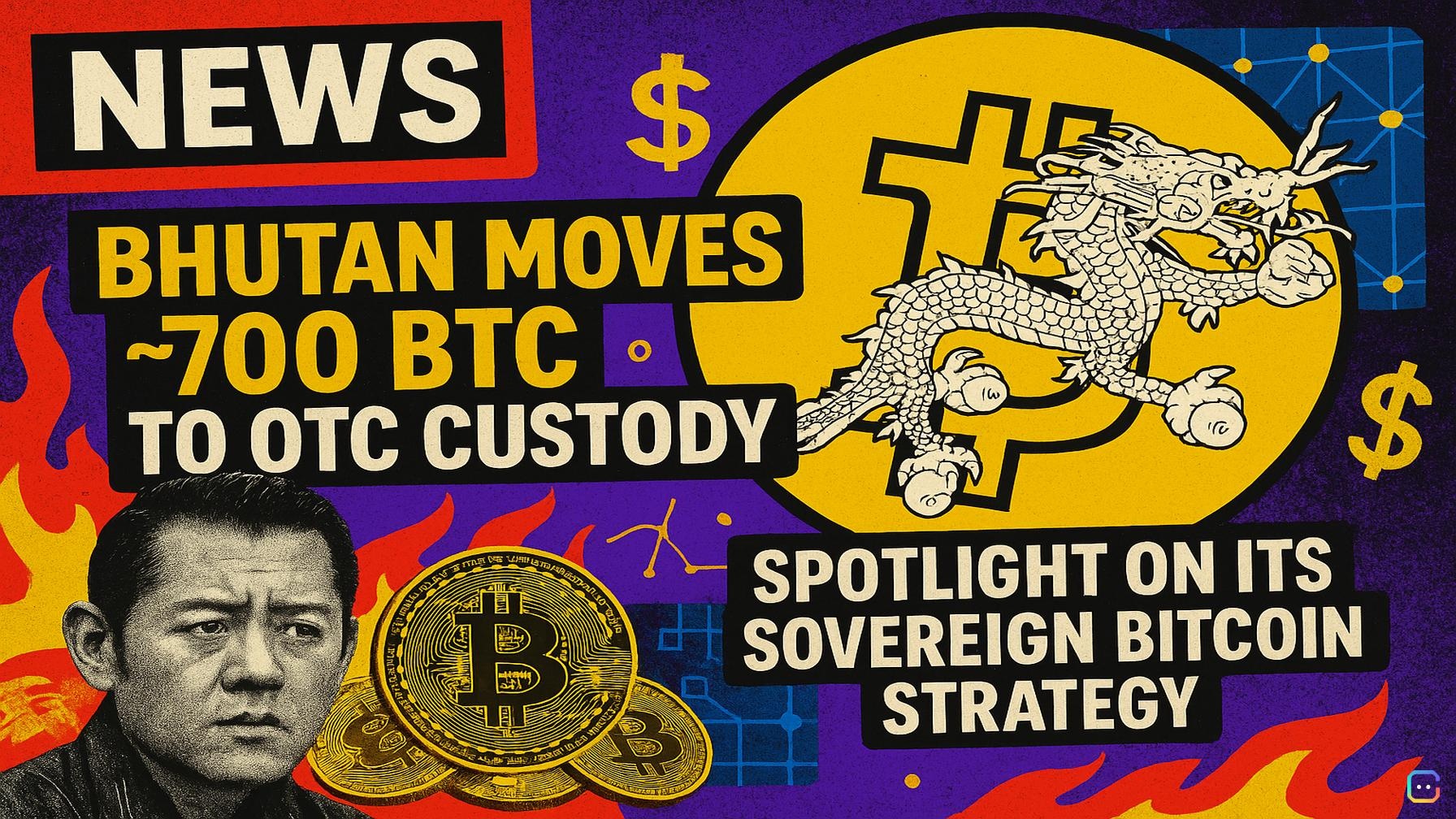
Bhutan’s recent Bitcoin moves are putting its unusual sovereign crypto strategy back in the spotlight.
On-chain sleuths at Onchain Lens and Arkham Intelligence flagged two large transfers from wallets attributed to Druk Holding & Investments (DHI), the kingdom’s sovereign investment arm. Together the transfers totaled about 700 BTC — roughly $50 million at recent prices — with one 325 BTC tranche (≈$25.19M) routed to a wallet that has previously sent coins to Galaxy Digital and a second 375 BTC (≈$25.18M) moved to an unknown address analysts suspect could be an OTC desk or a new custodian.
These outflows build on an active March for Bhutan. MEXC News reported a March 25, 2026 transfer of 519.7 BTC (≈$37.75M) from DHI wallets to an address that frequently interacts with Singapore-based OTC firm QCP Capital, suggesting off-exchange sales aimed at minimizing market impact. Earlier in the month, with BTC near $68,600, DHI nudged 175 BTC (about $11.85M at the time) — leaving the country with roughly 5,424.7 BTC, according to reports. Crypto trackers such as CryptoRank have estimated March movements in the range of $45M–$120M, while Yahoo Finance summarized the month as “over $84 million’s worth of Bitcoin” sold in March 2026.
Bhutan’s Bitcoin holdings are atypical among nation-states. Arkham’s 2025 research found the Royal Government of Bhutan once controlled just over 13,000 BTC (then valued around $764M), ranking it the fourth-largest government holder behind the U.S., China and the U.K. Crucially, Arkham noted Bhutan’s stash came not from seizures but from government-funded mining operations launched in 2019 and managed through DHI. Leveraging abundant hydroelectric power, Bhutan has been turning surplus renewable energy into a sovereign Bitcoin reserve — a strategy tracked by Bitcointreasuries.net and framed as part of the kingdom’s effort to diversify income beyond hydropower exports and tourism.
The government has not publicly explained the recent transfers. Industry commentators collected by CryptoRank and Yahoo Finance point to plausible motives: portfolio rebalancing, locking in profits, funding state projects, or moving assets to alternate custody. Observers also note Bhutan’s near-zero marginal electricity costs from hydropower make BTC sales largely realized profit before capital expenditure, which can make periodic, disciplined selling attractive.
There are practical reasons for the apparent preference for OTC routes and staged sales. On-chain visibility of large disposals can move markets, and recent headlines about institutional losses and hacks have made conservative, off-exchange handling sensible for a small sovereign with a material on-chain position. Bhutan’s mining-led approach — including repurposing legacy projects such as the stalled “Education City” into data center sites — exemplifies how countries with cheap energy can monetize stranded or surplus power via Bitcoin mining while avoiding heavy industrial development, aligning in Bhutan’s case with policy goals like Gross National Happiness.
As Bhutan’s BTC balance has dropped from the 13,000+ peak toward the mid-thousands, each transfer is being read as a signal about how the kingdom now values Bitcoin in its treasury. Whether these moves mark a new steady-state of revenue realization, short-term funding, or custodial reshuffling, they underline an evolving model of sovereign interaction with crypto that other energy-rich states may watch closely.
Neither the Royal Government nor DHI has offered an official comment on the recent transactions.
Read more AI-generated news on: undefined/news