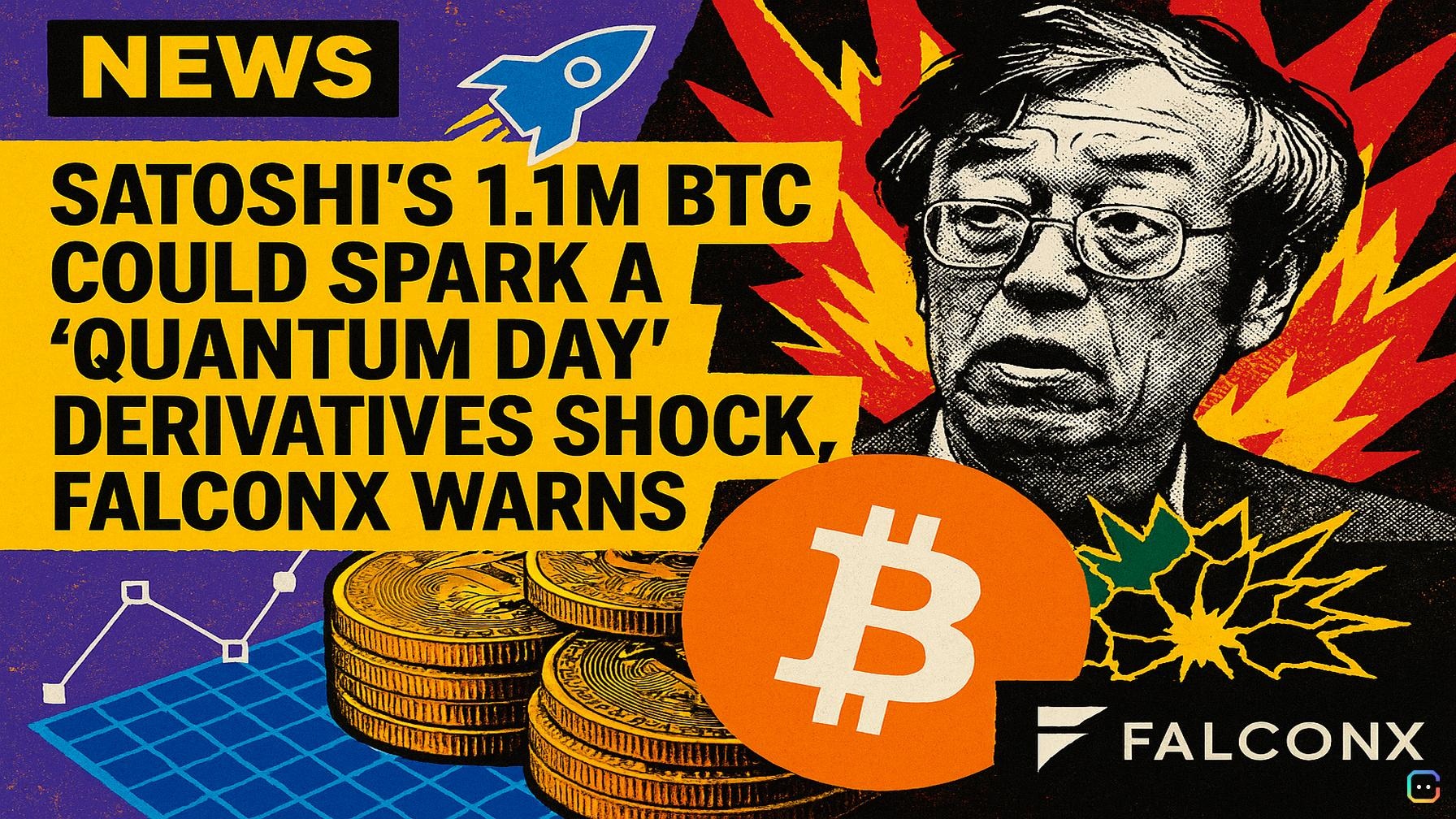
FalconX markets co-head Joshua Lim warned on April 16 that Bitcoin’s “quantum day” risk could show up in derivatives markets long before any compromised coins ever move on-chain. In an X thread, Lim mapped the most tradable signals traders should watch, and argued the real danger isn’t only cryptography — it’s what the community would do about Satoshi-era coins.
Two problems, not one
Lim splits the issue into a technical question and a political one. Technically, Bitcoin could migrate away from elliptic curve cryptography to post‑quantum schemes (he cites proposals like BIP 361 as possible blueprints). But the harder challenge is sociopolitical: what to do with coins that likely won’t be moved by their original owners — above all, Satoshi’s stash.
How big is the exposure? Lim estimates Satoshi’s holdings at roughly 1.1 million BTC and suggests other old or pay-to-public-key outputs could push the total exposed supply as high as 1.7 million BTC — “a $127bn question.” Those coins are unique because they probably won’t participate in any community‑led migration unless Satoshi is still active and willing to move them.
Two stark scenarios
Lim outlines two uncomfortable outcomes:
- If Satoshi is reachable and moves coins before q‑day, markets would reprice the future probability of those coins being sold, likely driving BTC down.
- If Satoshi is absent, a quantum-capable actor — likely a state — could seize those coins.
“That’s not a math problem,” Lim says. The responses are political: either burn the exposed coins via governance (raising hard questions about immutability and precedent) or hard fork so the market can choose between a chain that neutralizes the coins and one that preserves the current ruleset — a contest over Bitcoin’s identity as much as a security fix.
Why a fork today would be different
Lim compares any potential hard fork to the 2017 BTC/BCH split, but stresses the context has changed dramatically. Bitcoin’s market is now roughly $1.5 trillion, far more institutional, and heavily wrapped in ETFs, listed futures and options. A modern fork — or even the credible prospect of one — would likely trigger extreme volatility, large gap downs and cascading liquidations as institutions de‑risk.
Derivatives will flash first
Crucially for traders, Lim argues derivatives markets will be the first place q‑day risk registers. The signals to watch include:
- Long‑dated options skew (puts expensive relative to calls; long‑dated put skew is near multi‑year highs).
- Forward basis in futures (basis is near multi‑year lows vs spot).
- Distribution of open interest across traditional vs crypto‑native venues.
His reasoning: uncertainty about a quantum breakthrough and the possibility of a fork/airdrop will push some participants to hedge downside while others position for an airdrop-like payoff, compressing or inverting basis farther out on the curve. He notes the last comparable elevation in put skew occurred around the Three Arrows Capital and FTX collapses in 2022.
Not panic, but watchful
Lim stops short of saying markets are already pricing imminent q‑day. Some signals are “flashing red,” he writes, but they can also reflect broader systemic fears and secular shifts like rising institutional options activity on CME and IBIT. For now the picture is mixed — but his main point is clear: if q‑day ever begins to look real, traders are likely to see it in derivatives long before any dormant UTXOs move.
Bitcoin traded at $75,024 at press time.
Read more AI-generated news on: undefined/news