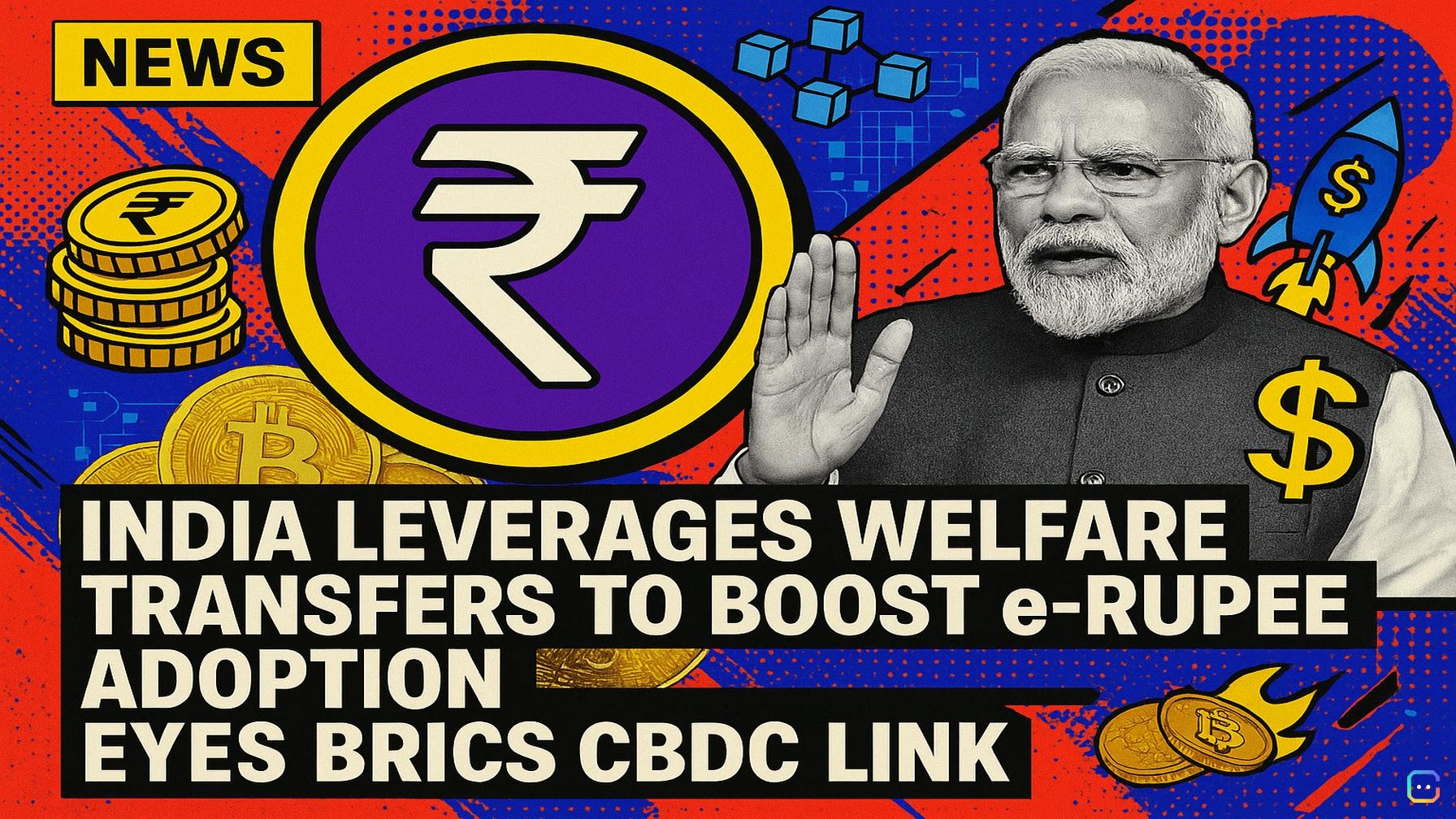
India is leaning on welfare payments to kick-start adoption of its central bank digital currency (CBDC), the e-rupee, as it prepares to showcase the project at the BRICS summit later this year.
According to Reuters, the Reserve Bank of India is running roughly 10 pilot programs that route portions of the country’s roughly $80 billion welfare system through the e-rupee. The pilots aim to harden a use case for the CBDC—reducing leakage and corruption in subsidy delivery—after a relatively slow consumer rollout.
Concrete examples are already underway. In Phulenagar village, Maharashtra, farmers are receiving programmable subsidies that cover up to 80% of drip-irrigation costs; those funds can be spent only at approved vendors. In Gujarat, a large-scale pilot aims to onboard all 7.5 million households eligible for subsidized food by June, effectively using targeted transfers to drive mass adoption.
But scaling remains a challenge. The e-rupee has grown to about 10 million users from roughly 7 million earlier this year, yet cumulative transactions since its December 2022 launch total only $3.6 billion—minuscule next to India’s payments behemoth, the Unified Payments Interface (UPI), which processes roughly $300 billion each month. Earlier adoption boosts have sometimes been engineered: CoinDesk reported that several major banks credited employee salaries into CBDC wallets to push daily transactions past 1 million in December 2023, a milestone that didn’t last.
Beyond domestic goals, India’s CBDC play has a geopolitical dimension. The Reserve Bank of India has urged the government to propose linking CBDCs across the BRICS economies (Brazil, Russia, India, China and South Africa) at the bloc’s 2026 summit—an effort intended to simplify cross-border trade and reduce dependence on the U.S. dollar. That ambition, however, carries political risk: President Donald Trump has threatened tariffs on BRICS countries pursuing dollar alternatives and has already imposed duties on Indian imports partly tied to India’s purchases of Russian crude.
What to watch: whether welfare-driven pilots can produce sustained behavioral change, how quickly transaction volumes climb relative to established rails like UPI, and whether BRICS-level CBDC interoperability advances beyond discussion to concrete infrastructure—despite the geopolitical headwinds.
Read more AI-generated news on: undefined/news