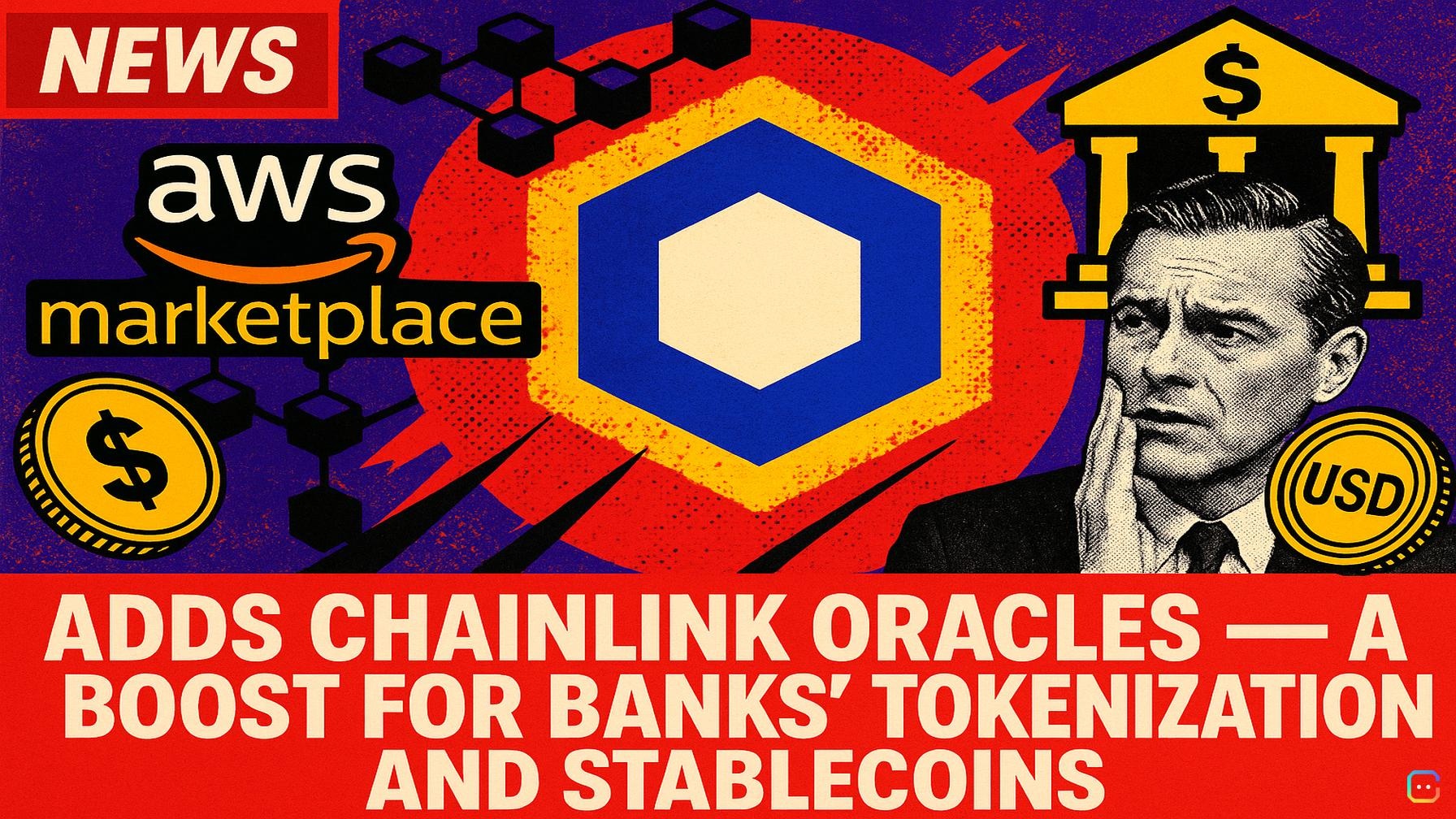
AWS Marketplace has added Chainlink’s oracle stack as a native offering, bringing a direct bridge between cloud infrastructure and on‑chain applications — a move that could accelerate banks and fintechs experimenting with tokenization, stablecoins, and real‑world asset (RWA) use cases.
According to The Block, Amazon has consolidated multiple Chainlink products into a single Marketplace listing that any AWS customer can deploy. The package includes:
- Chainlink Data Feeds (tamper‑resistant price oracles)
- Low‑latency Data Streams
- Proof of Reserve attestations
By making these services available inside AWS, developers can plug Chainlink oracles straight into AWS compute, storage, databases, and API stacks. That turns existing off‑chain enterprise systems into data sources and execution engines for smart contracts without leaving the AWS environment — essentially shrinking the gap between a traditional microservice on AWS and a live on‑chain application.
Amazon’s Marketplace page calls the Chainlink Platform an “all‑in‑one oracle solution,” highlighting features such as secure callbacks from smart contracts to AWS workloads and on‑chain attestations. Chainlink’s Proof of Reserve, for instance, provides verifiable attestations of collateralization for stablecoins, wrapped assets, and tokenized RWAs — enabling 1:1 backing checks and “circuit breakers” to halt minting if reserves fall short.
This is the next step in a pattern of deeper AWS–Chainlink integration. Earlier partner guidance showed how to run high‑availability Chainlink nodes on Amazon EKS; a March 2026 AWS sample project walked through using the Chainlink Runtime Environment (CRE) for tokenization tasks like price feeds and reserve verification. Jane Ginsburg, AWS’s go‑to‑market head for capital markets and fintech, said CRE “enables customers to integrate AWS workloads with smart contracts, unlocking use cases such as custom price feeds, stablecoin reserve verification, and off‑chain computation within trusted execution environments.”
For Chainlink, the Marketplace listing strengthens its pitch as the “industry‑standard oracle platform” for on‑chain capital markets. The company points to adoption of its stack — including Data Feeds, Proof of Reserve, and its cross‑chain interoperability protocol CCIP — by major institutions and projects, and says CRE is already used by Swift, Euroclear, UBS, J.P. Morgan’s Kinexys, Mastercard, AWS itself, and others. Chainlink also cites an $867 trillion opportunity tied to tokenization of traditional assets.
What this means in practice: by putting Chainlink services behind the familiar AWS Marketplace procurement and deployment model, Amazon is lowering organizational friction for banks, asset managers, and fintechs that want to experiment with tokenized assets and smart contracts while staying inside existing security and purchasing processes. For developers, it removes much of the “custom oracle plumbing” overhead, making it far easier to move real‑world data, reserve attestations, and workflows on‑chain.
Bottom line — embedding Chainlink in AWS Marketplace could materially speed enterprise adoption of blockchain primitives by making trusted external data and reserve verification available through the same cloud tools teams already use.
Read more AI-generated news on: undefined/news