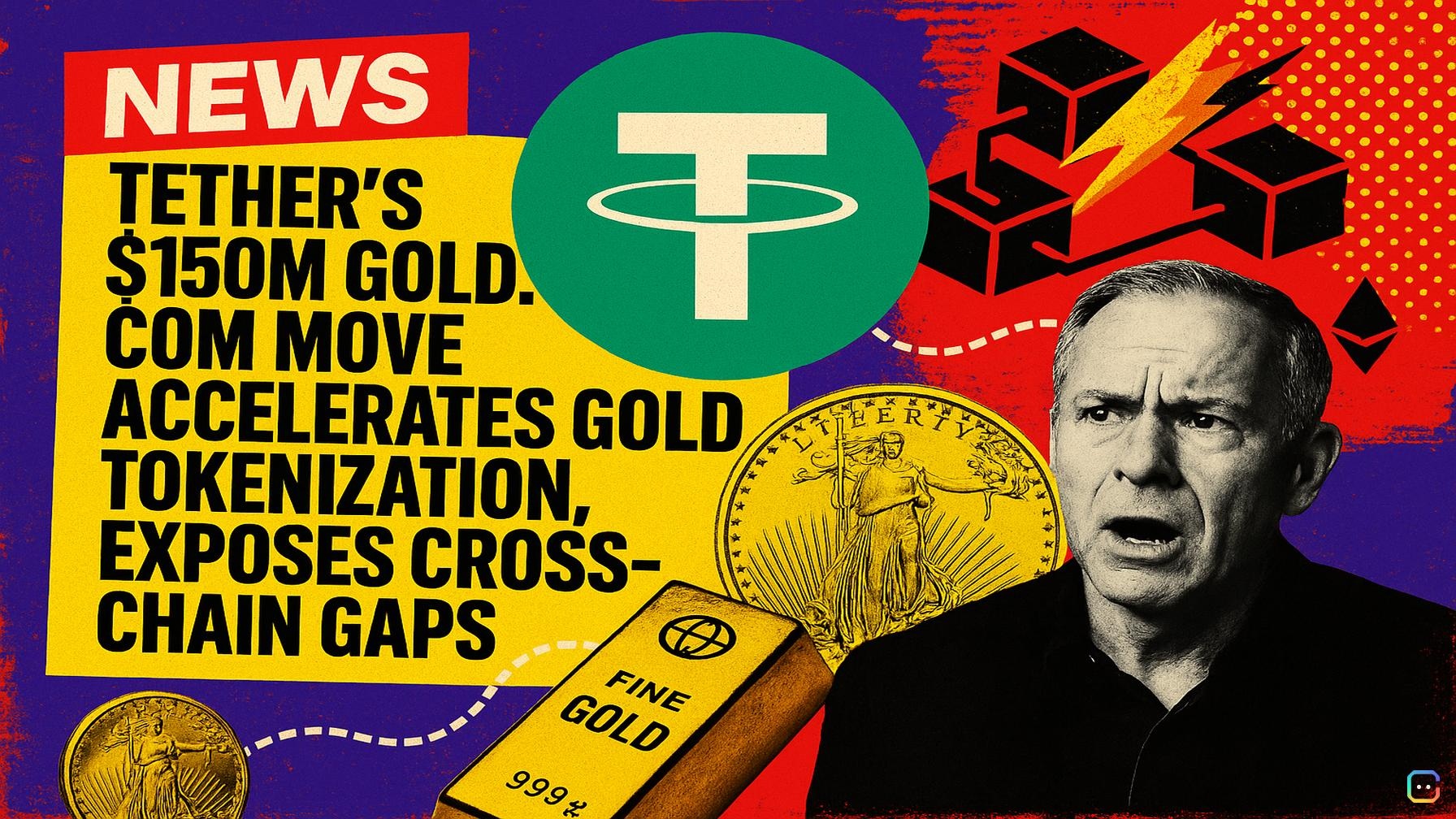
Tether’s move into gold just got a lot more tangible — and a lot more consequential for on-chain finance.
According to reports, Tether has made a roughly $150 million strategic investment in Gold.com. That’s not merely a premium domain buy or a bullion play; it signals a strategic bet on the digitization of gold and the broader Real World Asset (RWA) thesis for crypto. When the issuer of USDT — an entity that reportedly holds more U.S. Treasuries than many countries — places nine-figure capital behind gold tokenization, institutional investors and infrastructure builders take notice.
Why this matters
- Validation for RWAs: The investment reinforces a long-developing narrative that real-world assets (like gold) will become a major on-chain use case. Institutional appetite follows where perceived safety and liquidity lead, and Tether’s move is a loud signal.
- Spotlight on liquidity fragmentation: It also exposes a structural problem in crypto today — liquidity tends to be siloed by chain. A gold token minted on Ethereum, for example, is largely stuck there unless it’s wrapped or bridged to other networks. Those workarounds introduce counterparty and centralization risks, and they’ve been a recurring attack vector in billion-dollar bridge hacks.
The institutional friction
Institutional capital is typically risk-averse. Large-scale deployments require predictable, low-risk rails for moving value between ecosystems. The current landscape — an “archipelago” of deep but isolated liquidity pools across Bitcoin, Ethereum, and Solana — forces trade-offs. Developers often must pick a single chain to target, cutting off access to liquidity and users on other networks. Existing fixes, from Stacks on Bitcoin to conventional token bridges, are useful but largely bandaids: they move value but don’t create a unified execution environment.
Where infrastructure needs to go
As RWAs arrive on-chain, demand is rising for seamless cross-chain interoperability that preserves security and minimizes trust. The market is starting to focus on protocols that aim to unify execution across multiple chains rather than simply ferry tokens between them.
A proposed solution: LiquidChain
One such project attempting to fill that vacuum is LiquidChain, a Layer 3 protocol that pitches itself as a cross-chain liquidity and execution layer connecting Bitcoin, Ethereum, and Solana. Its design centers on a “Deploy-Once” philosophy powered by a Cross-Chain Virtual Machine (VM). In principle, developers could write a single application that taps Bitcoin’s security model, Ethereum’s smart contract ecosystem, and Solana’s throughput — without maintaining separate codebases for each chain.
For users, LiquidChain promises single-step interactions: swapping BTC for a Solana SPL token would happen behind the scenes with verifiable settlement, removing much of the manual friction around multiple wallets and gas tokens. That approach aims to turn the islands of liquidity into a more navigable, cohesive market — something that could be crucial if projects like Tether want their gold tokens to move freely across ecosystems.
Market interest and caveats
According to presale data, LiquidChain has raised more than $529K and lists a presale token price of $0.01355 for $LIQUID. Early capital inflows suggest investors are hunting infrastructure bets that could underpin the next phase of DeFi and RWA growth, beyond meme-driven speculation.
That said, these are still early-stage infrastructure plays. Bridging and cross-chain designs come with their own technical and security trade-offs, and presales are high-risk. Institutional deployment timelines and standards remain conservative, and any solution will be scrutinized for decentralization, auditability, and failure modes.
Bottom line
Tether’s reported $150M step into Gold.com is about more than shiny metal — it’s a real-world push that accelerates the need for reliable cross-chain plumbing. If gold tokens are to flow seamlessly from an Ethereum vault into lending protocols on Solana or liquidity on Bitcoin-linked rails, the industry will need more than token shuttles; it will need unified, secure execution environments. Projects promising that kind of interoperability are attracting attention — and capital — but they face the dual challenge of proving both their security and their practical utility at scale.
Disclaimer: This article is informational and not financial advice. Cryptocurrency investments, including presales, carry high risk, including the potential for total loss. Always verify contract addresses independently and conduct your own due diligence.
Read more AI-generated news on: undefined/news