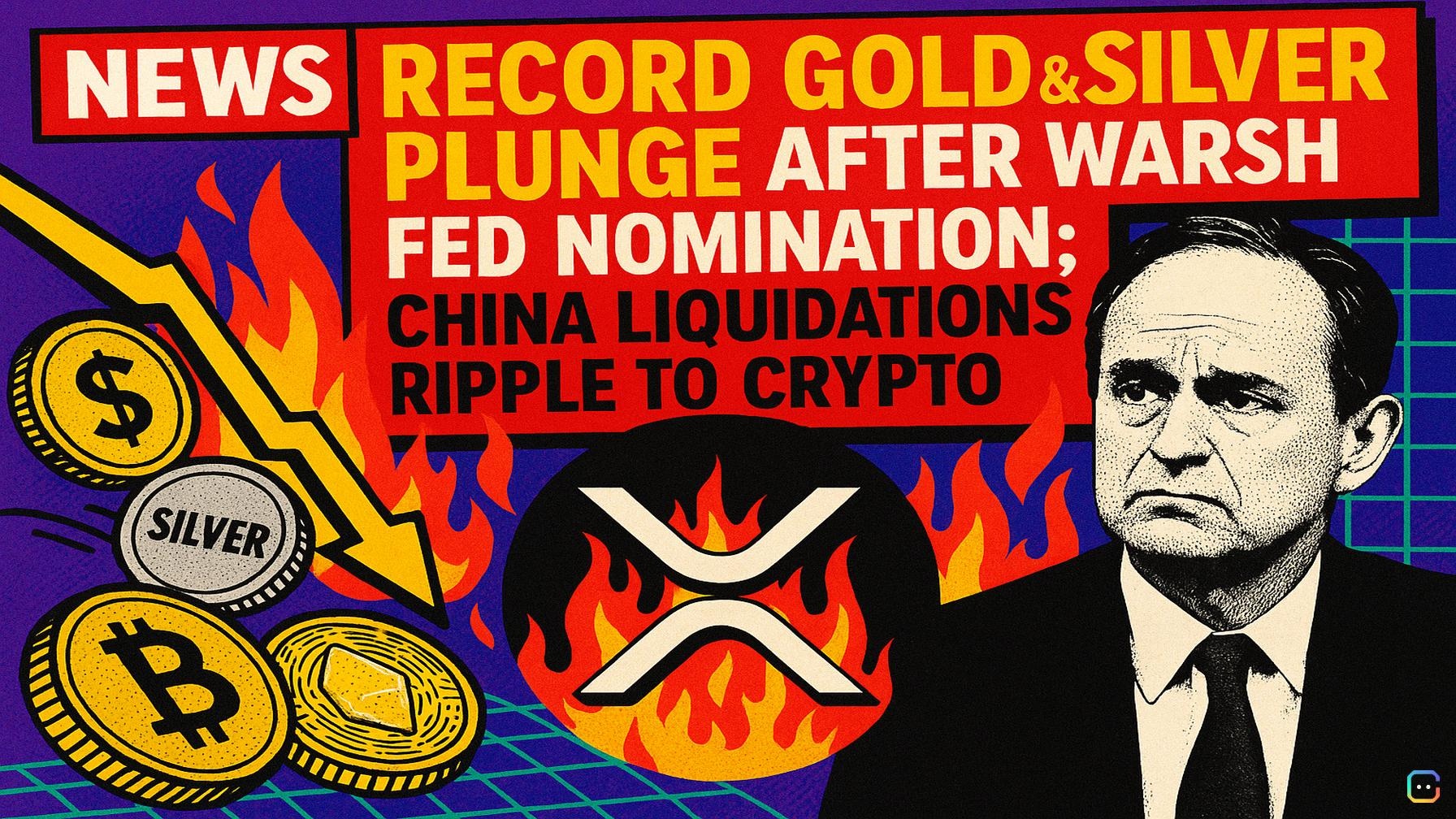
Gold and silver reversed course in one of the wildest precious-metals episodes in memory, as a Friday selloff accelerated into the following week and rippled through global markets.
What happened
- Gold futures plunged 9% on Friday — the metal’s worst single-day drop in more than a decade — and extended losses into Monday, sliding another 6% to about $4,538 per ounce at the time of reporting.
- Silver’s move was even more dramatic: an initial 26% collapse on Friday — the largest one-day fall on record — followed by an additional 12% drop to roughly $74.36 per ounce.
- Shanghai silver prices, which had surged to extraordinary highs just days earlier, collapsed as Chinese speculators rapidly unwound leveraged positions after a frenetic, momentum-driven rally.
Why it blew up
Market participants point to a combination of domestic Chinese unwinding and a shock in U.S. policy expectations. The immediate trigger for the sharp risk-off move was President Trump’s nomination of Kevin Warsh to head the Federal Reserve, which traders interpreted as a potential move toward a more hawkish Fed and a stronger U.S. dollar. That shift undercut the “safe-haven” and dollar-hedge narratives that had helped drive metals to extreme levels.
How China amplified the rout
- Heavy speculative buying in China had pushed prices to unprecedented levels — gold reportedly hit $5,595 an ounce on Thursday — and that speculative froth reversed quickly.
- Shanghai-based trading dynamics intensified volatility: daily price limits on some Chinese silver futures (roughly 16%–19%) and the market’s structure forced abrupt catch-up moves when global prices turned lower, magnifying the selloff as the new week opened.
- “China sold and now we’re suffering the consequences,” said Alexander Campbell, former head of commodities at Bridgewater Associates, summing up how local selling cascaded into global pain.
Voices from the market
- Dominik Sperzel, head of trading at Heraeus Precious Metals: “In my career it’s definitely the wildest that I have seen. Gold, it’s a symbol of stability, but such a move is not a symbol of stability.”
- Nicky Shiels, head of metals strategy at MKS PAMP SA: “January 2026 would go down as the most volatile month in precious metals history.”
- Jay Hatfield, CIO at Infrastructure Capital Advisors, pointed to momentum-driven positioning: “We had identified about three or four weeks ago that it turned into a momentum trade, not a fundamental trade.”
- José Torres, senior economist at Interactive Brokers, noted the policy-angle reversal: “The ‘Buy America’ trade is back… and the independence bid that drove gold and silver to nosebleed record heights is unraveling.”
Context and what comes next
Despite the violence of the selloff, both metals remain well above their pre‑January levels for the year: silver is reported to be up about 16% since the start of January, and gold roughly 8% year-to-date. The market now faces two central questions: will Shanghai silver stabilize, or will further unwinding by Chinese speculators spur additional waves of selling?
For crypto market watchers, this episode is notable because it highlights how shifts in monetary-policy expectations and concentrated speculative flows can rapidly reprice “store of value” assets — whether gold, silver, or digital alternatives — and how leverage and local market rules can amplify global volatility.
What to watch
- Any further policy signals from the Fed or developments around Warsh’s nomination.
- Volume and position flows out of Chinese exchanges, and whether price limits are changed or re-applied.
- Whether momentum traders return to the market once volatility cools, or whether fundamentals regain control of prices.
The breakdown was not just a correction — traders called it one of the most dramatic reversals in commodity trading in recent memory, driven by a mix of speculative excess, market structure quirks in China, and a sudden shift in expectations about U.S. monetary policy.
Read more AI-generated news on: undefined/news