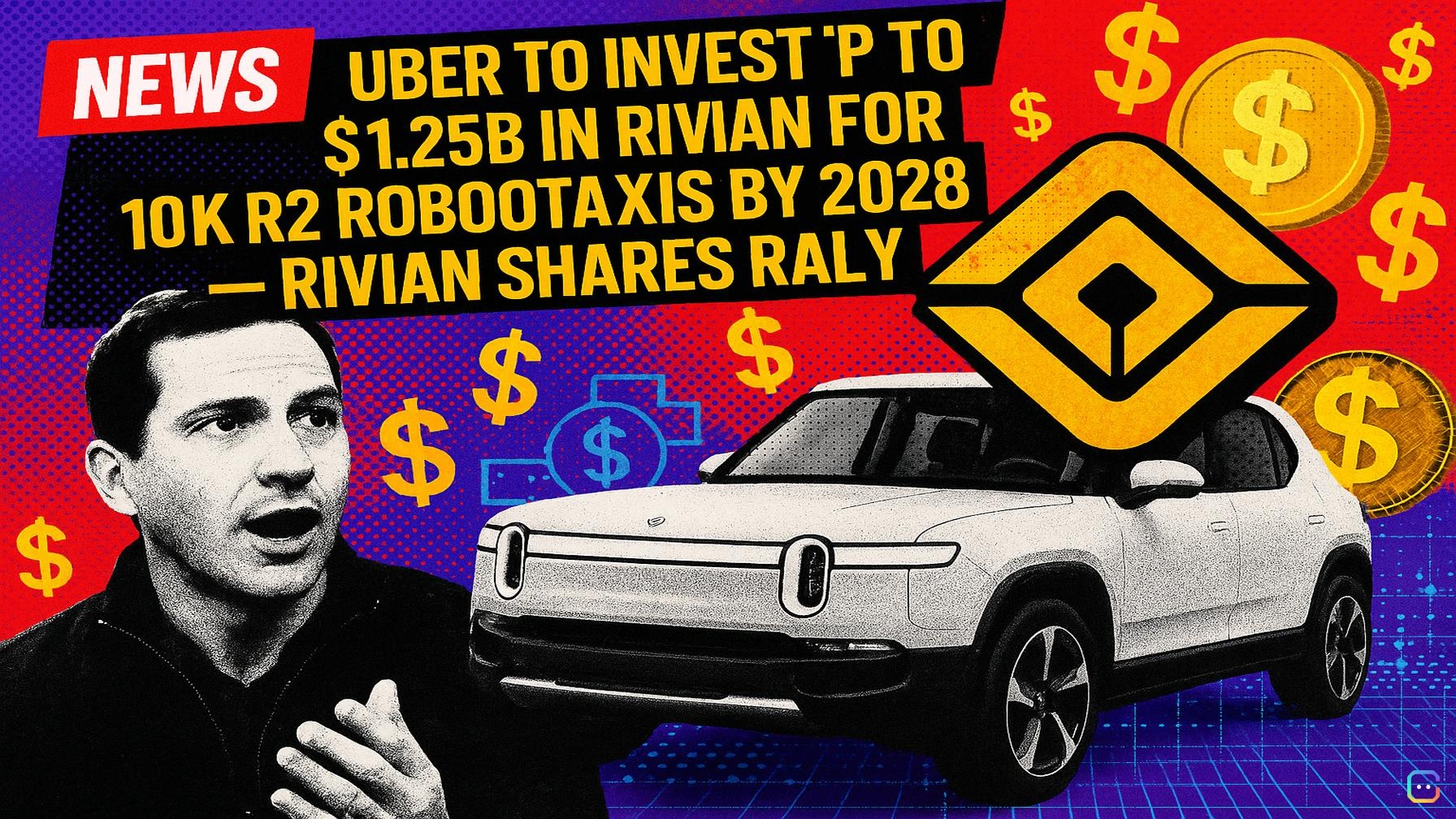
Headline: Uber doubles down on robotaxis with up to $1.25B Rivian deal, 10K R2s set for 2028—option for 40K more
Uber has agreed to invest up to $1.25 billion in Rivian in a deal that will put thousands of R2 robotaxis into its network. The arrangement includes an initial $300 million commitment and a purchase agreement for 10,000 Rivian R2 vehicles, with an option to buy another 40,000 by 2030.
Key deployment and timing
- Initial rollouts of the R2 robotaxis will begin in San Francisco and Miami in 2028.
- Uber and its fleet partners plan to scale service to 25 cities by 2031.
- The deal arrives days after Uber announced a separate collaboration with Nvidia for an Nvidia-powered self-driving taxi expected in 2027.
Market reaction
- Rivian shares jumped as much as 10% in early trading after the news.
- Uber’s stock was down on Thursday but has risen more than 3% over the last few days.
Why this matters
Rivian’s CEO RJ Scaringe framed the tie-up as an accelerator for Level 4 autonomy. He pointed to Rivian’s “growing data flywheel,” its RAP1 in-house inference platform, and a multi-modal perception stack as core advantages that will speed autonomous development over the next few years.
Dara Khosrowshahi, Uber’s CEO, emphasized the value of vertical integration: designing vehicles, compute, and software together while keeping manufacturing and supply under U.S. control. He cited Rivian’s consumer-vehicle data and fleet management experience as reasons the targets are “ambitious but achievable.”
Broader robotaxi strategy
This is one of several recent moves by Uber to build an autonomous future. Other partnerships include:
- A pact with Lucid to deploy up to 20,000 Lucid EVs as robotaxis using Nuro’s self-driving OS.
- An arrangement with Alphabet’s Waymo to let riders summon Waymo robotaxis through Uber in cities such as Atlanta and Austin.
Bottom line
The Rivian commitment gives Uber direct access to a purpose-built robotaxi platform and bolsters its multi-pronged approach to autonomy—pairing proprietary vehicle designs, third-party compute stacks (Nvidia), and fleet partnerships. For investors and mobility-watchers, the deal is a major step toward large-scale, commercially operated robotaxi networks in the U.S. by the end of the decade.
Read more AI-generated news on: undefined/news