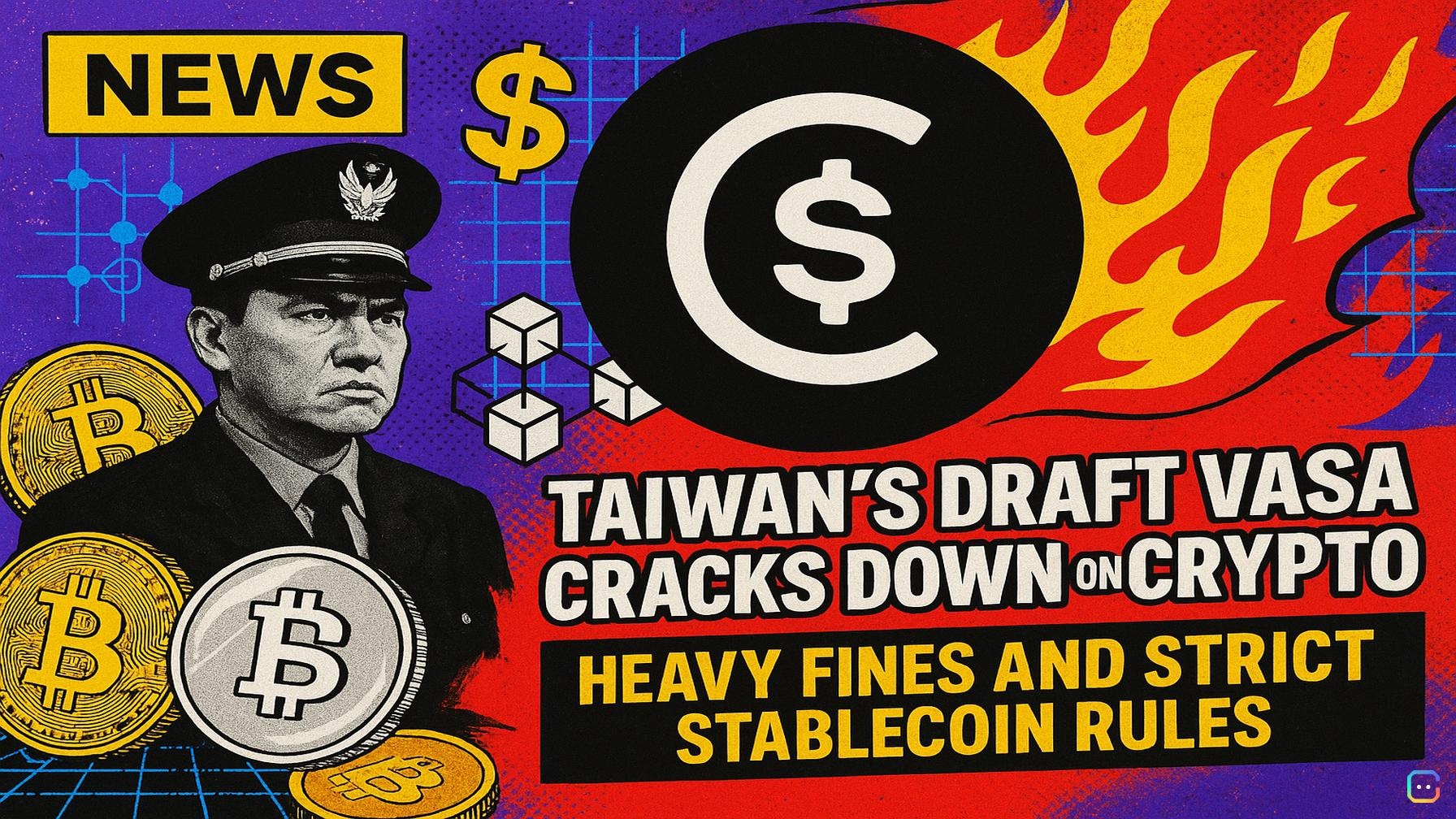
Taiwan moved decisively this week toward a tighter, clearer regulatory regime for crypto, approving a new draft of its Virtual Asset Service Act (VASA) that imposes stiff penalties and detailed rules for exchanges, stablecoin issuers and other digital-asset businesses.
What happened
- On April 2 the Executive Yuan passed the VASA draft, a bill shepherded by the Financial Supervisory Commission (FSC) and first proposed last year. The draft formalizes a comprehensive framework for Virtual Asset Service Providers (VASPs) and stablecoin issuers and follows the FSC’s 2024 overhaul of anti‑money‑laundering (AML) rules to explicitly include crypto firms.
- The government is rolling this framework out in four gradual phases that blend industry self‑regulation with a mandatory AML compliance registration system. All digital-asset firms must complete AML registration by September 2025.
Key rules and requirements
- VASPs will need to focus exclusively on virtual-asset services and meet strict standards for company naming, organizational structure and capital. Financial institutions may offer VASP services alongside other activities if they obtain approval.
- Regulators will tailor specific rules to different business types. Trading platforms, for example, will be required to publish clear listing and delisting policies.
- Stablecoin issuance and redemption must occur at face value; issuers cannot refuse redemption requests. Issuers are also barred from paying interest or returns on stablecoins — a constraint consistent with international practice.
- Issuers must maintain robust internal controls, audits and information‑security systems to ensure proper issuance and redemption.
Heavy penalties to deter abuse
- The draft imposes severe criminal and financial penalties for unlicensed, fraudulent or manipulative activity. Offences involving falsification, concealment or price manipulation of crypto could carry 3–10 years in prison and fines up to NTD 200 million (about $6.25 million).
- Unlicensed stablecoin issuance could result in up to seven years behind bars and fines up to NTD 100 million (roughly $3.13 million).
Who can issue stablecoins?
- FSC Deputy Chairman Chen Yen-liang said stablecoin issuance is not legally limited to banks, but noted that banks are generally better positioned to meet capital and risk‑management requirements. For nonbank operators, the draft proposes differentiated capital thresholds and operating guarantees based on business type, with final details to follow once the law is finalized.
Timing and next steps
- The FSC has signaled an incremental “gradual opening” approach with coordinated rule‑making alongside the Central Bank. According to earlier FSC statements, detailed stablecoin regulations are to be developed within six months after VASA approval; the regulator previously suggested Taiwan’s first regulated stablecoin could appear this year, though other reporting has placed the likely launch window for locally issued NTD‑ or USD‑pegged tokens in the second half of 2026. Officials say they will publish capital and operational thresholds for different operator types after the legislation is enacted.
Why it matters
- The draft VASA brings Taiwan closer to a structured, enforceable crypto regime that emphasizes consumer protection, AML compliance and cyber controls while allowing room for financial innovation. The tough penalties and specific stablecoin rules signal that Taipei intends to deter bad actors and make regulated crypto offerings more trustworthy for domestic users and institutions.
What to watch
- Final passage of the VASA into law and the subsequent issuance of implementing regulations, especially the stablecoin rules and capital requirements for nonbank issuers.
- How exchanges and other VASPs respond to the exclusive‑operation requirement and the AML registration deadline (September 2025).
- Coordination between the FSC and the Central Bank on custody, reserve requirements and the broader payments implications of regulated stablecoins.
This draft marks a significant step in Taiwan’s crypto policy: tighter rules, clearer responsibilities, and heavier consequences for misconduct — all designed to balance market growth with financial stability and consumer protection.
Read more AI-generated news on: undefined/news