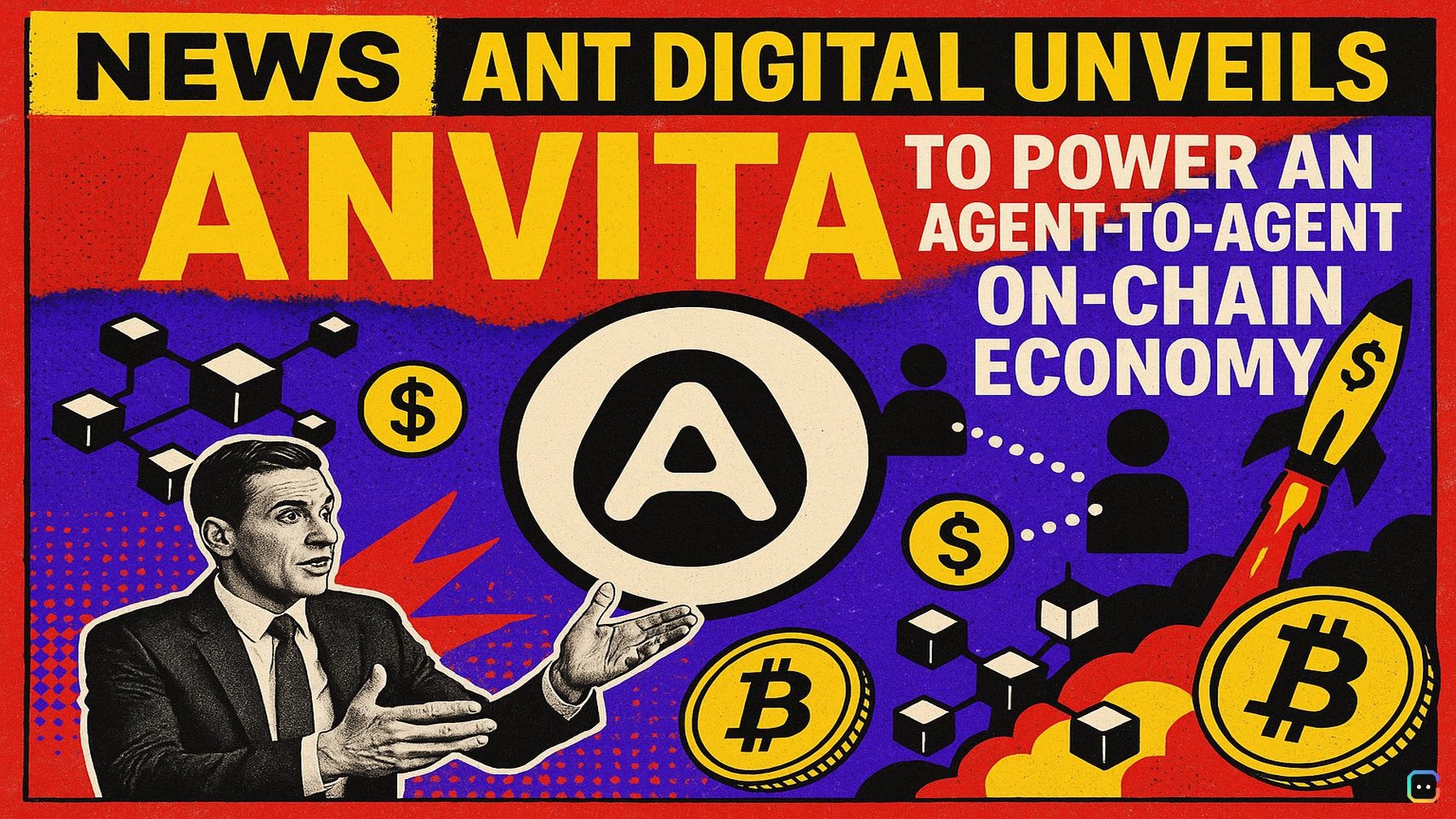
Ant Group’s blockchain arm, Ant Digital Technologies, has debuted Anvita — a platform designed to make AI agents, rather than people, first-class participants in crypto commerce. Unveiled at the company’s Real Up summit in Cannes, Anvita represents Ant’s vision of an “agent-to-agent economy” in which autonomous software programs can hold assets, trade, pay and coordinate with minimal human intervention.
What Anvita includes
- Two launch products: Anvita TaaS (Tokenization-as-a-Service), which targets institutional tokenization of real-world assets with custody and treasury tooling; and Anvita Flow, a runtime and registry for AI agents to discover one another, coordinate tasks and settle payments in real time.
- An Agent Store where developers can publish modules for data collection, financial analysis, gaming and more. The platform supports major agent frameworks such as OpenClaw and Claude Code and offers flexible hosting options.
- Integration of the x402 protocol (built by Coinbase and Cloudflare), enabling stablecoin payments over HTTP. Agents on Anvita Flow can reportedly execute instant sub-cent USDC payments, eliminating many traditional billing, subscription and manual-approval frictions.
“Pure RWA is just the ‘static infrastructure’ of digital assets,” said Zhuoqun Bian, president of Ant Digital’s blockchain business. “The real transformation lies in moving toward an onchain agentic economy, where autonomous agents will not just analyze data — they will hold assets, execute trades, and optimize portfolios.”
Why it matters
Anvita positions Ant Digital at the intersection of two fast-moving trends: the tokenization of real-world assets and the rise of autonomous AI agents that can transact onchain. In practice, agents could automatically allocate capital, execute trades, buy services, and settle microtransactions as they act on behalf of users or institutions.
Broader competitive and market context
Ant Digital joins a growing field of incumbents and newcomers building agent payment rails:
- Coinbase and Cloudflare’s x402 targets stablecoin micropayments over HTTP.
- Visa is developing a Trusted Agent Protocol focused on card-rail checkout.
- Google launched an Agent Payments Protocol (AP2) in September, backed by more than 60 organizations.
- Mastercard’s $1.8 billion acquisition of stablecoin firm BVNK signaled major payment networks’ interest in blockchain settlement.
Ecosystem signals and skepticism
There are early signs of traction: the Solana Foundation reports over 15 million onchain agent transactions, and Coinbase CEO Brian Armstrong has predicted agents could eclipse humans in transaction volume. McKinsey projects AI agents could mediate $3 trillion to $5 trillion of consumer commerce by 2030.
But usage metrics and activity quality remain uneven. The x402 protocol — central to Anvita Flow’s payments capability — is currently processing roughly $28,000 in daily volume, much of it testing activity, and Artemis analysts have flagged about half of observed transactions as artificial.
Ant Digital’s next moves
Ant’s blockchain already hosts tokenized assets from various financial institutions. The company is pursuing USDC integration with Circle and is applying for stablecoin licences in Hong Kong, Singapore and Luxembourg — steps that would be important for real-world adoption and cross-border settlement.
Bottom line
Anvita is Ant Digital’s bid to be a core infrastructure provider for an automated, onchain economy where AI agents transact autonomously. The technology stacks and high-profile backers suggest the idea is gaining momentum, but real-world adoption will hinge on transaction volume, regulation, stablecoin liquidity and whether agent-driven services prove reliably valuable beyond laboratory and testing environments.
Read more AI-generated news on: undefined/news