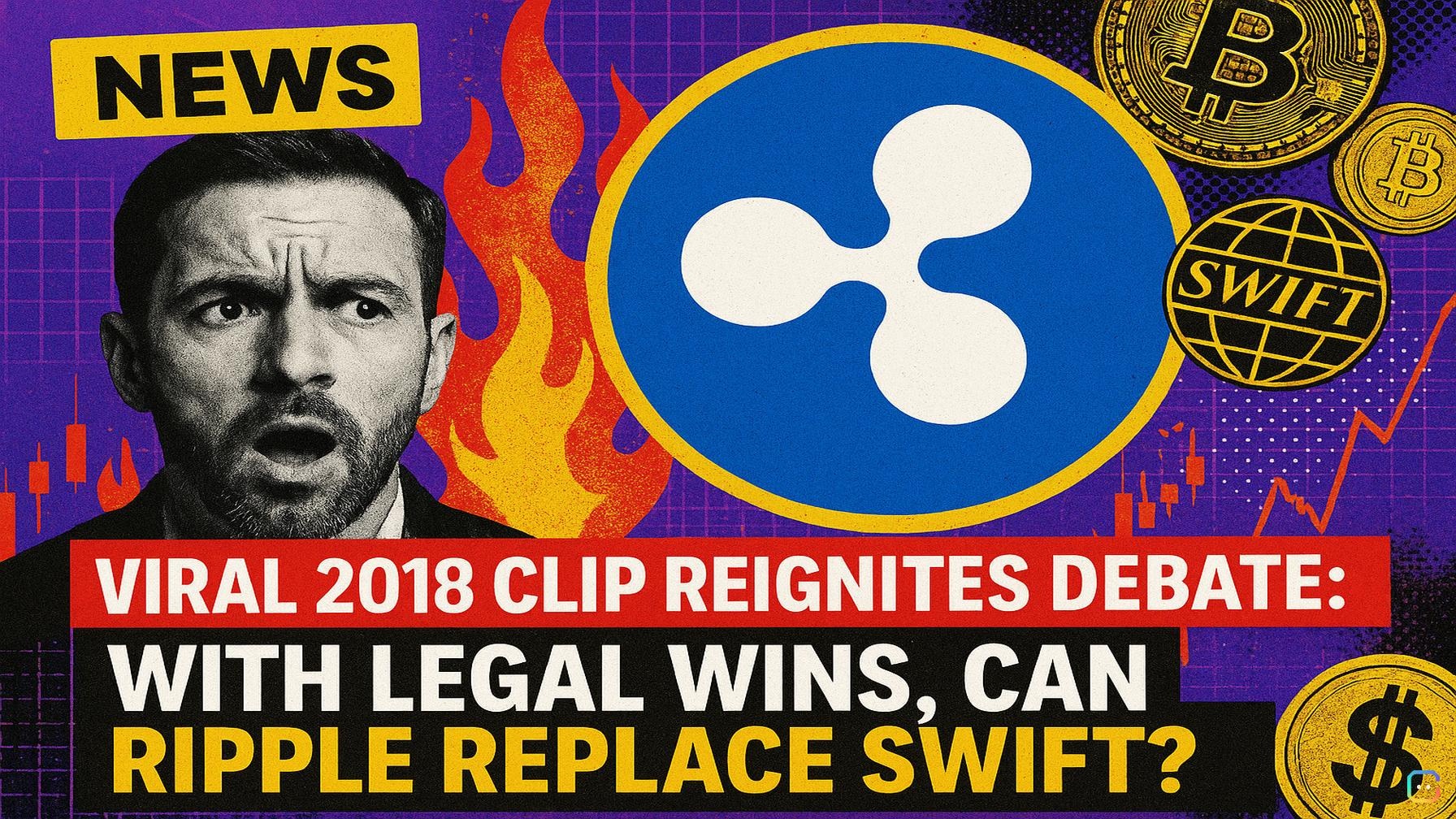
A resurfaced clip from 2018 is again putting Ripple in the headlines. In a Bloomberg interview, CEO Brad Garlinghouse confidently declared that Ripple was “taking over SWIFT” — a bold claim at the time, when the company was still aggressively positioning itself as a faster, cheaper alternative to the decades-old international payments network.
The 2018 moment
Garlinghouse’s calm, assertive reply — “I think what we’re doing and executing on a day-by-day basis is in fact taking over SWIFT” — underscored Ripple’s early growth strategy. He pointed to more than 100 bank relationships and said some of the largest SWIFT-enabled institutions were already using Ripple’s technology. He also cited a concrete example: a remittance provider that, after adopting Ripple’s platform, allegedly cut per-transaction costs from $20 to $2 and saw usage spike 800% overnight. That kind of instant scaling is exactly what Ripple has pitched as SWIFT’s weak spot.
Why the comparison matters
SWIFT has been the backbone of cross-border financial messaging since 1973, with entrenched trust, compliance and security standards. That legacy makes many skeptics question whether any newcomer can supplant it. Still, Ripple’s case centers on three practical shortcomings in today’s correspondent banking model:
- Speed: SWIFT-related transfers can take 1–5 days to settle; Ripple’s rails aim to settle transfers in seconds.
- Cost: Traditional correspondent transfers are frequently quoted at $25–$50 per transaction; Ripple’s institutional offering claims all-in costs as low as $0.001–$0.01 per transfer.
- Liquidity model: SWIFT transmits messages about money while relying on pre-funded Nostro accounts and intermediaries. Ripple’s On-Demand Liquidity (ODL) instead uses XRP as a bridge currency—converting sender fiat to XRP, moving it across the ledger, then converting it to recipient fiat—to avoid pre-funding and speed settlement.
How Ripple has changed since 2018
Since that interview, Ripple has evolved beyond a single-product payments pitch:
- Regulatory progress: The company has made significant legal and regulatory strides in recent years, including progress in its high-profile dispute with the U.S. Securities and Exchange Commission, which helped clarify parts of the firm’s regulatory standing.
- Product and ledger upgrades: Ripple has continued to develop the XRP Ledger (XRPL), rolling out security and feature updates to support more institutional use cases.
- Partnerships and expansion: Ripple reports hundreds of partnerships with banks, payment providers and remittance firms worldwide.
- Strategic acquisitions: The company has broadened its stack through purchases such as Hidden Road, Metaco and GTreasury, moving into custody, settlement, treasury management and other adjacent services.
- Banking status: Ripple has touted a recent milestone in engagement with U.S. regulators, including conditional approval from the Office of the Comptroller of the Currency (OCC) toward a national bank charter—an advance that, if finalized, would represent a major step toward traditional banking recognition.
What’s next — rivalry or collaboration?
Ripple’s trajectory suggests it is preparing to compete with, and in some cases complement, existing correspondent networks. Its strengths—faster settlement, lower quoted transaction costs and liquidity-on-demand via XRP—are clear selling points. Yet SWIFT’s decades of institutional trust, compliance infrastructure and global reach make any wholesale replacement a difficult prospect.
Crypto and traditional finance observers remain split: some see Ripple as the company best positioned to modernize cross-border payments; others view the entrenched banking ecosystem and regulatory complexity as major hurdles.
Bottom line
That now-viral 2018 clip captures both a moment of confidence and a longer-term strategic bet. In the years since, Ripple has grown into a broader financial infrastructure player, but the question Garlinghouse posed—can Ripple supplant SWIFT?—remains open. The answer will hinge on regulatory clarity, institutional adoption, and whether banks choose to compete with or integrate Ripple-style rails into the global payments stack.
Read more AI-generated news on: undefined/news