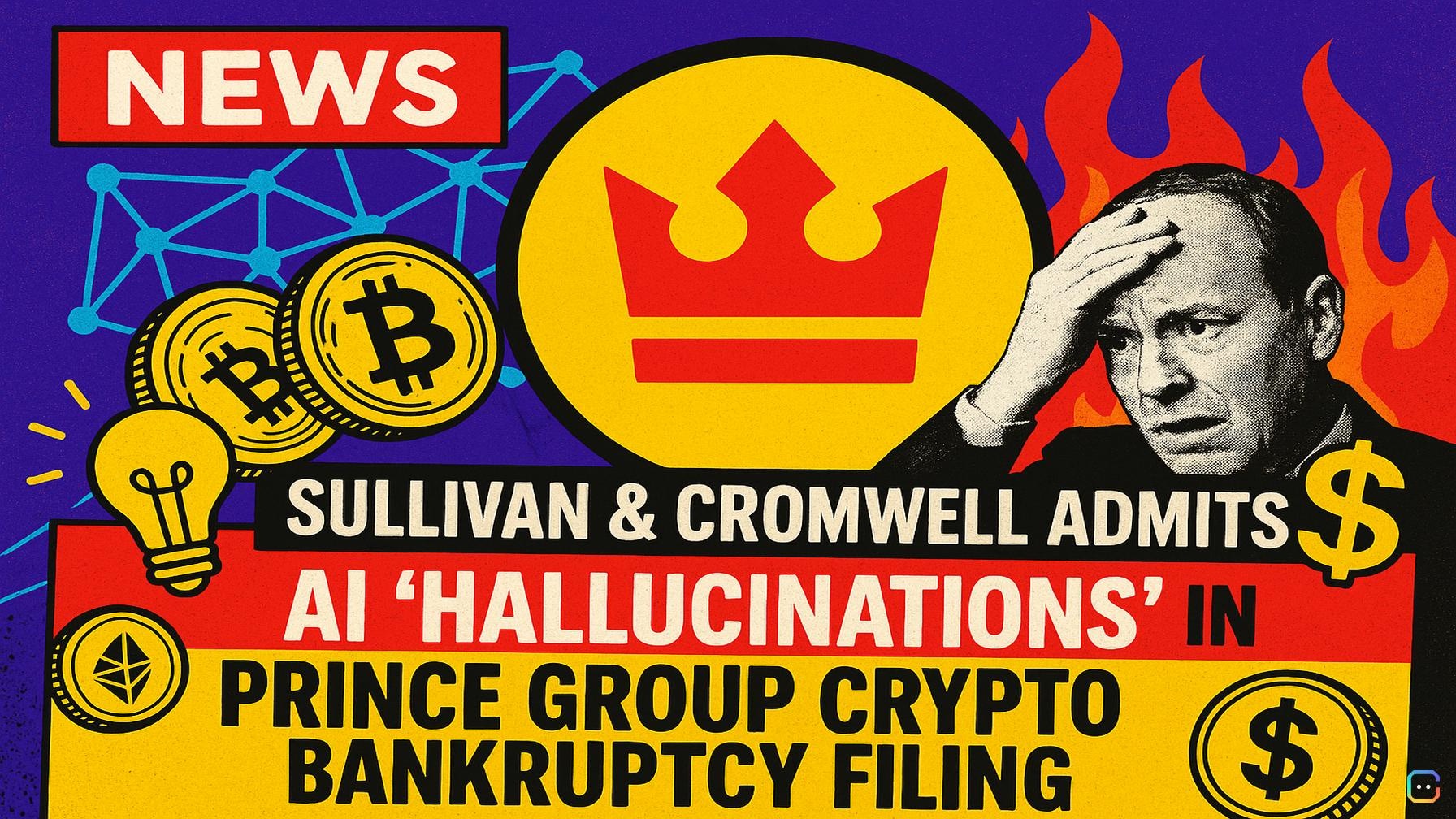
Headline: Sullivan & Cromwell admits AI “hallucinations” in bankruptcy filing tied to alleged crypto scam — withdrawal, revision follow
Sullivan & Cromwell has told a U.S. bankruptcy court that a recent filing in a high‑profile Chapter 15 case contained errors produced by artificial intelligence — including fabricated and mischaracterized legal citations. The disclosure came as the firm represents court‑appointed liquidators from the British Virgin Islands pursuing claims tied to Prince Group and its owner Chen Zhi, whom U.S. prosecutors allege ran large‑scale scam operations that siphoned billions in cryptocurrency.
What happened
- In a letter to Judge Martin Glenn in the Southern District of New York, Andrew Dietderich, head of the firm’s restructuring group, said an April 9 motion contained AI “hallucinations” that produced fictitious authorities and distorted others. The firm acknowledged its internal AI rules were not followed during preparation.
- Sullivan & Cromwell withdrew the original motion and has filed a corrected version after defendants and their counsel at Boies Schiller Flexner flagged the problems. Lawyers for Prince Group and Chen said the filing included misstatements of case law, citations that did not support the propositions attributed to them, and some references that appeared to have no basis. In one example, a cited case actually referred to a different decision in another circuit.
- In a separate filing, defendants said at least 28 citations were erroneous and included quotations attributed to courts that do not exist. They argued the late correction was prejudicial because it followed their objections and asked the court to adjourn a scheduled hearing and hold a status conference.
Case background
- The Chapter 15 proceedings seek U.S. recognition of the British Virgin Islands liquidators’ authority to act for creditors and alleged victims while they pursue recovery of cryptocurrency tied to Prince Group. U.S. authorities have linked Prince Group to large‑scale fraud operations in Southeast Asia; Chen Zhi was detained in Cambodia earlier this year and later repatriated to China. Prince Group has been sanctioned by the U.K. and U.S. governments.
Firm response and AI rules
- Sullivan & Cromwell said its policies require lawyers to complete two training modules before being granted access to generative AI tools; the modules emphasize the risk of AI “hallucinations” and instruct lawyers to “trust nothing and verify everything.” The firm said failing to independently verify AI output violates firm policy.
- A broader internal review found additional minor drafting issues in other filings, which the firm attributed to human error rather than AI misuse. The firm did not identify the lawyers who prepared the original motion.
Wider implications for law and crypto recoveries
- The episode is the latest in a string of AI‑related legal missteps as firms experiment with generative tools to speed research and drafting. Courts in several jurisdictions have recently criticized or sanctioned submissions containing fabricated or inaccurate references produced by AI. In Australia last year, a lawyer lost the ability to practise as a principal over AI misuse.
- Judges and law schools are responding: senior jurists have warned that misuse could undermine the integrity of proceedings, and some law schools now require instruction on AI. Courts are also grappling with privacy and privilege questions around interactions with AI — even as a few pilot AI systems to help manage caseloads.
Why it matters for crypto news readers
- Errors in filings can delay or complicate high‑stakes efforts to repatriate alleged ill‑gotten crypto funds and may give defendants tactical grounds to seek adjournments or challenge procedures. The incident also highlights operational risks law firms face when using generative AI in complex litigation that involves large sums of digital assets and cross‑border enforcement.
The court will decide how to proceed on scheduling and whether the correction process altered the parties’ rights or timing for the Chapter 15 matter.
Read more AI-generated news on: undefined/news