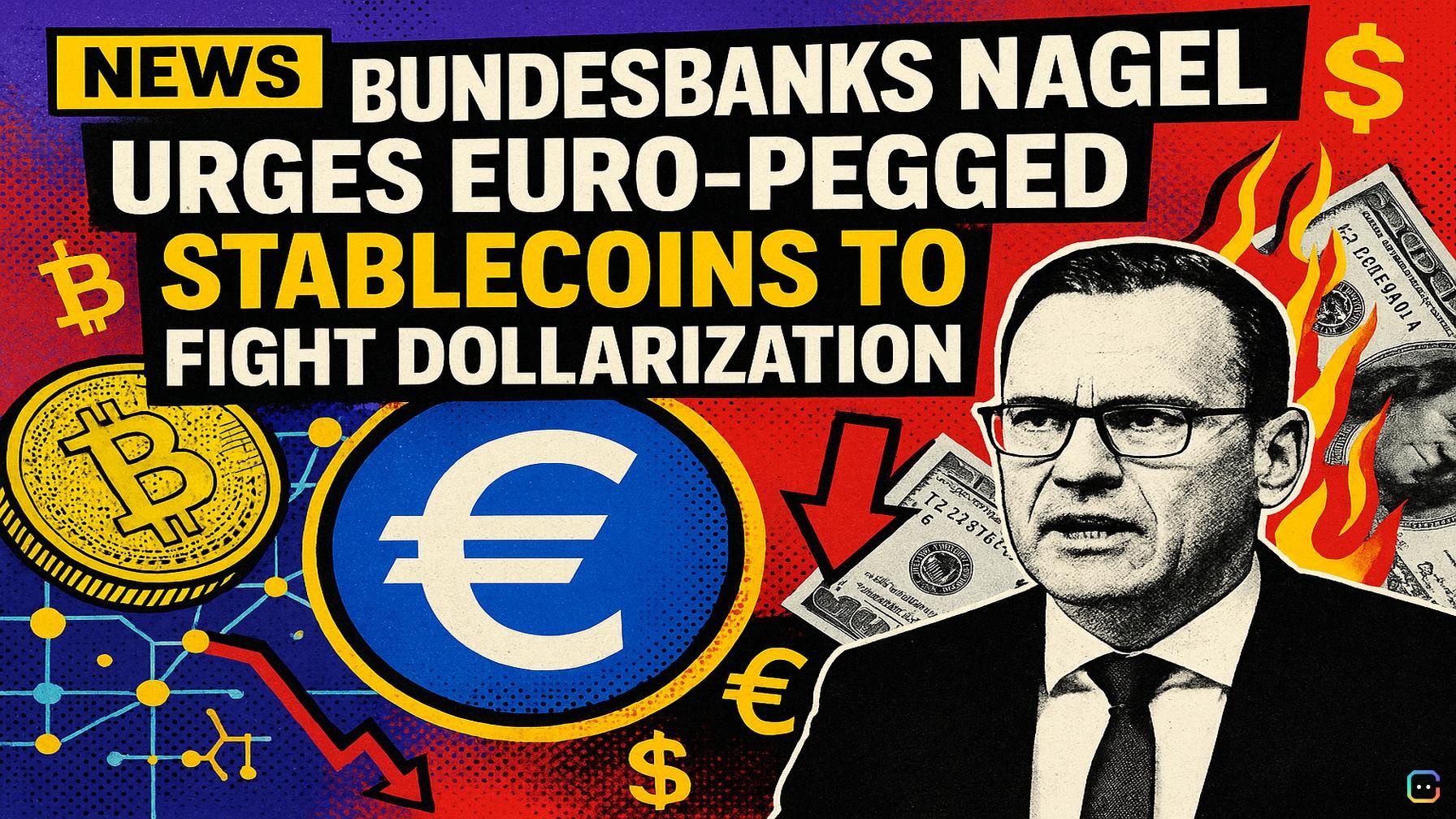
Bundesbank president Joachim Nagel is pushing for euro-pegged stablecoins as part of a broader strategy to safeguard the euro’s international role—and to blunt the risk of “dollarization” through USD-backed tokens.
Speaking at the American Chamber of Commerce in Germany, Nagel (also an ECB Governing Council member) argued Europe should “channel efforts into supporting the international role of the euro,” including by building European payment rails and exploring euro-denominated stablecoins. He said such tokens could be “used for cross-border payments by individuals and firms at low cost,” improving remittances and payment efficiency while protecting monetary sovereignty.
Nagel warned that a large-scale switch to USD-pegged stablecoins would amount to a form of dollarization: “A hypothetical replacement of a domestic currency with [USD-pegged] stablecoins would be equivalent to a dollarisation of the corresponding economy,” he said, noting this could sharply reduce the effectiveness of domestic monetary policy and weaken European sovereignty.
To respond, Nagel said the ECB and national central banks are weighing several digital-era tools. These include a wholesale CBDC—intended for institutional actors to execute programmable transactions in central bank money—and use of distributed ledger technology for non-central-bank money like tokenized deposits and euro-denominated stablecoins. He argued that both wholesale CBDCs and euro-pegged stablecoins would help the Eurosystem “utilise cutting-edge digital technologies to maintain our monetary policy effectiveness in an uncertain geopolitical future.”
Nagel reiterated these themes in a speech in Germany on Monday, and reminded listeners that the ECB is developing a digital euro described as “the first pan‑European retail digital payment solution, based solely on European infrastructures.” The ECB currently aims to launch the digital euro in 2029, though the project has provoked debate: German Vice-Chancellor Lars Klingbeil recently warned delays are “harming” Europe, while the European Parliament approved an amendment to include both online and offline functionality for the CBDC—a shift from its earlier preference for offline-only payments.
Not everyone welcomes stablecoins unreservedly. Economic author and journalist Paul Blustein told Decrypt that stablecoins risk violating the “singleness of money” and could enable dollarization in developing countries that would hamper central banks’ control over money supply. However, Blustein downplayed the immediate dollarization threat for Europe, saying “I don’t think the dollarization threat is nearly as big a deal for Europe as it is for developing countries. Europeans generally have confidence in the euro and the ECB.” He suggested Europe should accelerate tokenized deposits—an alternative he believes “don’t have the drawbacks” of stablecoins and could reveal stablecoins’ weaknesses.
From industry, Matt Osborne, Policy Director for UK & Europe at Ripple, urged a pragmatic view: he described the future as a “mixed money ecosystem” and said the EU “needs global stablecoins.” Osborne argued concerns over monetary sovereignty should not be overstated, noting the euro’s strength and the existing widespread use of the dollar in cross-border trade; USD-backed stablecoins, he suggested, can make those use cases more efficient and serve as complements rather than threats to the existing monetary system.
Blustein also flagged practical risks: beyond monetary-policy concerns, he warned stablecoins could facilitate illicit finance—despite blockchain transparency—because criminals can exploit self-hosted wallets, mixers and other tools to evade AML/KYC controls.
The debate captures a wider policy tension: Europe is racing to modernize its payments architecture and defend the euro’s standing while weighing the trade-offs of stablecoins, tokenized deposits and CBDCs. Policymakers will need to balance innovation, cross‑border efficiency and financial integrity as they decide which digital instruments to adopt.
Read more AI-generated news on: undefined/news