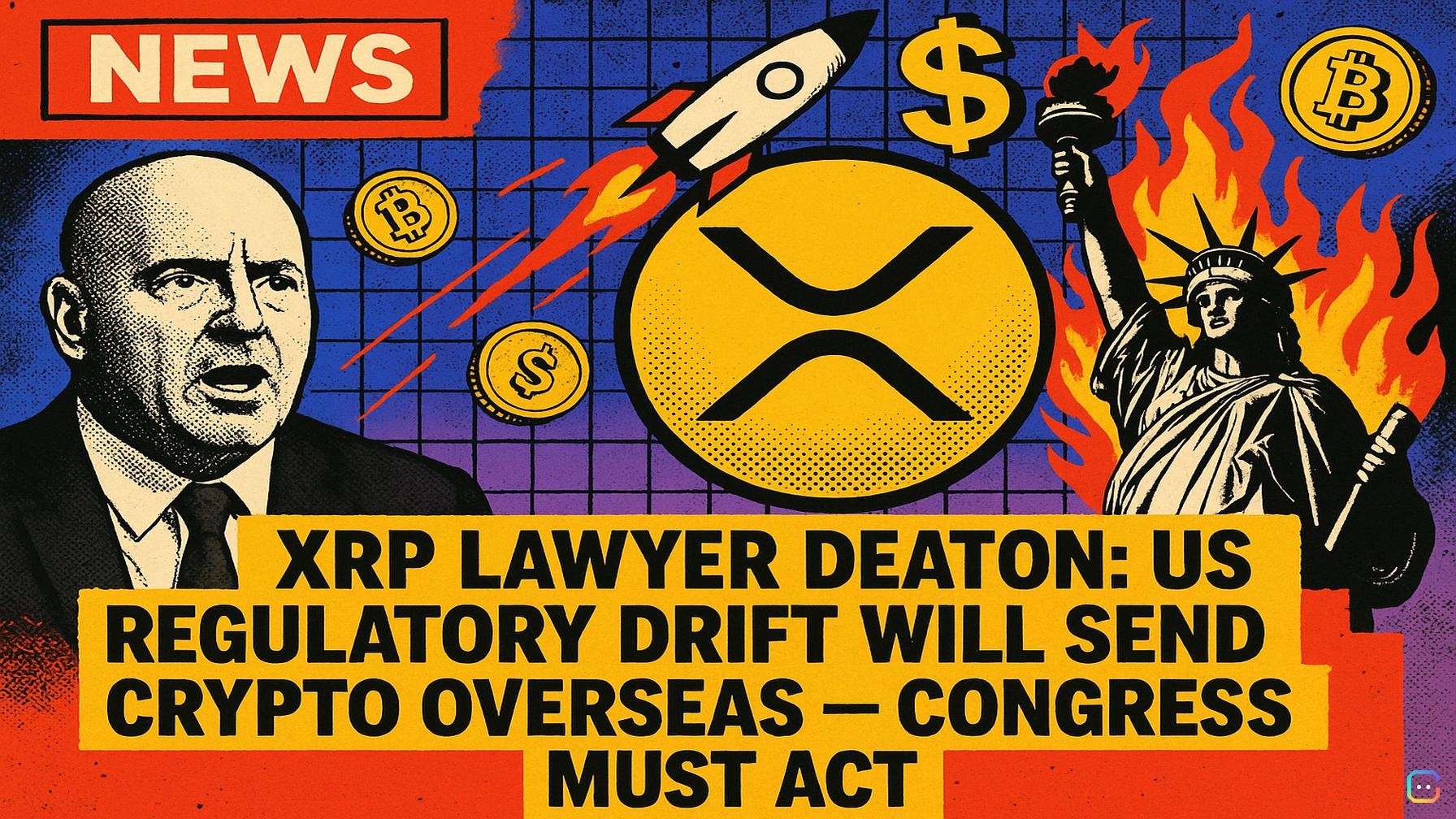
John Deaton, the U.S. attorney who defended XRP holders in the SEC v. Ripple saga, fired a broadside at the direction of U.S. crypto policy this week — warning that Washington’s regulatory drift could drive the industry overseas unless Congress acts.
Deaton’s comments came in a long post on X responding to Ripple CEO Brad Garlinghouse’s Fox Business interview with Maria Bartiromo. In that interview, Garlinghouse cautioned that continued regulatory uncertainty and aggressive enforcement risk will push American companies, talent and capital to friendlier jurisdictions — and urged lawmakers to prevent “another Gary Gensler moment.”
“American companies and our financial markets cannot afford to experience Gensler 2.0. And the only way to guarantee that we don’t — is by passing legislation,” Deaton wrote, echoing Garlinghouse’s central point.
Why it matters
- Enforcement-first policy: Deaton argues that current and past SEC tactics under Chair Gary Gensler — relying on enforcement rather than clear rulemaking — have left the industry treating most tokens as potential securities by default. That posture, he says, forces projects and investors into a perpetual defensive mode.
- CBDC fears and legal solutions: Against the backdrop of high-profile debates — including a contentious fight over a presidential CBDC ban order — Deaton warns that only explicit congressional legislation can block a surveillance-style central bank digital currency or prevent future regulatory overreach. Agency guidance, he notes, can be reversed by a change in administration; statutory law cannot.
- Political backdrop: Deaton closed by pointing to what he sees as relevant political realignments: Elizabeth Warren is set to chair the Senate Banking Committee, which oversees the SEC. Warren has positioned herself as a tough regulator of Wall Street and an active critic of crypto, backing measures like the Digital Asset Anti‑Money Laundering Act and other amendments that critics say favor banks and constrain digital-assets development.
Shared warnings
Both Deaton and Garlinghouse contend that regulatory drift is already pushing talent, liquidity and innovation offshore, and that unclear treatment of tokens (including XRP even after litigation) is moving capital into assets perceived as lower enforcement risk. They argue that meaningful, bipartisan legislation is the only durable way to restore certainty and keep next-generation financial infrastructure in the U.S.
Context: Ripple’s long legal fight with the SEC — along with other high-profile enforcement actions involving projects like LBRY and companies such as Coinbase — forms the backdrop for these concerns. Deaton frames those actions as illustrative of the risks of regulation by enforcement.
Images: cover image from Perplexity; XRP/USDT chart from TradingView.
Read more AI-generated news on: undefined/news