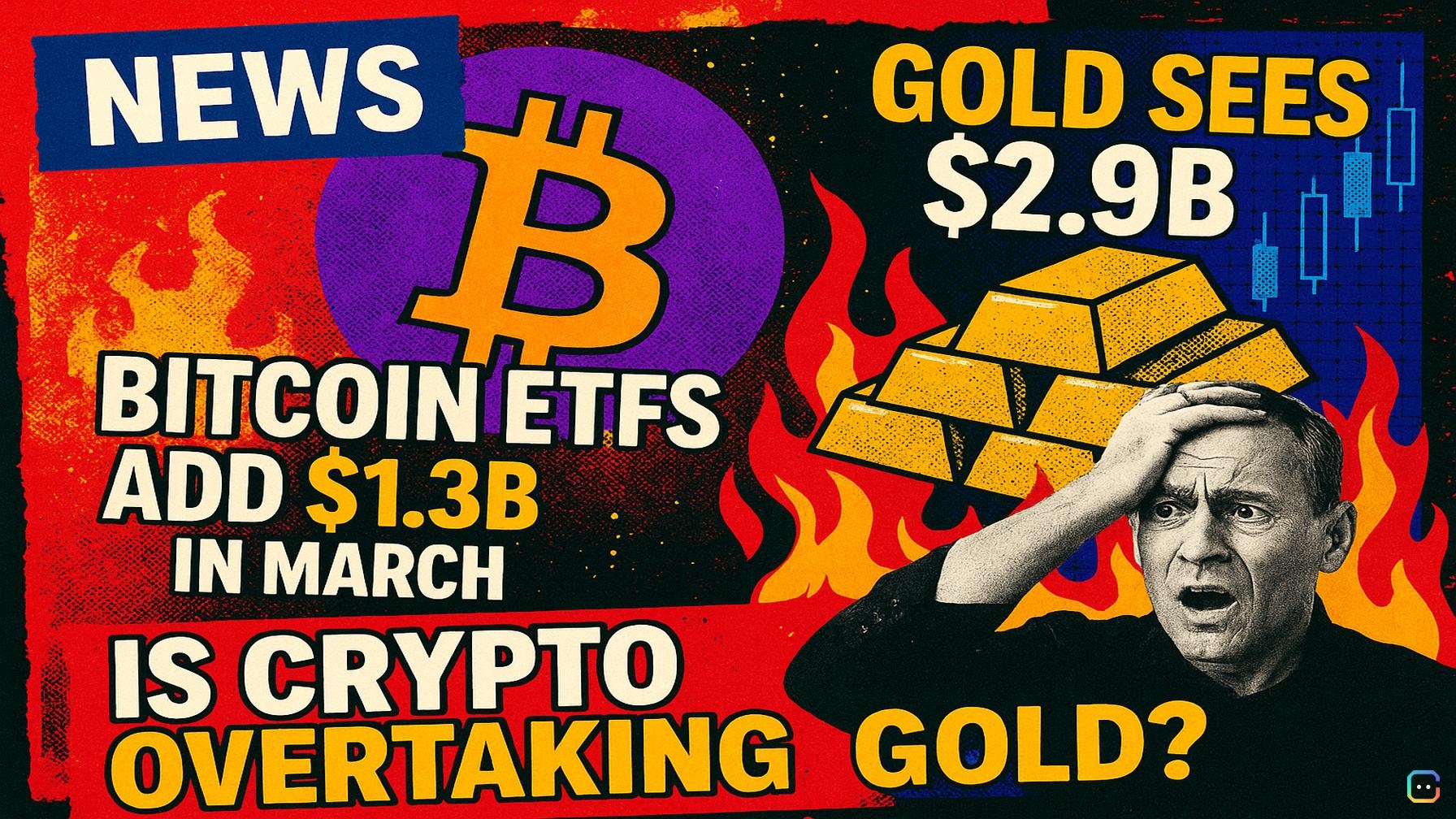
Bitcoin ETFs quietly pulled in more cash in March even as gold funds saw heavy redemptions — a divergence that’s catching the market’s attention.
Key numbers
- US spot Bitcoin ETFs: $1.32 billion net inflows in March.
- US-based gold ETFs: $2.92 billion net outflows in March.
- GLD (largest US gold ETF) had a dramatic $3 billion single-day outflow on March 4 — its biggest in more than two years.
Why it matters
Bloomberg ETF analyst James Seyffart flagged the trend on the Coin Stories podcast, saying the move looks like more than a monthly blip. His thesis: investors are starting to treat Bitcoin as a multi-purpose portfolio instrument, whereas gold remains primarily a hedge against inflation and currency debasement.
“As an asset, Bitcoin has more use cases,” Seyffart said. Some investors buy it as a store of value, others as a growth or liquidity bet, or as “digital property.” He even called it “hot sauce in a portfolio” — a volatile, high-upside ingredient that can boost returns for those willing to accept the risk. Based on that view, Seyffart expects Bitcoin ETFs to eventually eclipse gold ETFs in assets under management — a big shift given gold’s current lead.
What else is happening
- Data cited from the Bank for International Settlements in mid‑March showed accelerating gold sales by Wall Street over the prior four months, even as retail buyers were purchasing gold at roughly three times the pace seen six months earlier.
- Despite the flow divergence, both assets were down over the trailing month at the time of the report: Bitcoin ~ $66,889 (down ~7.35% over 30 days) and gold ~ $4,674 (down ~8.20%).
Market context and outlook
Analysts note gold and Bitcoin have a history of alternating leadership. Chris Kuiper pointed out that after gold’s outperformance in 2025, a rotation back to Bitcoin wouldn’t be surprising. Whether that rotation happens remains uncertain, but March’s ETF flows suggest at least some investors are already reallocating capital into Bitcoin exposure.
Takeaway
The March data doesn’t prove a permanent regime change, but it does highlight an evolving narrative: institutional and retail allocations may be broadening beyond traditional inflation hedges toward crypto-linked tools that serve multiple roles in portfolios. Watch ETF flows, AUM rankings, and whether price correlation between gold and Bitcoin persists — they’ll tell you whether this was a one-off or the start of a longer-term shift.
Read more AI-generated news on: undefined/news