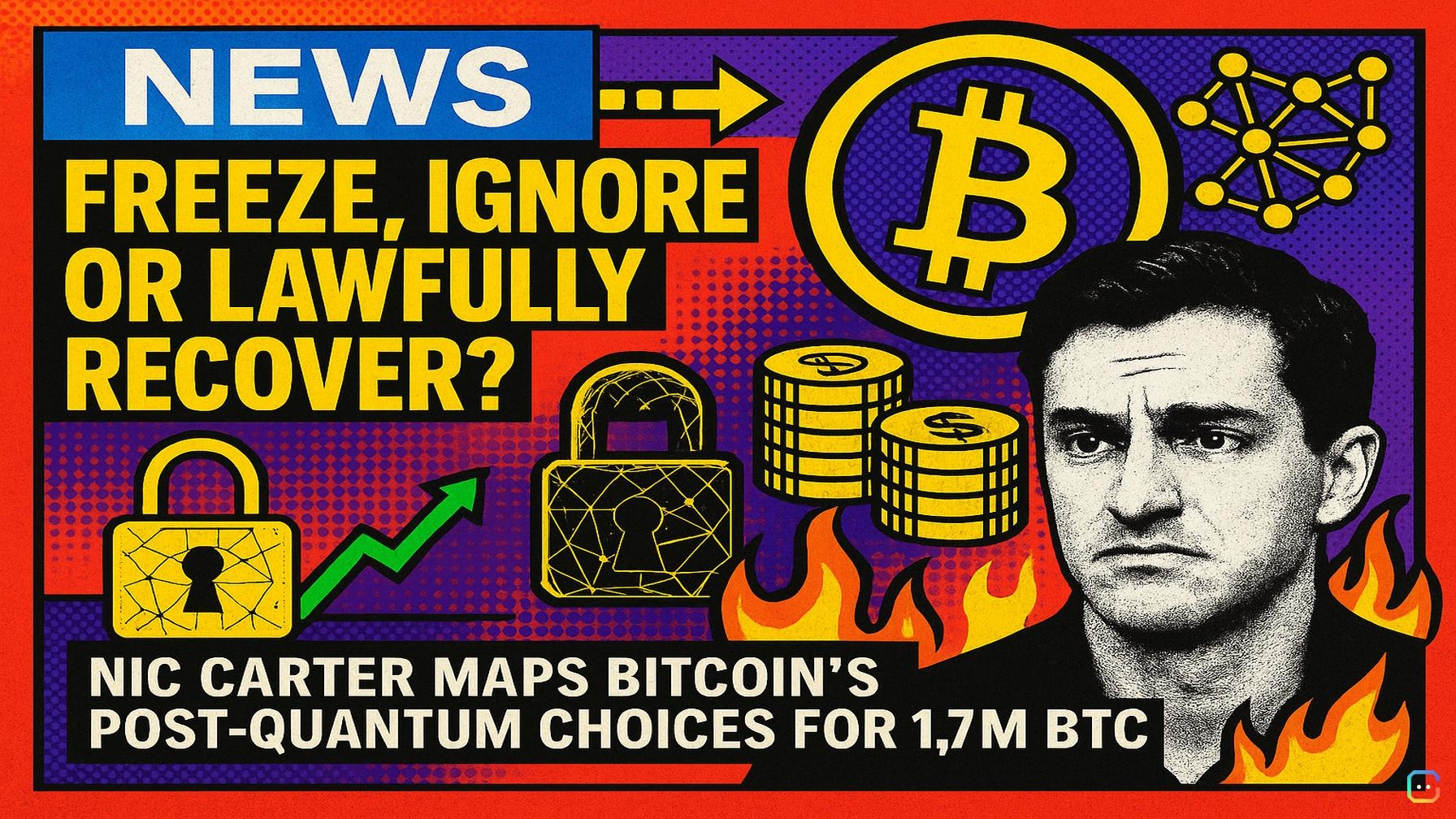
Nic Carter, founding partner at Castle Island Ventures, has mapped out three realistic futures for Bitcoin as the network contends with the coming age of post‑quantum cryptography — and the stakes could be huge.
In a series of posts on X, Carter warned that roughly 1.7 million BTC locked in old pay‑to‑pubkey (p2pk) outputs could become vulnerable if Bitcoin ever deprecates elliptic‑curve signatures (ECDSA/Schnorr) and a “cryptographically relevant quantum computer” (CRQC) emerges. What until recently was dismissed as a fringe concern, he wrote, is rapidly becoming a mainstream engineering and governance problem for a monetary system built entirely on cryptography.
How the transition might play out
Carter lays out the likely technical path: a soft fork introduces support for post‑quantum signature schemes while allowing existing elliptic‑curve signatures to coexist for a time. Eventually, legacy signatures would be disallowed entirely, forcing everyone to migrate to post‑quantum schemes. That migration phase is the easy part, he says — the hard question is: what happens to coins that never move?
Three plausible policy outcomes
Carter frames the debate as three plausible responses:
- Freeze vulnerable coins. Institutions, custodians, exchanges and fiduciaries could demand freezing non‑migrated outputs to neutralize the risk that a hostile quantum actor recovers dormant keys (including Satoshi’s) and dumps them into the market. These actors, Carter argues, would likely find any other outcome unacceptable.
- Do nothing. A laissez‑faire approach would leave the protocol unchanged and accept the consequences if some addresses are later compromised. Purists argue that protocol‑level manipulations to recover or freeze funds would violate Bitcoin’s monetary and political principles — “Satoshi set 21 million,” Carter paraphrases the line of thinking, and the protocol shouldn’t perform selective “irregular state changes” as happened in other communities.
- Legal salvage (Carter’s preferred “secret third thing”). Under this scenario, a domestic quantum leader (e.g., Google or IBM) that first builds a CRQC would work with the U.S. government and the courts to lawfully recover vulnerable coins. Rather than taking ownership, the firm would be appointed a court‑authorized custodian or neutral receiver, tasked with securing the assets and returning them to rightful owners where possible, or holding them in trust pending judicial disposition.
Politics, market concentration and the likely outcome
Carter argues the freeze camp may be likelier to prevail than many Bitcoiners expect. Since the blocksize wars of 2015–2017, Bitcoin’s economic power has become concentrated in ETFs, custodians, exchanges and large asset managers — what he calls “economic nodes” with meaningful leverage. He also notes that several influential technical figures have already signaled support for freezing vulnerable coins if a genuine quantum threat materializes.
Still, Carter stresses that an outright protocol‑level confiscation would be deeply divisive. In his ranking, lawful legal salvage is the best outcome, a freeze is second‑best, and doing nothing is the worst. “If Bitcoin really does freeze the coins, then something about Bitcoin will truly have died,” he wrote. “It would survive, but it will be forever changed.”
Why it matters
The conversation matters not only for Bitcoin’s cryptographic roadmap but for governance and the social contract that underpins the network. How the community handles post‑quantum risk will test the balance between technical safety, legal authority and ideological commitments to immutability.
At press time, Bitcoin traded at $74,795.
Read more AI-generated news on: undefined/news