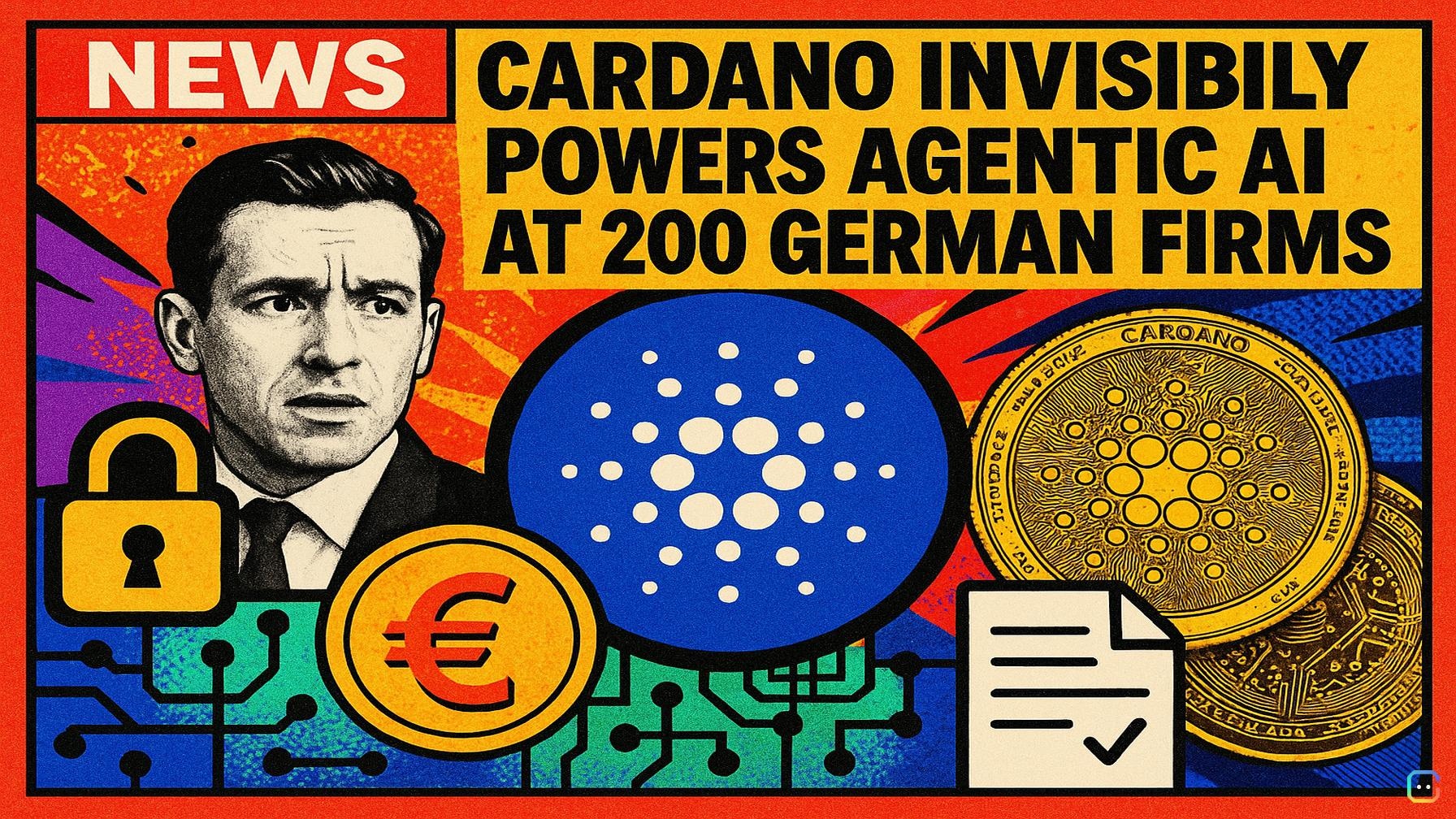
Cardano is quietly powering agentic AI deployments at roughly 200 large German companies, often without those firms realizing the blockchain sits beneath their stacks, Cardano Foundation CEO Frederik Gregaard told Jane King on GBBC’s Markets on Chain series from the New York Stock Exchange (interview published April 16).
Gregaard described a model of blockchain adoption that’s invisible to end users but deeply embedded in enterprise infrastructure. “We have about 200 companies in Germany who live on agentic AI, fairly large companies, and they don’t even know they’re using Cardano as a security layer, as a digital identity layer and as an accountability layer,” he said. In his view, Cardano is being used to verify AI agents’ identities, validate data provenance without exposing private data, and provide auditable accountability for AI-driven decisions.
Beyond identity and provenance, Gregaard said some of these systems already use a regulated stablecoin called USDM for microtransactions between AI agents. “The AIs are actually paying themselves using regulatory compliant stablecoins,” he said, explaining that tiny payments are used to meter prompt activity and discourage any single database or agent from abusing compute resources or bypassing security.
Regulatory clarity is central to scaling this model, Gregaard added. He argued the U.S. GENIUS Act has nudged U.S. policy closer to Europe’s MiCA regime, but that the proposed Clarity Act could be a bigger catalyst—potentially unlocking much broader non-financial blockchain use cases once legal certainty arrives. Gregaard claimed recent regulatory language has clarified that “Cardano is a commodity,” and suggested the U.S. might move faster than Europe on some aspects of policy.
Security and governance were another focus. Gregaard highlighted Cardano’s on-chain governance and distributed validator base as protections against single points of failure, contrasting this with networks he said are effectively controlled by a small group of insiders. He also pitched Cardano as emerging “as a first level quantum secure environment” thanks to interoperability with legal-entity identity standards—a feature he says is attracting interest from banks, brokers, exchanges and central securities depositories.
The takeaway: Gregaard’s picture is of Cardano operating as an invisible trust, identity and compliance layer for AI-native enterprise systems—handling provenance, identity and payments in the background while consumer-facing apps remain seamless.
At press time, Cardano (ADA) traded at $0.2566.
Read more AI-generated news on: undefined/news