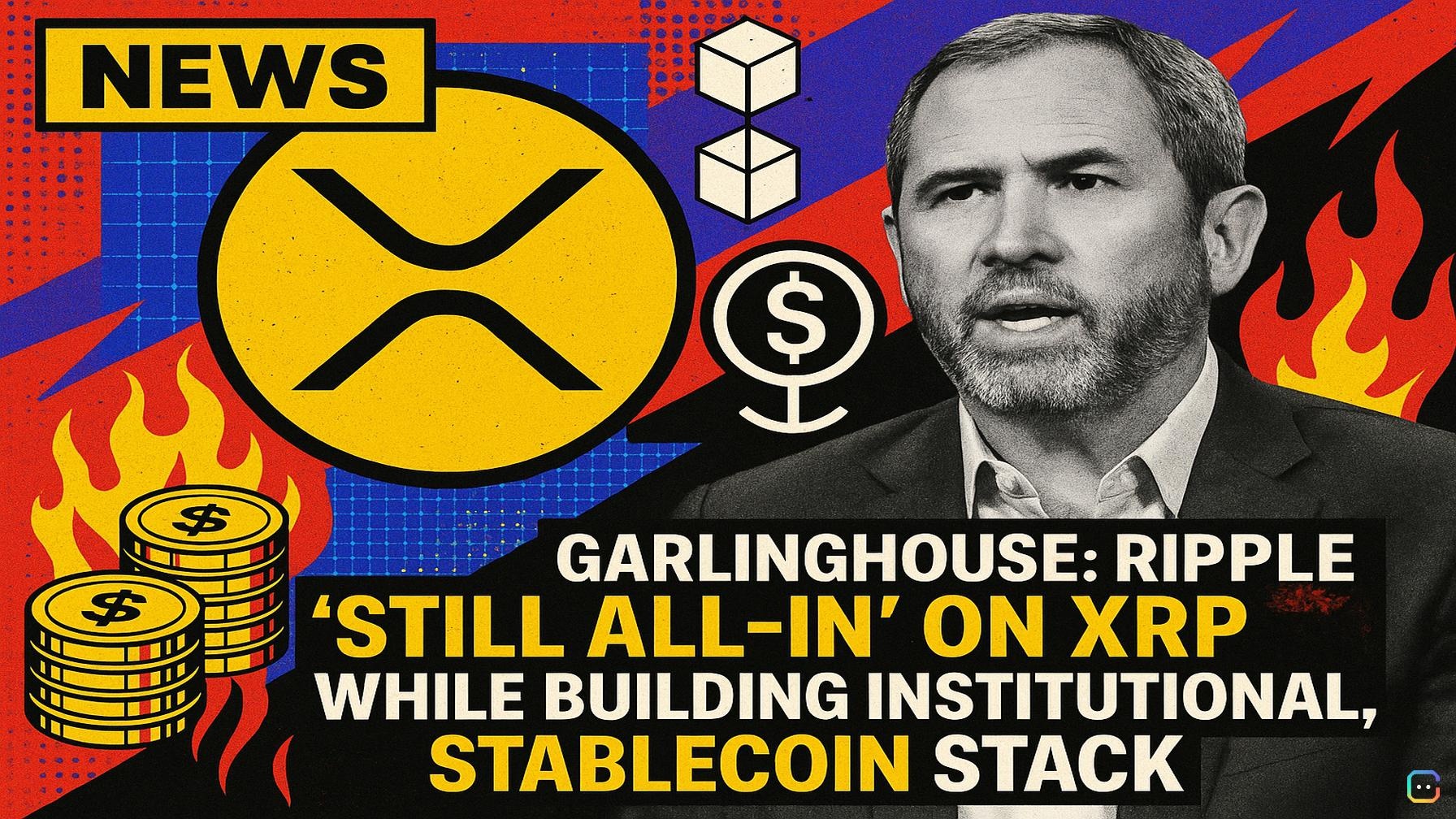
At XRP Las Vegas on April 30, Ripple CEO Brad Garlinghouse used a high-profile appearance to blunt growing doubts about the company’s commitment to XRP — arguing that Ripple remains economically and strategically tied to the token even as it broadens into institutional finance, stablecoins and regulated U.S. infrastructure.
Garlinghouse said criticism that Ripple has “moved on” from XRP is “funny and strange,” noting the company is still the largest holder of the token and “the most interested party in seeing XRP be successful.” He framed Ripple’s mission in three clear goals for the asset: make XRP the most useful, the most liquid and the most trusted digital asset — a positioning he tied directly to enterprise offerings like Ripple Prime and Ripple Treasury.
The CEO acknowledged that some of Ripple’s moves — including work on stablecoins such as RLUSD and an expanding suite of institutional products (custody, treasury services, prime-brokerage-style offerings and market infrastructure) — may not look like direct endorsements of XRP at first glance. But he insisted those efforts are part of a broader strategy to grow liquidity, utility and trust in XRP, even if the path isn’t always a straight line. “We’re going to do things that may not at first blush make crystal clear sense,” Garlinghouse said, “but it’s all in service of how do we… drive in liquidity, utility, and trust in XRP.”
That balancing act reflects Ripple’s evolution: the company is no longer just defending XRP in court or promoting a single payments narrative. It is building a diversified institutional stack while asking the XRP community to view custody, tokenization and stablecoin initiatives as connected pieces of the same liquidity network. Garlinghouse noted Ripple now has about 1,500 employees and is having a record year across multiple areas.
On tokenization, Garlinghouse pointed to real-world use cases where the XRP Ledger could play a role even if Ripple isn’t the direct operator. He singled out bond settlement as an example of an antiquated market ripe for on-chain transformation: “Bond settlement is slow, it is arcane, and it is absurd to think about how that works in a world of the internet,” he said, predicting it’s only a matter of time before such assets move on-chain.
Policy and regulation dominated much of the conversation as well. Garlinghouse reiterated Ripple’s support for the Clarity Act — U.S. legislation aimed at giving clearer rules to digital assets — arguing the bill would boost institutional confidence. He stressed, however, that XRP already enjoys legal clarity thanks to the court fight with the SEC: “We have a federal judge [who] said in her opinion, XRP in and of itself is not a security. Boom. We have clarity.” He added that Ripple’s frustration in Washington stems more from concern for the broader industry than its own status.
Garlinghouse warned the legislative window is tight: if the Clarity Act doesn’t move out of the Senate Banking Committee by the end of the third week of May, “we’re in real trouble.” He said that while progress stalled after Coinbase CEO Brian Armstrong urged caution, bipartisan support in the Senate could still carry the bill if it clears committee.
On stablecoins and oversight, Garlinghouse confirmed that Ripple’s conditional OCC trust-charter approval is tied to its stablecoin strategy, particularly RLUSD, and described dual supervision by the New York Department of Financial Services and the OCC as a “belt and suspenders” approach. He said Ripple aims to be “the most white hat around stablecoins as possible” given its institutional customer base. A Federal Reserve master account is also “very much on our radar,” he added, calling it a potential “big unlock” for Ripple and for U.S. financial infrastructure.
The panel ranged widely — from Ripple’s Las Vegas ad push and private-market valuation to its relationship with the XRP community — but Garlinghouse’s central message was consistent: Ripple remains invested in XRP’s success, even as it builds many pieces of a broader institutional ecosystem.
At press time, XRP traded at $1.37.
Read more AI-generated news on: undefined/news