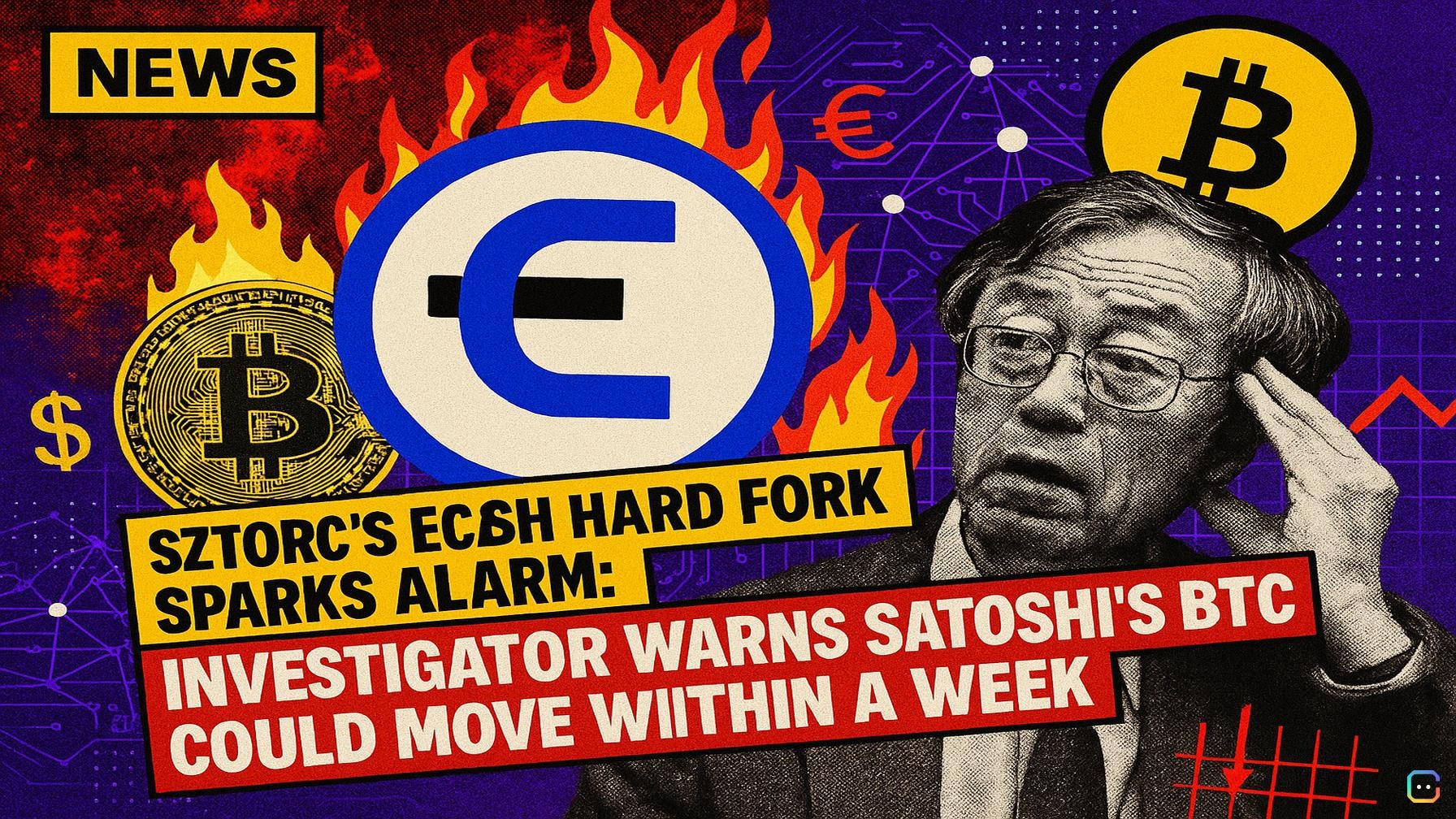
On-chain investigator Tyler has sounded the alarm over a proposed Bitcoin hard fork—claiming Satoshi Nakamoto’s BTC stash could be at risk within a week of the split—after LayerTwo Labs founder Paul Sztorc unveiled plans for a new chain called “eCash.”
What’s being proposed
- Paul Sztorc says eCash will launch this August as a Bitcoin hard fork. He describes its L1 node as a near-copy of Bitcoin Core that remains SHA256d‑mined.
- The fork would perform a one-time difficulty reset to the minimum value; Sztorc says this will make mining “very difficult at the beginning.”
- LayerTwo Labs plans to change seed nodes, the network magic, and the chain name, and to initially replay all transactions on the new chain. They also intend to publish a coin-splitter tool so BTC holders can claim their corresponding eCash balances.
- Investors would receive an eCash balance equivalent to their BTC holdings, according to Sztorc, who framed eCash as “a permanent, sustainable fix for BTC’s problems.”
Why Satoshi’s coins are in the conversation
Tyler warned on X that Satoshi’s well-known BTC addresses might be moved soon after the proposed fork—stoking community concern. Crypto educator DBCrypto suggested the proposal could be a pretext to access Satoshi’s coins and criticized proponents for undermining on-chain privacy.
Sztorc’s response
Sztorc has publicly denied any intent to touch Satoshi’s BTC. He said eCash developers won’t control BTC private keys and therefore cannot move BTC balances. Instead, he said they plan to “gift” the BTC creator 600,000 eCash (not the roughly 1.1 million BTC attributed to Satoshi). He argued this amount exceeds what Satoshi allegedly received from other projects such as Litecoin, Ethereum, Solana and Tether. Sztorc also explained that eCash balances would be generated to mirror BTC movements—i.e., eCash moves when the holder moves BTC—but selling eCash would not replay back onto the Bitcoin network.
Community and technical implications
- The proposal renews debates about hard forks, replay protection, and how to safely split coins without compromising keys or privacy.
- Sztorc’s plan to replay transactions and provide a coin-splitter aims to reduce confusion for holders, a distinction he drew versus past forks like Bitcoin Cash.
- Questions remain about initial mining dynamics after the proposed difficulty reset, as well as how exchanges, custodians, and wallet providers would handle the split.
Market snapshot
At the time of writing, Bitcoin is trading around $77,000, up over the past 24 hours, per CoinMarketCap.
Bottom line
Sztorc’s eCash proposal has reignited fierce community debate—between those who welcome a Bitcoin-derived alternative with built-in replay and splitter tools, and those who fear any hard fork could put dormant, high-profile BTC balances under unusual scrutiny. As August approaches, the project’s technical details and the community’s response will determine whether eCash gains traction or remains a controversial proposal.
Read more AI-generated news on: undefined/news