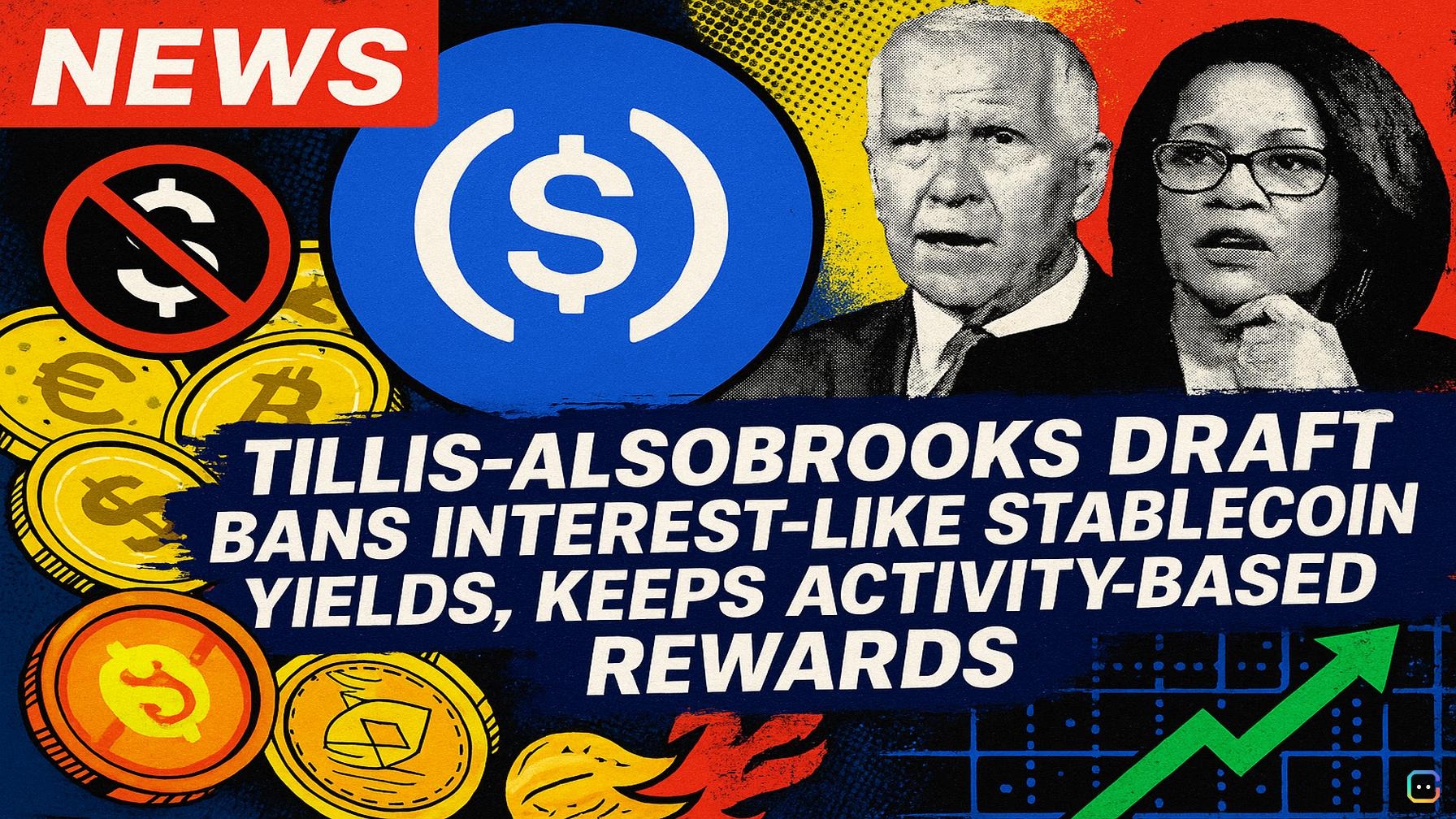
A newly released compromise over the Digital Asset Market Clarity Act would let crypto firms keep offering rewards tied to activity, while explicitly blocking stablecoin yields that look like bank deposit interest — a deal that could finally clear the way for a Senate Banking Committee markup.
What was released
Senators Thom Tillis (R-N.C.) and Angela Alsobrooks (D-Md.) circulated text Friday that would bar stablecoin issuers from paying yield “solely in connection with the holding of such restricted recipient’s payment stablecoins” or in any way that is “economically or functionally equivalent to the payment of interest or yield on an interest-bearing bank deposit.” The language frames the policy as protecting depository institutions — asserting that stablecoin issuers offering bank-like services “may inhibit” those institutions — while carving room for crypto-native rewards programs.
What is allowed — and what isn’t
- Prohibited: Paying interest or yield just for holding stablecoins, or paying in a way that effectively replicates bank deposit interest. Loyalty-style programs that amount to the same are also restricted.
- Allowed: Incentives tied to “bona fide activities or bona fide transactions” — for example, rewards for real participation on platforms or network activity, akin to credit-card or activity-based rewards. The text explicitly preserves activity-based incentives that reward use rather than passive holding.
Regulatory follow-up and scope
The bill directs the Treasury Department and the Commodity Futures Trading Commission to complete rulemaking within one year of enactment to define how and when crypto firms can offer yield. That rulemaking language, plus anti-evasion provisions in the draft, gives regulators notable latitude — they can consider factors such as balance, duration, tenure, the defined activity, and incentive structure when judging whether a program is permissible.
Industry reaction
- Coinbase: CEO Brian Armstrong urged lawmakers to “Mark it up,” signaling support for moving the bill forward. Coinbase’s chief legal officer Paul Grewal said the language “preserves activity-based rewards tied to real participation on crypto platforms and networks,” and suggested it shouldn’t be an obstacle to the bill’s passage.
- Trade group: Digital Chamber CEO Cody Carbone called the public release “an important step” toward resolving a major final issue and said the group will continue to advocate for rewards as a driver of consumer utility, competition, and innovation.
- Consumer advocates: Corey Frayer of the Consumer Federation of America warned the rulemaking wording could give regulators room to allow crypto firms to run activities and then pay returns back to customers, depending on how terms are interpreted.
- Crypto insiders: One industry source said firms will likely need to shift from “buy-and-hold” rewards toward “buy-and-use” models to meet the transaction-focused caveats, though exactly how that will look depends on forthcoming regulations.
What’s next
The Tillis–Alsobrooks text resolves one of the thorniest disputes that stalled a Banking Committee markup in January, which prompted months of negotiations involving lawmakers, bank lobbyists and crypto companies — including talks hosted at times by the White House. While releasing this language makes a markup more likely, other negotiation points remain unresolved behind the scenes.
Bottom line
The draft represents a middle path: it aims to protect banks from deposit-analog competition while letting crypto platforms continue to incentivize real network and product activity. The details will be shaped decisively by the post-enactment rulemaking — which could either preserve a broad set of activity-based rewards or narrow them considerably depending on how regulators interpret terms like “bona fide activities” and “economically equivalent.”
Note: This story incorporates comments from Coinbase executives and additional reporting following the May 1 release of the proposed text.
Read more AI-generated news on: undefined/news