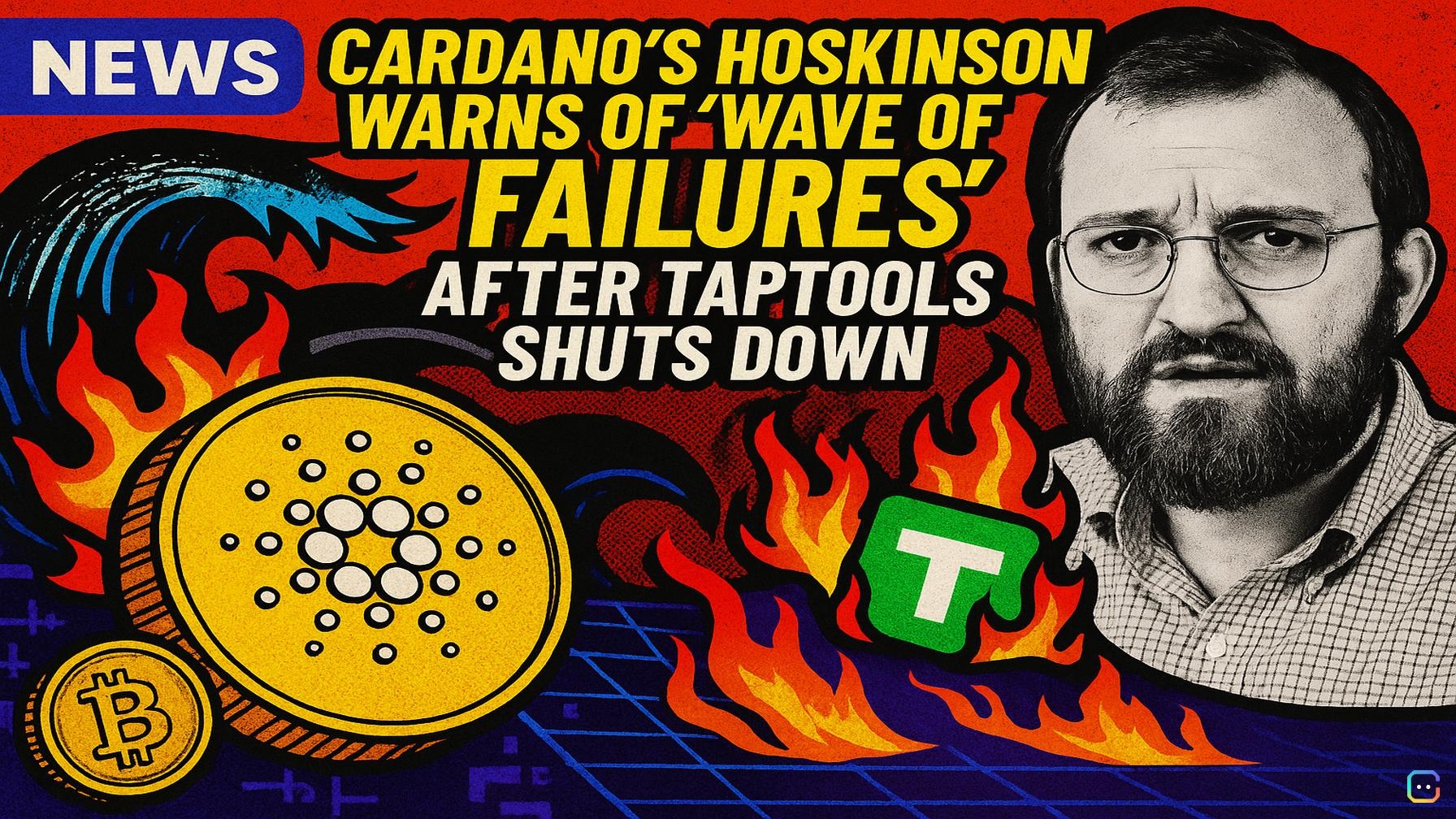
Cardano founder Charles Hoskinson warned on June 2 that the network could be headed for a “wave of failures” after TapTools, a major Cardano analytics and discovery platform, announced it will wind down operations over the next two weeks. In a livestream response to TapTools’ shutdown statement, Hoskinson framed the collapse not as an isolated loss but as evidence of deeper funding, coordination and incentive failures across the Cardano ecosystem.
TapTools said it became unsustainable to continue after multiple senior departures. Two co‑founders — including the CTO and COO — left earlier this year; a back‑end developer who stepped into the CTO role has also departed. The team stressed that the technical knowledge to run TapTools “cannot be replaced overnight,” and pointed to real infrastructure, development and support costs as ongoing barriers. TapTools said it had served more than one million users, supported hundreds of projects through its API, published hundreds of articles, generated hundreds of millions of social impressions and helped raise visibility for Cardano builders. The team said it remains open to acquisition offers or other resources that could preserve the platform.
Hoskinson, who said TapTools had been part of his “daily ritual,” used the moment to reiterate warnings he made earlier this year: weak markets have left many Cardano projects with little runway. He pointed to TapTools and JPEG Store as recent casualties and predicted more projects will struggle in the second half of the year. “I would suspect others are coming very soon,” he said. “There’s going to be a wave of failures in the ecosystem.”
To address the problem, Hoskinson said he has previously proposed several fixes — including a Cardano sovereign wealth fund, an ecosystem index and strategic acquisitions — but claimed these ideas either lacked support or were criticized as centralizing. He highlighted his own efforts to preserve infrastructure through acquisitions of Nami and Blockfrost, arguing similar interventions have faced pushback. A core gripe, he said, is that Cardano’s governance still lacks an effective mechanism for deploying treasury resources to sustain commercial infrastructure. He also noted that a large ADA allocation to Draper may not solve the issue, as venture capital tends to back new ventures rather than distressed legacy platforms.
Throughout the livestream Hoskinson was careful to reject claims that he controls Cardano’s trajectory: he said he does not hold governance keys, cannot initiate hard forks or protocol parameter changes, does not control the treasury and does not own the Cardano trademark. At the same time, he launched a broader critique of Cardano’s political culture, accusing some community factions of opposing commercialization while then blaming leadership when commercial projects fail. He urged DReps and delegators to assess whether their representatives are enabling growth or obstructing it: “You need to pick a leader. You need to pick a vision. You need to pick a strategy and fix it,” he said.
Hoskinson also floated a range of potential remedies — from constitutional and treasury reforms to changes in executive function — and even mentioned a radical “nuclear option”: launching a new Cardano via a proof‑of‑burn mechanism if current governance cannot be made to support builders.
At press time ADA traded at $0.2177.
Read more AI-generated news on: undefined/news