Jamie Dimon signals JPMorgan may enter prediction markets as big banks circle a fast-growing sector
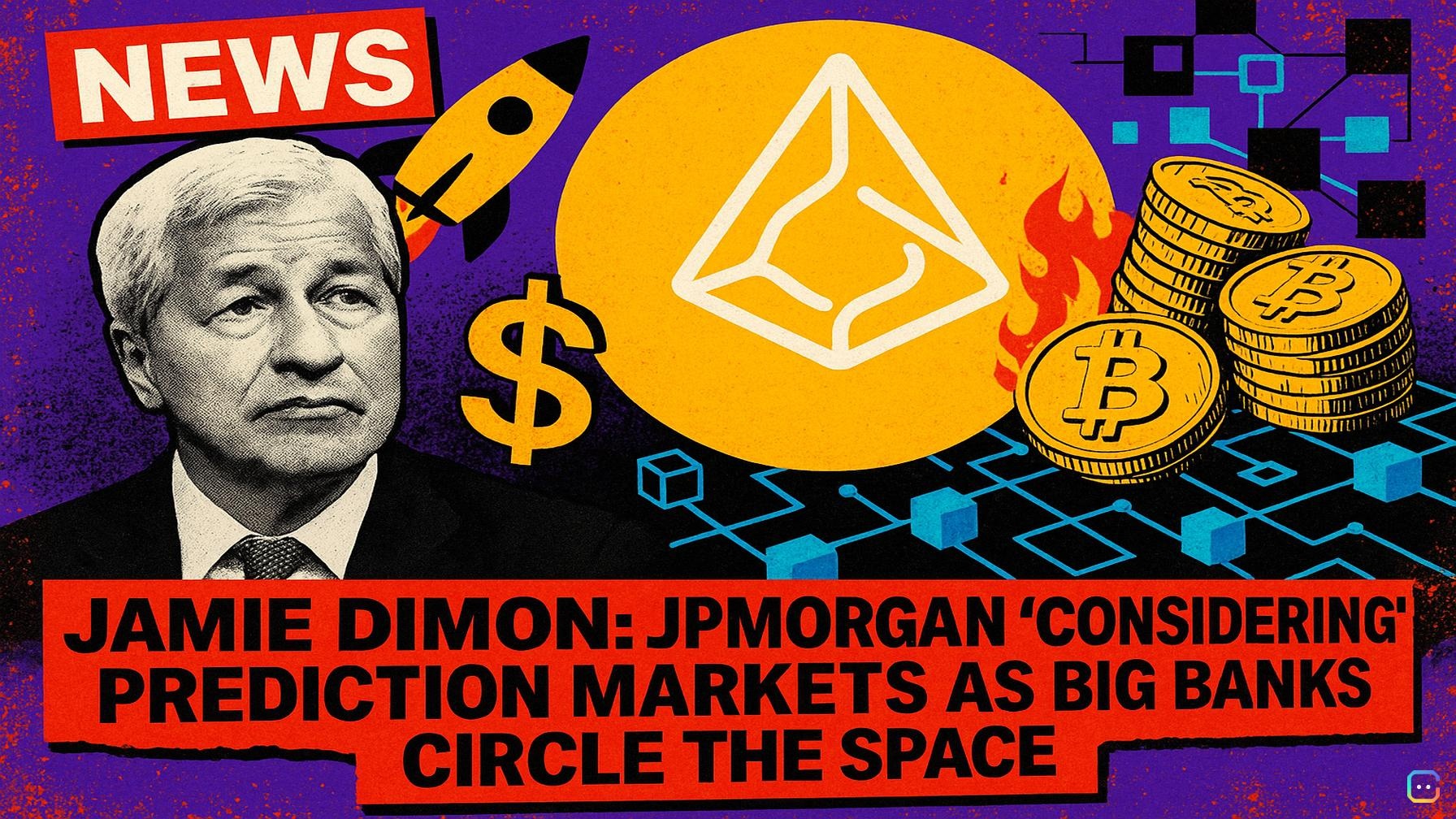
JPMorgan CEO Jamie Dimon told CBS this week the bank is “considering” entering the prediction markets space — a clear sign that major financial institutions are taking the market seriously as it rapidly expands. Dimon stopped short of specifics and said JPMorgan would avoid markets tied to sports or politics, adding that the bank would adhere to strict insider-information rules.
Goldman Sachs has made similar noises. CEO David Solomon said during the bank’s January earnings call that Goldman is actively exploring prediction markets, and that he personally met with leaders from the two biggest prediction companies to learn more. “We have a team of people here that are spending time with them and are looking at it,” Solomon said.
What’s changed: from niche to mainstream
Not long ago, prediction markets were a niche corner of finance, led by two credible players: Polymarket and Kalshi. Now competition is intensifying. Crypto and retail platforms, including Coinbase and Robinhood, have added prediction-market trading, opening access to a much broader retail base and boosting activity across the sector.
The early leaders are also scaling. Polymarket has secured partnerships and investments — including ties with Intercontinental Exchange, the NYSE’s parent — and is thought to be valued around $20 billion. Kalshi recently hit a roughly $22 billion valuation after a funding round led by Coatue Management.
Two different tech models
Polymarket leans on blockchain infrastructure, routing trades and settlements through smart contracts on networks like Polygon. Users deposit stablecoins, take positions on event outcomes, and receive automated payouts when results are verified.
Kalshi, by contrast, runs like a traditional exchange: centralized order matching and settlement within a regulated framework, not built on blockchain.
What the banks might do — and the regulatory question
It’s unclear whether JPMorgan or Goldman would adopt blockchain-based systems or stick to conventional exchange infrastructure if they launch products. Regulation is a major open question: U.S. legal treatment of prediction markets is still evolving, especially around which event types are permissible and how contracts are classified. That uncertainty makes large banks likely to move cautiously.
Regulators are beginning to act. Earlier this month the Commodity Futures Trading Commission (CFTC) took two notable steps toward creating a regulatory framework for prediction markets, indicating oversight is starting to take shape.
Bottom line: prediction markets have moved from fringe experiment to mainstream battleground. With crypto platforms, retail brokerages and now major banks circling the space — and regulatory clarity still developing — the next year will likely determine which technological and business models dominate.
Read more AI-generated news on: undefined/news