Today's Cryptocurrency Prices by Market Caps
The global cryptocurrency market cap today i $2.35T
Market Cap
$2.35T
24h Trading Volume
$311.37B
BTC Dominance
55.51%
|
#
|
Name
|
Price
|
1h %
|
24h %
|
7d %
|
Market Cap
|
Volume (24h)
|
Chart (7d) |
|---|---|---|---|---|---|---|---|---|
|
|
—
|
|||||||
|
No cryptocurrencies found Try adjusting your search query |
||||||||
Latest Crypto News
View All News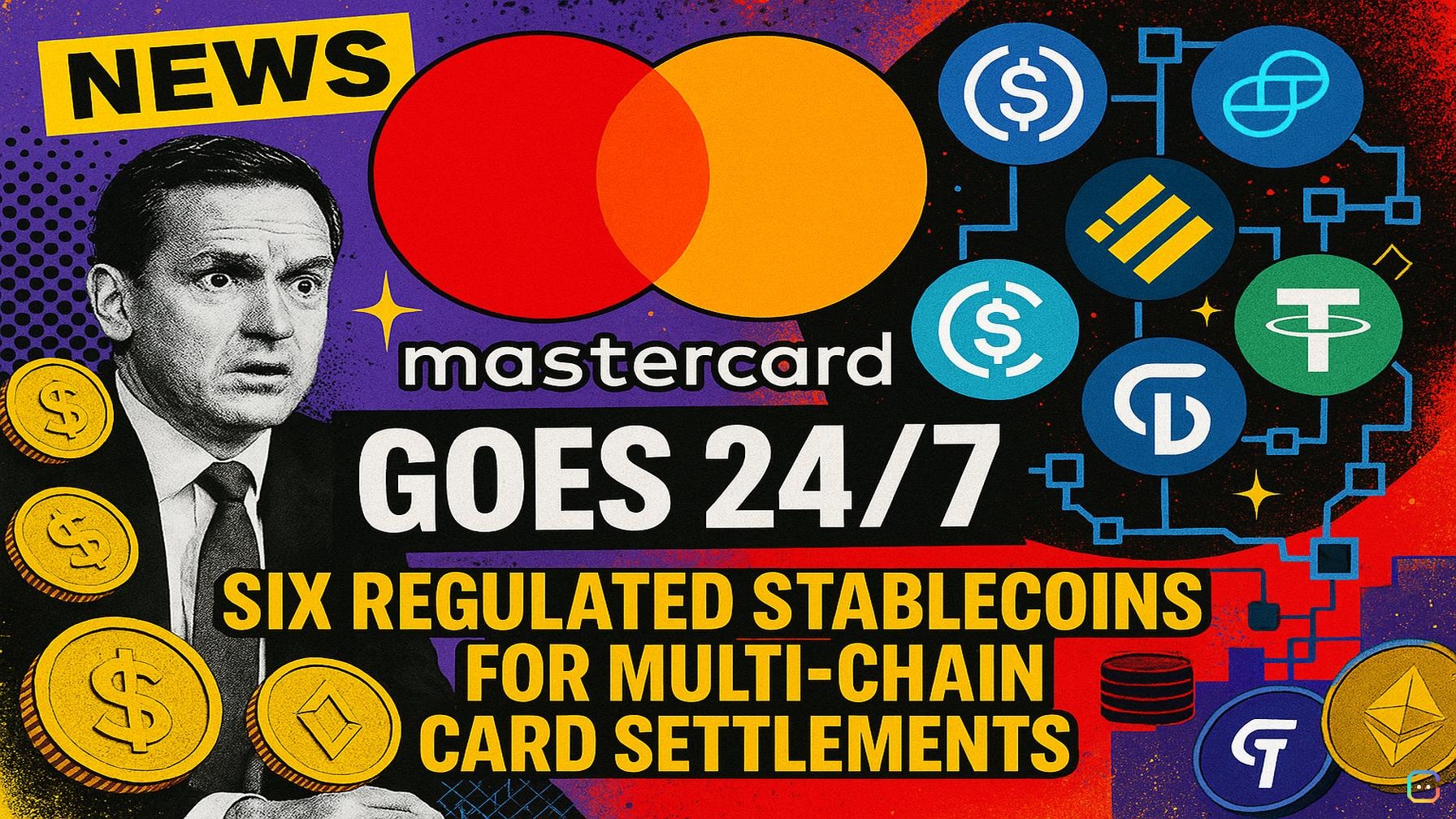
Mastercard Goes 24/7: Six Regulated Stablecoins for Multi-Chain Card Settlements
Mastercard is moving deeper into crypto payments by adding support for six regulated dollar stablecoins and enabling card settlements across multiple blockchains — even outside traditional banking hours. What’s new - Mastercard will allow card settlement using Circle’s USDC, Paxos-issued PYUSD, USDG and USDP, Ripple’s RLUSD, and SoFiUSD. - These stablecoin settlements will be available across Ethereum, Solana, Polygon, Base, Arbitrum, Canton, Tempo, and the XRP Ledger. - Crucially, issuers and acquirers can settle transactions on weekends, holidays, and around the clock instead of being limited to standard bank operating times. Mastercard says this capability will complement — not replace — existing settlement processes. Initial rollout and partners - Early supporters expected to enable the new option include ARQ (formerly DolarApp), CBW Bank, Cross River, Lead Bank, and Nuvei. - The initial deployment will cover parts of the United States and Latin America, with broader expansion planned through 2026. Compliance and safety - Mastercard emphasizes the rollout will adhere to the same operational standards already used across its network: security controls, fraud protections, dispute handling procedures, and interoperability will remain in place as stablecoin settlements are introduced. Regulatory and strategic context - The announcement follows Mastercard’s recent BitLicense approval for its subsidiary Mastercard Transaction Services (U.S.) LLC from the New York Department of Financial Services, which authorizes virtual currency business activity in New York and supports services involving stablecoins and tokenized deposits under existing compliance frameworks. - It also builds on Mastercard’s March agreement to acquire stablecoin infrastructure provider BVNK for up to $1.8 billion and its decision to grant Mastercard Principal Membership to stablecoin card issuer Rain — moves that signal a sustained push into regulated digital-asset infrastructure. Industry picture - Competitors are likewise expanding blockchain settlement efforts: Visa continues testing stablecoin-linked settlement programs across multiple chains, and MoneyGram recently launched its MGUSD stablecoin on Stellar to support international payments. - Market context: CoinGecko data shows dollar-backed stablecoins are approaching $300 billion total supply. Tether’s USDT remains the largest with roughly $188 billion in circulation, followed by Circle’s USDC at about $76 billion. Why it matters - By enabling regulated stablecoin settlements across several blockchains and outside bank hours, Mastercard is aiming to speed up settlement, extend 24/7 payment rails to card ecosystems, and deepen ties between traditional payments infrastructure and regulated digital assets — while keeping existing compliance and security frameworks intact. Read more AI-generated news on: undefined/news

FCA Warns Premier League Clubs Over Unauthorised Crypto Sponsorships — Fans, Finances at Risk
The UK financial regulator has sounded a clear warning to top-flight football clubs: deals with unauthorised crypto firms can put fans — and clubs — at financial and legal risk. What the FCA said The Financial Conduct Authority (FCA) has written to Premier League clubs and other football organisations after flagging examples of crypto businesses and trading platforms using sponsorship arrangements to promote financial products in the UK without proper authorisation. The regulator says those partnerships can give unauthorised firms high visibility and access to large fanbases, potentially breaching the UK’s financial promotion rules. Consumer and club risks The FCA flagged a broad set of risks tied to such sponsorships: consumer harm, money‑laundering vulnerabilities, legal exposure and reputational damage for clubs. “Millions of fans place trust in their clubs and should not be exposed to potentially unsafe financial products through sponsorship arrangements,” said Lucy Castledine, the FCA’s director of consumer investments. She warned that unauthorised firms could exploit fan loyalty while offering products that fall outside UK regulatory safeguards. Enforcement and protections Regulators have already contacted clubs where concerns were identified and say they will take further action where necessary. The FCA emphasised that customers who use unregulated crypto firms risk losing all their money and are unlikely to have access to UK regulatory protections if something goes wrong. Why this matters for club finances Sponsorship and commercial deals are increasingly central to club finances — and that’s why crypto partners are attractive. Deloitte data cited by the FCA shows commercial income overtaking broadcasting for many clubs: Manchester City, for example, generated €408 million ($475 million) from commercial activities in 2025, exceeding €332 million from broadcasting. Political response UK Sports Minister Stephanie Peacock acknowledged the importance of sponsorship revenue to the game but said supporters “deserve confidence that companies associated with their clubs are responsible, accountable and safe to use.” Regulatory context and what’s next The FCA’s letter comes as part of its wider work to establish a regulatory framework for digital assets ahead of the UK’s planned crypto licensing regime. In April the regulator launched consultations covering stablecoins, crypto trading platforms, custody services and staking. These proposals are designed to set rules under the forthcoming Financial Services and Markets Act framework and help firms prepare for authorisation. Timelines Under the FCA’s current timetable, crypto firms will be able to apply for UK authorisation from September 30, 2026, with the full cryptoasset regime due to take effect on October 25, 2027. The FCA has reiterated that it wants consumers to be served by authorised crypto businesses and to have enough information to make informed choices. Bottom line Clubs should treat crypto sponsorships with heightened scrutiny, regulators are watching closely, and fans should be cautious about financial services promoted through their teams until providers are properly authorised. Read more AI-generated news on: undefined/news

Walrus Memory: Portable, zk-Proofed Agent Memory Backed by Mysten Labs
Headline: Walrus Memory Aims to Give AI Agents Portable, Trustworthy “Agentic” Memory — Mysten Labs’ Co-Founder Explains Mysten Labs co-founder and chief cryptographer Kostas Chalkias says the next big bottleneck for capable AI agents isn’t compute — it’s memory. In a drive to fix that, Mysten (an original contributor to Walrus) is backing Walrus Memory, a purpose-built memory layer for AI agents that promises portability, user control and coordinated, long-running context across apps and providers. “The major misconception in AI is that compute is the only bottleneck,” Chalkias told Decrypt. “The major issue is we’re using a lot of memory as humans, and we want our LLMs to actually learn about us.” Today’s agents are cobbled together from disparate databases, vector stores and runtime state, he argues, producing brittle systems that forget or fail on complex workflows. Walrus Memory aims to solve what Chalkias calls the “real bottleneck” — agentic memory that mirrors user context and can move between sessions, apps and models. What Walrus Memory brings - Portability: Agents, apps and workflows can share memory independently of runtime, session or cloud provider, preventing vendor lock-in. Chalkias highlighted integrations with major models like Claude, ChatGPT and Gemini to “future-proof” workflows. - Multi-agent coordination: Shared memory spaces let multiple agents coordinate on long-running tasks and workflows rather than operating in isolated silos. - Cryptographic verification & programmable access: Walrus uses cryptographic tools including zk-proofs to enable contextual verification and programmable access controls over encrypted memory, letting teams protect and selectively expose data. - Privacy and lifecycle control: Memory stored on the platform has programmable access and retention policies — “you don’t want your data to be there forever, you don’t want your data to be misused,” Chalkias said. - Developer tooling: Plugins (OpenClaw, NemoClaw) plus Python and TypeScript SDKs make it straightforward to add portable memory to existing agent workflows. Chalkias argued these elements are all necessary: “Just having fast compute, you don't necessarily have privacy; just having an encryption layer, you don't necessarily have a way to share your policies on whatever LLMs you want. If you just have large data, this is also not enough.” He added that, in his view, few blockchain-focused solutions currently combine all three — portability, cryptographic verification and policy-driven sharing — at once. Early adopters and performance claims Teams already experimenting with Walrus Memory include Allium, Conso Labs, Inflectiv, OpenGradient, Talus Labs and Tatum. Use cases range from portable agent identity systems to AI assistants that remember customer interactions across sessions. On technical gains, Chalkias said Walrus improves the effective quality of memory provided to LLMs by addressing four layers: storage, retrieval, ranking and encryption. “In some metrics we had 60% improvements by having better ranking, better filtering and context,” he said, attributing gains to smarter classification, encryption-enabled filtering and improved relevance ranking. “We're not just a storage layer anymore.” Why crypto and Web3 care For blockchain and crypto builders, portable, verifiable agent memory opens new possibilities: account-linked assistant histories, auditable agent decisions, and cross-platform identity that respects user control and cryptographic guarantees. The use of zk-proofs and programmable access meshes with Web3 values around verifiability and privacy-preserving sharing. Get started Developers and teams can learn more or trial Walrus Memory at walrus.xyz/memory. Sponsored: Brought to you by Walrus. Learn more about partnering with Decrypt. Read more AI-generated news on: undefined/news

MicroStrategy Sells 32 BTC, Sparking Market Volatility and Leverage Concerns
MicroStrategy’s surprise Bitcoin sale has injected fresh volatility into the market — and opinions are split on whether the move calmed or cracked investor confidence. What happened - In an 8-K filing Monday, MicroStrategy revealed it sold 32 BTC last week — its first bitcoin sale since 2022. The disclosure followed CEO Michael Saylor’s recent comment on an earnings call that the company “will probably sell some Bitcoin to pay a dividend just to inoculate the market and send the message that we did it.” - The announcement coincided with other big balance-sheet moves: MicroStrategy used roughly $1.38 billion in cash to retire $1.5 billion of its 2029 convertible bonds and, in the same multi-week window, bought 24,869 BTC with proceeds from a $2 billion STRC offering — a sequence critics say drained corporate cash ahead of an expensive monthly dividend. Immediate market impact - Bitcoin slipped sharply after the filing, trading as low as under $66,000 and sitting around $65,560 (CoinGecko) at the time of reporting — a roughly 10% drop from the June high near $74,000. CoinGlass data shows about $1.76 billion in leveraged crypto positions were liquidated on June 2 alone. - MicroStrategy’s preferred perpetual stock, STRC, fell from its $100 par value to about $94.84. MicroStrategy’s common stock (MSTR) plunged 9.6% at Monday’s open to $134 and dropped another 4% to $130 later, per Yahoo! Finance. Why critics are alarmed - Skeptics say the 32 BTC sale undercuts MicroStrategy’s long-standing “never sell your Bitcoin” mantra and signals structural stress around how the company will fund hefty dividend obligations. Crypto economist Alex Krüger called Saylor’s moves “tragicomic,” arguing the signaling intention backfired and left the firm “cornered.” - Tiger Research analyst Ryan Yoon said STRC’s depegging “signals a structural crack in MSTR’s leverage-heavy Bitcoin flywheel,” adding that the fear of forced liquidations shattered investor confidence and put immediate downward pressure on BTC. Defenders say it’s pragmatic, not fatal - Not everyone views the episode as a death spiral. Andri Fauzan Adziima of Bitrue Research Institute framed Saylor’s actions as sensible balance-sheet management that was poorly timed amid a macro-sensitive pullback. He suggested the STRC decoupling mostly raises funding costs and compresses margins, making future equity issuance or Bitcoin sales more likely, but still “navigable leverage friction” for institutional investors. - Paul Howard, director at market-maker Wincent, said the current turbulence doesn’t portend a long-term crypto collapse, though it may erode MicroStrategy’s dominance as institutional alternatives multiply. What comes next - Analysts expect MicroStrategy to rebuild USD reserves to avoid large-scale Bitcoin sales. Adziima predicts targeted MSTR equity raises and STRC dividend tweaks (for example, switching to semi-monthly payouts) as likely moves. - Downside risks remain: rumors of further Saylor selling or large public distributions (e.g., Mt. Gox) could apply additional pressure. Upside catalysts could include clearer regulatory progress, such as U.S. clarity on crypto rules. Market mood and macro backdrop - On prediction market Myriad, users shifted bearish, placing a 58% chance on Bitcoin falling to $55,000 next. Overall crypto sentiment is muted while many equities and altcoins rise. - Broader macro forces — notably the U.S.-Iran conflict, rising energy costs and persistent inflation — have pushed policy rates higher for longer, reducing risk appetite and exacerbating the correction. Bottom line MicroStrategy’s small, symbolic BTC sale and aggressive capital moves were intended to “inoculate” the market and shore up the company’s balance sheet — but the episode has instead intensified debate and volatility. Whether this is a temporary market overreaction or a meaningful crack in MicroStrategy’s leveraged Bitcoin strategy will depend on the company’s next financing choices and the wider macro and regulatory environment. Decrypt reached out to MicroStrategy for comment. Read more AI-generated news on: undefined/news

MoonPay's MoonAgents Lets Local AI Trade Crypto From Your Desktop — Keys Stay Local
MoonPay is bringing AI agents one step closer to trading crypto on your desktop. This week the crypto payments firm released MoonAgents, a desktop app that connects Anthropic’s Claude Code and OpenAI’s Codex to users’ wallets, token swaps, prediction markets and other on‑chain services via a visual interface. MoonPay first shipped MoonAgents as a command‑line tool in February; the new graphical version, launched three months later, moves setup and plumbing behind the scenes so non‑technical users can plug in and go. MoonAgents lets users sign in with existing Claude or Codex accounts instead of wrestling with manual configuration. The app ships with prebuilt “Skills,” scheduled Automations, and an Artifacts system that can generate custom dashboards and interfaces to manage financial activity—effectively turning local LLMs into programmable crypto assistants. “All that stuff is hidden under the hood for you,” MoonPay Head of Agents Kevin Arifin told Decrypt. “It will set up Codex or Claude locally on your computer behind the scenes, and then it's a front end.” Security and control are central selling points. As AI agents gain more autonomy, real incidents and research have highlighted risks: in April, PocketOS founder Jeremy Crane said a Cursor agent running Anthropic’s Claude Opus wiped production data and backups with a single Railway API call, and researchers continue to warn about prompt‑injection attacks that can trick agents into leaking secrets or taking unintended actions. MoonPay says MoonAgents addresses these concerns by keeping users’ private keys on their machines rather than in the cloud. “The most important piece of security is not revealing the private keys,” Arifin said. “The private keys are stored locally on the user’s computer and are fully encrypted, so the LLM can’t just access or view them.” MoonAgents follows other recent MoonPay moves to integrate with ChatGPT‑style workflows. In May the company launched an app enabling people to buy cryptocurrencies like Bitcoin and Solana through ChatGPT by voice. According to Arifin, the key advantage of the desktop MoonAgents approach is enabling models to run locally and interact with blockchain services using locally held keys—letting users automate research, token exploration and trading workflows without exposing credentials to remote AIs. “The LLM is not the answer in this case,” he said. “It's empowering you to be able to do the research, dive into the meme coin, dive into the tokens, and dig into the trenches in a way that in the past was only restricted to the people that could write scripts.” Disclosure: MoonPay Ventures is an investor in Dastan, parent company to an editorially independent Decrypt. Bottom line: MoonAgents packages local LLMs into a user‑friendly crypto workstation, lowering the technical barrier for AI‑driven on‑chain activity—but it also underscores the need for robust safeguards and oversight as AI agents gain the power to move real funds. Read more AI-generated news on: undefined/news

Analyst: XRP Likely Holds $1.20 Floor — Patient Buyers Could Win Big Amid Mideast Oil Fears
An analyst who has been watching XRP closely says patient investors who sit through the current pullback could end up among the biggest winners when sentiment turns. XRP has been trading near the lower end of its recent range amid a broader crypto selloff that has pushed Bitcoin below key support levels and shaken market confidence. In a video report, the analyst identified roughly $1.20 as a likely floor — a “final washout” level that, historically, has often preceded major rallies. Based on his read of the charts and market structure, he does not expect the token to collapse below $1. What’s driving the pressure right now isn’t primarily crypto fundamentals, the analyst says, but geopolitics. Escalating tensions in the Middle East have raised fears of a significant crude-oil supply disruption. He cited falling oil inventories, drawdowns from Japan’s strategic petroleum reserves, and renewed conflict between Iran and Israel. Operational issues affecting idle vessels in the Gulf could further slow energy transportation, and even if hostilities ease, supply chains may take months to normalize. That overhang, he warns, could spark another round of selling across risk assets — crypto included. Traditional markets aren’t offering much reassurance, the analyst adds. The US bond market remains in a prolonged drawdown, while the S&P 500’s recent gains are heavily concentrated in a handful of firms. With market breadth thin and valuations at historic extremes, he recommends steering clear of overheated equity trades and focusing instead on assets that have already endured severe corrections. Despite the selling pressure — which even large institutional buyers haven’t fully stemmed — the analyst believes XRP’s long-term case remains intact. He expects a substantial rally later in 2026 and plans to continue buying on dips, viewing the current environment of heavy selling and widespread fear as the kind of set-up that can produce outsized gains. For traders and investors, the takeaways are clear: watch the $1.20 area as potential support, be mindful of geopolitical risks that could spark further downside, and consider that deeply corrected digital assets may offer upside if macro and regional tensions stabilize. Featured image from Pexels; chart from TradingView. Read more AI-generated news on: undefined/news