Today's Cryptocurrency Prices by Market Caps
The global cryptocurrency market cap today i $2.35T
Market Cap
$2.35T
24h Trading Volume
$141.09B
BTC Dominance
56.47%
|
#
|
Name
|
Price
|
1h %
|
24h %
|
7d %
|
Market Cap
|
Volume (24h)
|
Chart (7d) |
|---|---|---|---|---|---|---|---|---|
|
|
—
|
|||||||
|
No cryptocurrencies found Try adjusting your search query |
||||||||
Latest Crypto News
View All News
Altura Winds Down Stablecoin Vault After $8.5M Redemption Rush Amid MainStreet Depeg
Altura begins orderly wind-down of stablecoin vault after $8.5M rush Altura has started winding down its stablecoin yield vault after processing more than 8.5 million USDT in instant redemptions over a 24‑hour period, CEO Ranveer Arora said. The move follows a weekend spike in withdrawal requests that the team attributed to “sustained withdrawal demand and current market sentiment,” and was taken to protect user capital and ensure redemptions are handled “fair, transparent, and efficient[ly].” What’s happening now - The protocol has notified counterparties and partners and started unwinding positions across the vault portfolio. Holdings being unwound include allocations on exchanges, private credit opportunities, and real‑world asset (RWA) strategies. - Some positions can return capital quickly; others require standard settlement or redemption windows. Altura says it is working with counterparties to accelerate where possible and will return funds to users as each underlying position redeems. - The team has pledged ongoing updates as liquidity becomes available. No final completion date has been set—timelines depend on each position’s settlement terms. Why it escalated The wind-down followed market unease in yield-bearing stablecoin products after MainStreet’s MSUSD experienced a depeg. MSUSD fell sharply after proof-of-solvency provider Accountable ended its service agreement, saying MainStreet “was unable to meet our verification standards.” MainStreet later insisted its assets remained fully backed and blamed market stress on the shutdown of a third‑party proof‑of‑reserves dashboard. Altura stresses limited exposure Altura emphasized it had no direct exposure to MainStreet or its strategies. The firm said its HyperEVM lending vault (Alpha USDT Prime), the related USDT/AVLT market, and borrowers using its Ethereum vault were not affected by the MainStreet incident. CEO comments and market noise Arora said the team worked through the weekend to process redemptions and engage partners and users, and criticized “misinformation and speculation” for stoking additional market fear and withdrawal pressure. Scale and context - DeFiLlama data lists Altura with roughly $32.36 million total value locked (TVL) on Hyperliquid L1, with one tracked yield pool and an average APY near 17.49%. The vault previously peaked at about $39 million TVL on HyperEVM. - The case highlights growing demand—and fragility—in tokenized RWA and stablecoin yield products. Recent industry moves include a $100 million yield-bearing RWA vault from Plume and Ether.fi, underscoring appetite for yield even as proof‑of‑reserves disputes can quickly create liquidity shocks. Key questions going forward Users will be watching how fast settlements complete, how much capital returns at each stage, and whether the process can avoid forced or rushed sales of slower positions. Altura says it will continue posting updates as redemptions progress and new liquidity is unlocked. Read more AI-generated news on: undefined/news

Taiko Urges Users to Pull Funds After Bridge Verification Flaw Drains $1M+
Taiko urges users to pull funds after bridge exploit drains >$1M Taiko has told users to withdraw funds from every bridge on its network after confirming a compromise of its chain state verification mechanism. The Ethereum Layer-2 project said the issue undermines the security assumptions of its bridge system and warned that deposits should not be trusted until further notice. What happened - Blockchain security firm Blockaid flagged an active attack on Taiko’s ERC-20 vault on Ethereum. Its exploit-detection system identified ongoing unauthorized activity, estimating losses above $1 million and publishing the victim contract, attacker wallet and exploit transactions. - Blockaid attributes the breach to a flaw in Taiko’s bridge “source-signal” proof validation. Crafted message proofs were accepted as valid on Ethereum L1 even though no corresponding legitimate MessageSent events existed on the Taiko source chain. - Those fraudulent proofs enabled the attacker to register and later retrieve forged bridge messages, triggering unauthorized releases from the ERC-20 vault. Taiko’s response - Taiko confirmed a broader verification failure and said it is coordinating with its Security Council and ecosystem partners to investigate and remediate the issue. - All block proposers on the network have temporarily stopped producing new blocks while the team works through the incident. - The project asked centralized exchanges to immediately suspend TAIKO deposits and said deposits should only resume after an official announcement. - Taiko published several attacker addresses and said it will pursue technical and legal remedies where appropriate, but gave no timeline for restoring bridge security or restarting block production. About Taiko Taiko is a Type-1 Ethereum-equivalent zkEVM rollup that launched mainnet in May 2024. The network supports EVM-compatible smart contracts and is designed so that Ethereum L1 validators help order transactions. Broader context Cross-chain bridge exploits have been a recurring source of losses in 2026. Crypto.news recently reported bridge-related attacks accounted for $28.6 million in May — roughly 42% of that month’s reported losses, according to CertiK. High-profile incidents this year include: - Verus Protocol: over $11.5 million lost in a forged-transfer exploit. - Axelar: disabled Secret Network bridge routes after a $4.7 million exploit. - Aztec Connect: about $2.1 million lost due to a verification mismatch that let unbacked balances move through Ethereum settlement records. What users should do - Withdraw funds from any Taiko bridges immediately. - Avoid depositing TAIKO to centralized exchanges until official confirmation that bridge security has been restored. - Monitor official Taiko channels for updates and published attacker addresses. We’ll update this story as Taiko and security partners disclose more technical details and recovery steps. Read more AI-generated news on: undefined/news
MSUSD Plunges After Proof‑of‑Reserves Feed Halt, Sparking DeFi Liquidity Panic
MainStreet’s yield-bearing stablecoin MSUSD plunged after a rapid loss of confidence tied to a halted proof-of-reserves feed, fueling a wider scramble in related DeFi markets. What happened - MSUSD, designed to trade at $1, slid as low as $0.065 in the last 24 hours and was trading around $0.3781 at the time of writing (24‑hour range $0.065–$0.9995). PeckShield reported the token dropped as much as 85% before a partial rebound. - CoinGecko shows MSUSD’s market cap near $27.06 million and 24‑hour volume about $8.25 million, underscoring volatile trading as holders tested liquidity and redemption confidence. Trigger: verification feed cut - The rout followed Accountable’s immediate termination of its service agreement with MainStreet, with the verification firm saying MainStreet “was unable to meet our verification standards.” That move removed a public layer users relied on to confirm the stablecoin’s backing. - MainStreet says the issue stems from the shutdown of a third‑party proof‑of‑reserves dashboard and that the dashboard’s removal “does not reflect any loss of assets or deterioration in portfolio quality.” The protocol asserted it “remains fully backed” and has deployed more than $8 million in USDC to support liquidity while searching for alternative proof‑of‑reserves providers. Contagion into lending markets - The shock rippled into lending: PeckShield reported the Morpho msY/USDC market reached 100% utilization, meaning available lending liquidity was fully used—a state that can make withdrawals difficult, push borrowing rates higher, and leave users waiting for repayments or new deposits. - AlphaUSDC Delta V2, a product curated by AlphaPING, reportedly had ~30% exposure to the affected market—about $18 million—highlighting how stress in one yield‑linked instrument can threaten lenders, vault depositors and borrowers using linked positions. Why this matters - The episode highlights the fragility of yield-bearing stablecoins that rely on external verification feeds. A depeg isn’t just a token‑price problem: it can cascade into real liquidity shortages across DeFi’s composable stack. Past incidents, such as the Resolv Labs USR depeg and related exploit losses, underline how quickly risk can spread between protocols. What to watch next - Restoration or replacement of proof‑of‑reserves verification, MainStreet’s ongoing liquidity support, and on-chain indicators such as Morpho utilization and MSUSD’s market price versus its $1 peg. Traders and depositors will be watching whether deployed liquidity and transparency measures are enough to rebuild trust. Bottom line MainStreet insists assets are intact and has injected liquidity, but the loss of an independent verification layer sparked a severe market reaction that exposed the broader risks of yield‑bearing stablecoins. Recovery now depends on restored transparency and demonstrated liquidity. Read more AI-generated news on: undefined/news
Mercury 2: Ultra-Fast Diffusion LLM Cuts Costs, Boosts Crypto dApp Performance
Inception Labs this week shook up the AI race with Mercury 2, a new “diffusion” language model the company bills as the world’s fastest reasoning LLM. In benchmark and customer tests, Mercury 2’s standout claim is raw throughput: roughly 1,000 tokens per second versus about 89 tokens/sec for Anthropic’s Claude Haiku 4.5 Reasoning and 71 tokens/sec for OpenAI’s GPT-5 Mini. That puts it squarely in the same high-speed bracket Google later associated with its own DiffusionGemma — welcome to what some are calling the diffusion era of large language models. What diffusion models do differently - Traditional chatbots generate text one token at a time, checking each step as they go. Diffusion models instead initialize a block of text with noisy placeholder tokens and refine that block in several parallel passes until a final answer emerges — a technique borrowed from image generators like Stable Diffusion. - The result is much higher parallel throughput and a snappier “flow” for long sessions: instant autocompletes, faster iterations on code or plans, and subagents that can run many quick utility calls without dragging down the whole system. Benchmarks and head-to-heads - On AIME 2026 (based on real American Invitational Mathematics Examination problems, scored as percent solved), Mercury 2 scored 90%. Google’s DiffusionGemma scored 69.1% on the same test, while standard (non-diffusion) Gemma 4 scored 88.3%. - On GPQA, a PhD-level science benchmark, the gap narrows: Mercury 2 at 77% vs. DiffusionGemma’s 73.2%. Google’s own guidance still recommends standard Gemma 4 for applications that need the absolute highest quality, noting DiffusionGemma trails it across the board. Real-world performance and cost - Mercury 2’s speed claims aren’t just lab numbers. Augment Code, an AI coding-agent company, swapped Mercury 2 in for Anthropic’s Claude Opus 4.7 on a context-compaction subagent and reported an 82% latency drop and a 90% cost reduction, while maintaining comparable output quality (per a joint case study). Origins and funding - Inception’s approach builds on diffusion research from founder Stefano Ermon, a Stanford professor who co-authored early score-based diffusion work used in image generation. The startup raised a $50 million round with backing from Nvidia’s venture arm and individual investors Andrew Ng and Andrej Karpathy. Mercury 2 is currently available via API/cloud — the model weights aren’t public. Practical caveats and the new architecture - Diffusion LLMs excel where latency and high-volume throughput matter (real-time editing, many small utility calls, voice interfaces, etc.), but they’re not necessarily the best fit for the absolute hardest frontier reasoning tasks, where larger autoregressive models may still hold an edge. - Architecturally, the big shift is toward orchestras of specialized subagents (reasoners, summarizers, routers, checkers). Sequential token-by-token models make many utility calls slow and expensive; parallel diffusion models make those calls cheap enough to use liberally. - The ecosystem is still catching up: local runtimes, agent frameworks, and other infrastructure need to mature to make diffusion models seamless everywhere. Where this matters for crypto and web3 - Faster, cheaper LLMs lower the friction for latency-sensitive on-chain and off-chain services: - real-time developer tools for smart contract coding and “vibe coding” that keep pace with edits; - multi-agent support systems and bots for DAOs that require many quick sub-calls; - low-latency voice or chat interfaces for wallets, dApps, or on-call node operators; - cheaper inference costs for oracle preprocessing, monitoring, and alerting pipelines. - At scale, higher throughput on commodity GPUs can translate into meaningful cost and energy savings for projects that run lots of AI calls. Bottom line Mercury 2 pushes diffusion LLMs into the “fast and good” quadrant, delivering dramatic latency and cost improvements for throughput-heavy tasks while keeping competitive quality. It won’t replace every model class, but for crypto builders and other developers focused on speed, responsiveness, and multi-agent systems, diffusion models like Mercury 2 open new practical possibilities — provided the surrounding tooling and runtimes catch up. Read more AI-generated news on: undefined/news
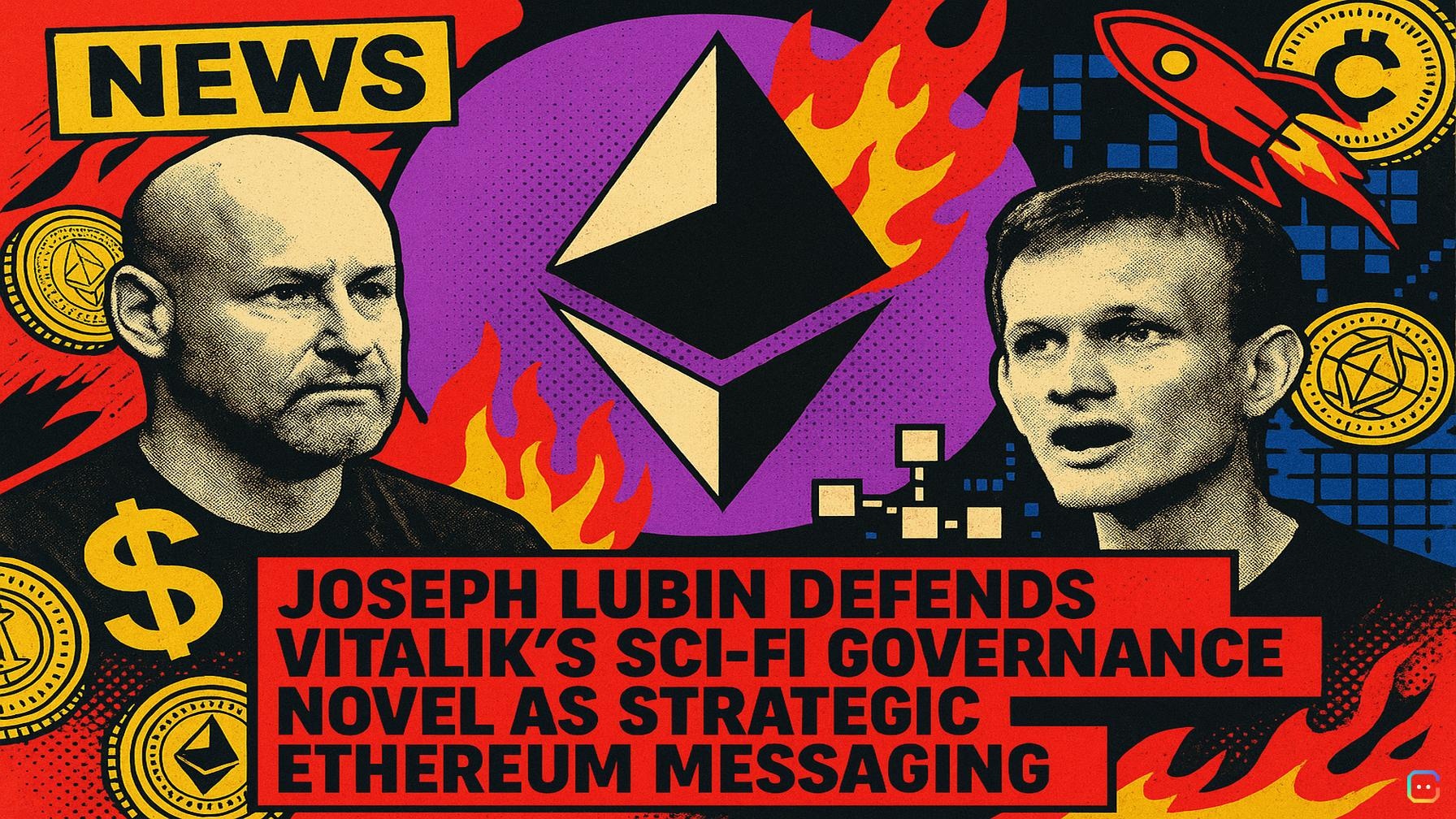
Joseph Lubin Defends Vitalik’s Sci‑Fi Governance Novel as Strategic Ethereum Messaging
Joseph Lubin has stepped forward to defend Vitalik Buterin after parts of the Ethereum community questioned the co‑founder’s decision to write a science‑fiction novel about decentralized governance. Calling Buterin “an enormously effective communicator” and “the most important contributor to and steward of the Ethereum ecosystem,” Lubin pushed back on critics who see the fiction project as a distraction. Posting on X, he argued that storytelling can be a powerful way to communicate Ethereum’s values—sometimes more effective than technical essays. “Anyone who thinks that by writing fiction Vitalik isn’t choosing the most effective way he can think of to further the growth and adoption of Ethereum is missing the point,” Lubin wrote, likening the idea to Cory Doctorow’s Little Brother and proposing a cypherpunk tale of people navigating a dark digital future using Ethereum tech. Buterin announced in May that he would pause regular long‑form research posts to try writing sci‑fi centered on decentralized governance. He has posted the first two chapters on his personal website, and the draft reportedly explores governance topics—quadratic voting, AI‑assisted decision‑making, and the limits of decentralized autonomous organizations—through fictional narrative rather than formal papers. Reaction in the community has been mixed. Some users questioned the timing, given current concerns around ETH price weakness, privacy, and the Ethereum Foundation’s direction. Others welcomed the change of format, saying a story can make complex governance concepts more accessible. One user writing as “12” noted that the early chapters already reference open source and privacy, even pointing out an in‑story “Veridian Privacy Robe” and proposing a community signal—“HOOD UP = Privacy”—as a solidarity gesture. Lubin tied Buterin’s fiction to themes that sit at the heart of Ethereum culture—open source development, privacy, censorship resistance and credible neutrality—framing the novel as part of a broader communication strategy rather than a retreat from technical leadership. That context matters: privacy has been a recurring focus for Ethereum builders, who in recent months have been working on tools for private money, private identity, private voting and private messaging—areas Buterin himself has urged developers to prioritize. The fiction project doesn’t alter Ethereum’s technical roadmap, but it has shifted public discussion about governance, privacy and Buterin’s role in the ecosystem into a new medium. With ETH price action soft and calls for clearer progress ongoing, debate over the merits of the novel is likely to continue. For now, Lubin’s public backing gives the project cover and underscores a broader belief in diverse approaches to advancing Ethereum’s adoption and values. Read more AI-generated news on: undefined/news
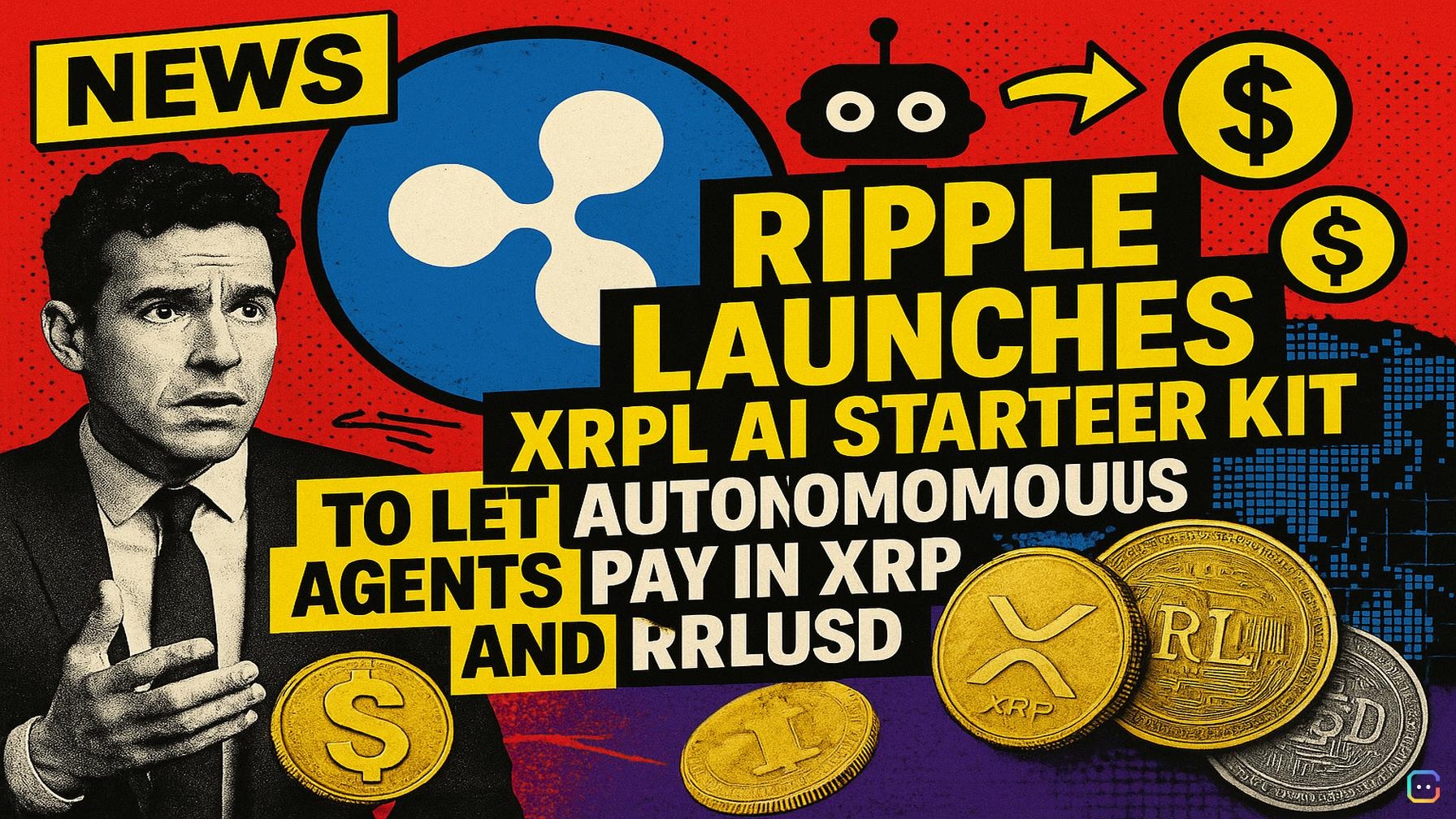
Ripple Launches XRPL AI Starter Kit to Let Autonomous Agents Pay in XRP and RLUSD
Ripple is doubling down on AI — and it wants the XRP Ledger to be where autonomous agents pay. The company has rolled out the XRPL AI Starter Kit, a developer toolkit designed to let AI agents send, receive and manage payments on-chain using XRP and Ripple USD (RLUSD). The kit supports the x402 payment standard, which enables payments to be handled inside web requests: a service can request payment, an agent can forward funds on-chain, and the service proceeds once payment proof is received. What’s in the starter kit - Developer access to XRPL Docs MCP Server and Claude-based tools for wallet creation, balance checks, transaction monitoring and payments. - Support for x402-powered workflows so agents can pay for compute, settle invoices and complete transactions with limited human intervention. - Integration that lets XRP act as a native settlement asset and RLUSD offer a dollar-pegged option for agents that need lower volatility. Why XRPL thinks it’s a fit Ripple highlights XRPL’s fast 3–5 second settlement times, predictable fees, built-in decentralized exchange and native cross-currency capabilities as advantages for automated, machine-to-machine payments. Those characteristics, Ripple says, make XRPL suitable for real-time agentic payment flows. Hiring signals and internal ambitions Ripple is also advertising a Staff Software Engineer — GenAI Platform role in San Francisco. The posting focuses on agentic AI systems: runtimes, orchestration, memory and evaluation pipelines, security controls and developer tooling, plus enterprise agent architecture and production deployments. While Ripple hasn’t said this hire is explicitly tied to the AI Starter Kit, the listing suggests the company is building internal GenAI infrastructure as well as tools for external developers. Market context and competition x402 activity so far is dominated by USDC, which accounts for more than 120 million cumulative transactions and over $41 million in settled volume. That means Ripple is entering an area where rivals already have early payment flows. Ripple’s effort gives XRP and RLUSD a role in the growing machine-payment market, but winning developers and real-world use cases will be key. Broader ecosystem signals Ripple’s AI payment push sits alongside its work on stablecoins and cross-border settlement. Industry moves such as Mastercard’s Agent Pay for Machines — which lists Ripple among more than 30 partners — show machine-speed payments are attracting wider attention beyond just crypto firms. What it means for XRP holders AI agent payments add another potential utility for XRPL, but demand — and any sustained impact on XRP price — will hinge on developer adoption, liquidity, regulatory clarity and broader market conditions. A developer kit is a start; meaningful network activity requires real applications and committed builders. Bottom line: Ripple is positioning XRPL as a payments layer for the age of autonomous agents, pairing new tooling and potential internal GenAI hires with XRPL’s speed and on-chain features. The outcome will depend on whether developers and businesses actually build and pay on-chain at scale. Read more AI-generated news on: undefined/news