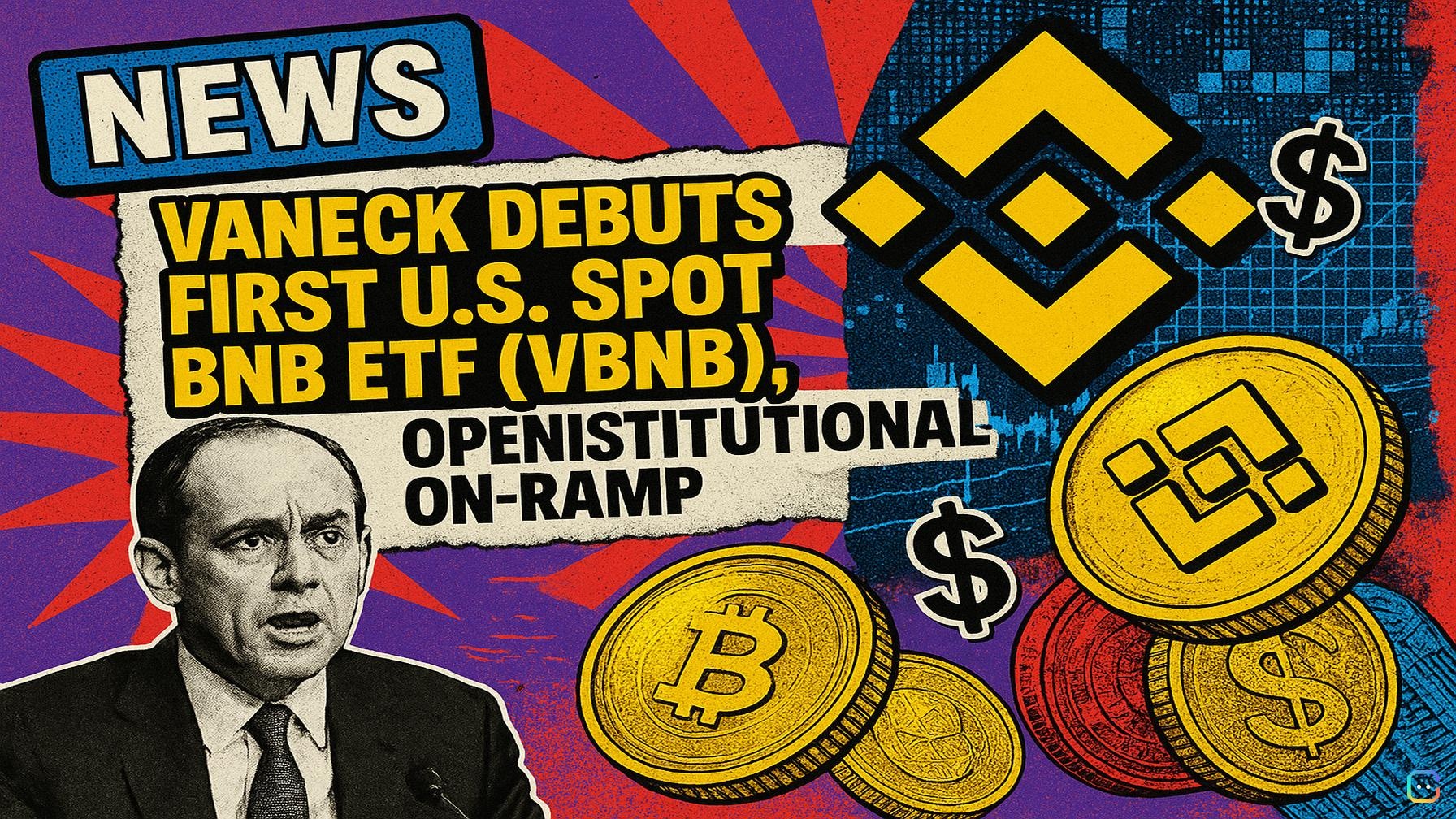
Headline: VanEck launches first U.S. spot BNB ETF as BNB Chain courts institutional flows ahead of regulatory clarity
VanEck this week opened a regulated institutional on‑ramp to the BNB Chain, debuting the VanEck BNB ETF on Nasdaq under the ticker VBNB — the first U.S. exchange‑traded product that offers spot exposure to BNB (excluding stablecoins). The fund charges a 0.39% sponsor fee and stores its assets offline with custodian Anchorage Digital Bank.
Why it matters: VBNB gives U.S. investors exchange‑traded access to one of the crypto ecosystem’s most actively used networks at a moment when asset managers and institutions are lining up to deploy capital as regulatory frameworks take shape. “Until today, BNB stood out among major crypto assets as one of the few not yet available in a U.S. spot ETP,” said Kyle DaCruz, VanEck’s Director of Digital Assets Product. VanEck pointed to the token’s network fundamentals — more than 14 million transactions per day and 2.5 million+ daily active users — as primary reasons for the listing. Senior analyst Patrick Bush added that BNB’s heavy on‑chain utility helped it weather recent market cycles.
The VBNB launch expands VanEck’s suite of spot crypto products (it already offers the Bitcoin ETF HODL) and marks a milestone for the BNB Chain: institutional capital can now access the network through a regulated vehicle. VanEck was the first to file for a U.S. BNB ETF in May 2025; Grayscale followed with a filing in January 2026 and is also pursuing a product in this space.
Regulatory tailwinds could lift major chains
Grayscale’s Head of Research, Zach Pandl, recently identified BNB Chain as one of the ecosystems best positioned to capture institutional flows once proposed U.S. changes — commonly framed around the CLARITY Act — advance. Pandl argues that clearer rules would unlock tokenized assets and DeFi use cases, creating a rising tide for digital-asset infrastructure, but that institutions will likely target established chains with demonstrated activity and compliance pathways first: Ethereum, Solana and BNB Chain.
BNB’s tokenized asset and RWA metrics
On tokenized assets, Ethereum remains the market leader for full on‑chain functionality, but BNB Chain has cemented itself in second place with $3.67 billion in distributed asset value, ahead of Solana’s $2.6 billion. While that distributed-asset figure has slipped by about 4.2% over the past month, BNB’s real‑world-asset (RWA) transfer volume surged — up 121.6% over 30 days to $2.53 billion, according to RWA.xyz. RWA holders climbed 68.5% month‑over‑month to 77,155 as of June 1; earlier in 2026 the chain recorded some of the fastest RWA holder growth among major ecosystems.
Stablecoins, payments and DeFi
Grayscale also highlighted BNB Chain’s strength in the stablecoin sector and on‑chain finance more broadly. In March the network reportedly handled roughly 40% of global stablecoin transactions by count for small‑value transfers, despite holding only about 5% of the total stablecoin supply. Over the last 30 days the chain posted $231.9 billion in stablecoin transfer volume and 68.53 million stablecoin holders — increases of 9.74% and 8%, respectively — underscoring growing use for transfers and real‑world payments. BNB Chain also ranks among the top ecosystems for DeFi activity and total value locked (TVL) by application metrics, according to Grayscale.
What this means going forward
The combination of a regulated spot ETF for BNB, rising on‑chain activity in tokenized assets, RWA flows and stablecoin throughput positions BNB Chain as a key junction between traditional finance and decentralized infrastructure. Institutions are already using the chain for permissioned financial products and integrating it with projects such as Circle’s USYC, BlackRock’s BUIDL, Franklin Templeton’s Benji Technology Platform and Matrixdock’s XAUm — signaling that BNB Chain could be a leading beneficiary as institutional deployment accelerates under clearer rules.
Read more AI-generated news on: undefined/news