Headline: Aave rewrites listing rules after $230M rsETH exploit exposes bridge vulnerabilities
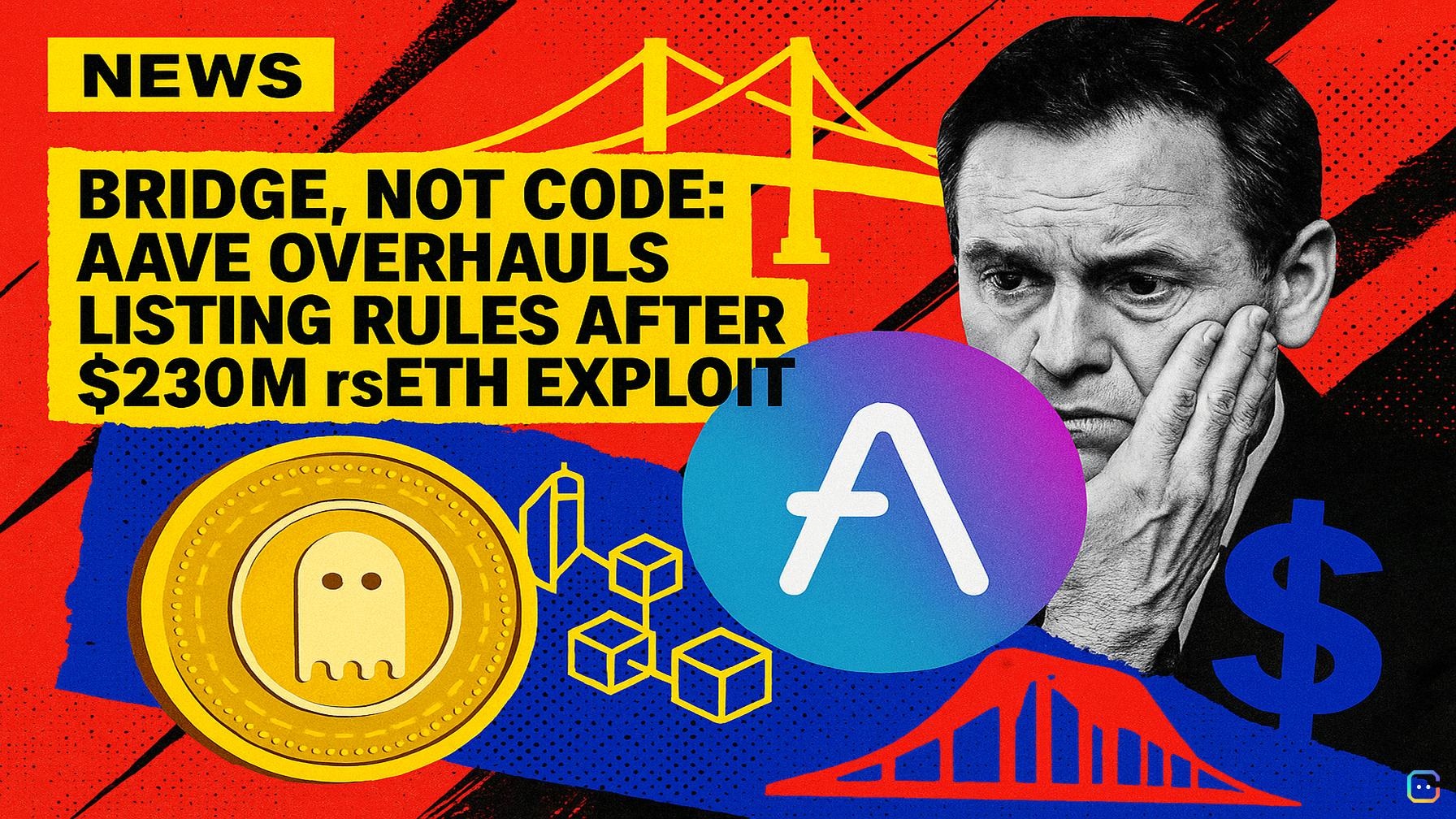
Aave has launched a sweeping review of every V3 asset and is overhauling its listing standards after April’s $230 million rsETH exploit — the largest DeFi attack of 2026 — showed that the weakest link can be the cross-chain infrastructure around a token, not the lending protocol’s own code.
What happened
- The exploit originated with KelpDAO’s rsETH — a “restaked” ether token that represents a claim on ETH users have staked and re-used as collateral to earn extra yield.
- To move rsETH across chains, KelpDAO relied on LayerZero, a cross-chain messaging/bridge system that uses multiple verifiers to validate messages. In this incident, a single verifier approved a forged message.
- That approval allowed the attacker to mint 116,500 rsETH with no underlying ETH backing. The attacker then deposited those tokens into Aave and drew loans the protocol could not recover once the rsETH was revealed as worthless.
- Aave’s postmortem stresses that Aave’s smart contracts functioned as intended; the root cause was a bridge verification failure. LayerZero has acknowledged it “made a mistake” by relying on a one-of-one verification configuration for high-value assets.
Aave’s response and new rules
- Aave says it will rework collateral listing standards to look beyond classical checks (volatility, liquidity, smart-contract audits) and explicitly evaluate the external infrastructure that tokens depend on.
- New assessment factors will include bridge security and verification models, oracle dependencies, third-party contracts and custodians, operational security, and secondary-market liquidity.
- Aave is also building automated defenses to react faster when an asset shows distress. One proposed measure would automatically reduce an asset’s loan-to-value to zero if predefined risk thresholds are breached, cutting off borrowing power before losses cascade.
- Operationally, Aave’s risk team has already made roughly 295 parameter changes across V3 markets since the exploit — including 168 supply-cap reductions and 66 borrow-cap cuts — to limit exposure to individual assets.
Why this matters
- The incident underscores a broader lesson for DeFi: as protocols become more interconnected, off-chain and cross-chain infrastructure (bridges, relayers, verification networks) must be treated as first-class risk vectors alongside smart contracts and market risk.
- Aave’s shift toward infrastructure-aware listings and faster automated defenses could set a new industry standard for how lending platforms vet and manage collateral that depends on third-party systems.
Bottom line: The rsETH exploit didn’t break Aave’s code — it broke a bridge. Aave’s postmortem argues the remedy is not just patches, but a fundamental rethink of how DeFi measures and responds to risk across the entire stack.
Read more AI-generated news on: undefined/news