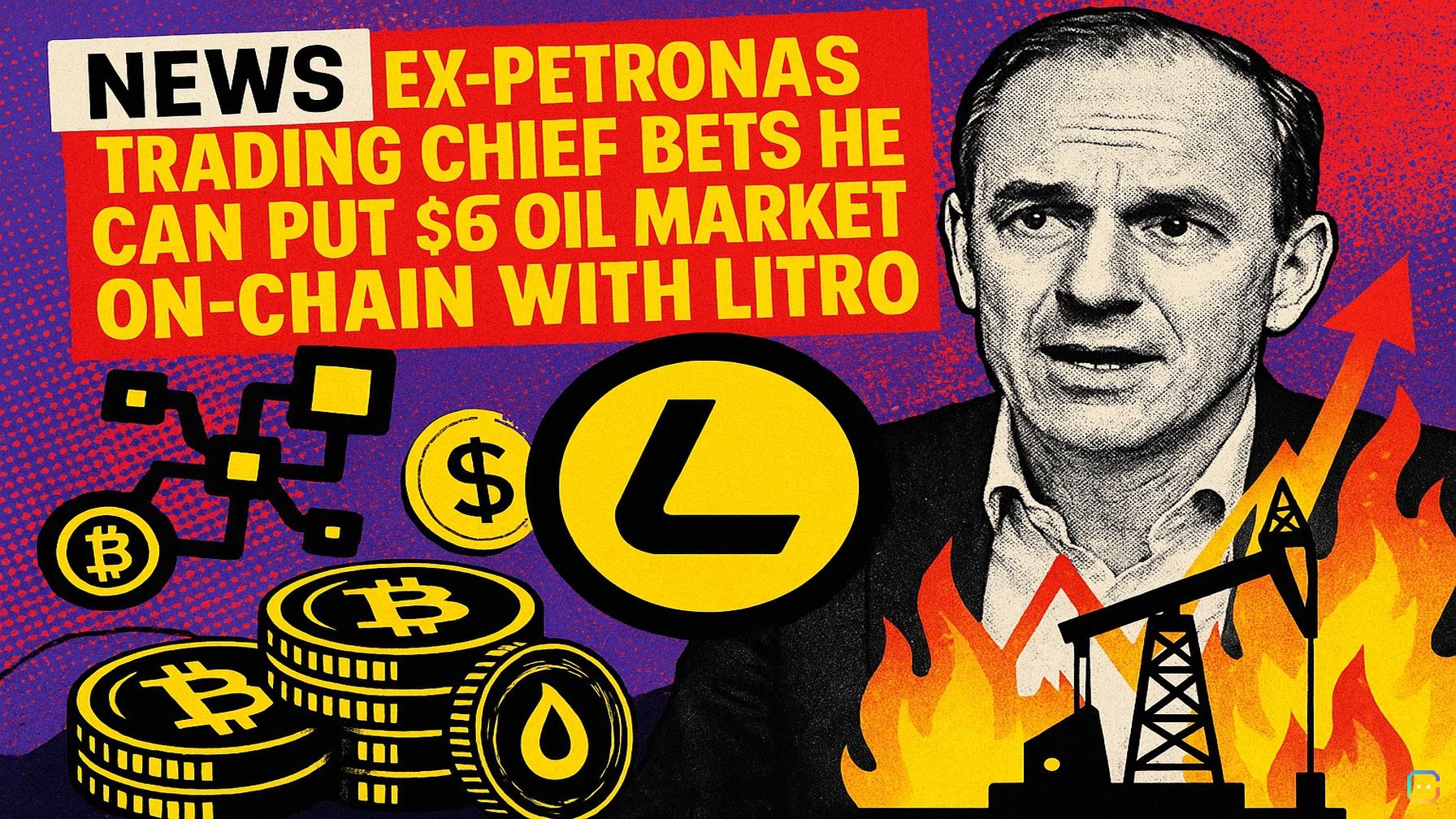
A former Petronas trading chief is betting he can put the $6 trillion crude market on-chain — and remake how oil is bought, sold and settled.
Baron Lamarre, co-founder of the International Digital Exchange (INDEX) and ex-head of trading at Malaysia’s Petronas, is launching LITRO: a tokenized crude product in which each LITRO represents one litre of real oil. The token will be indexed to mainstream benchmarks such as Brent and West Texas Intermediate and is pitched as a bridge between physical energy markets and blockchain rails.
“Litro’s testnet and product demo roll out March through May 2026, with official launch in January 2027,” Lamarre told CoinDesk, laying out a clear timetable for the project’s rollout.
Why tokenize oil?
Oil remains the world’s most consequential commodity, and recent geopolitical shocks that pushed prices above $100 a barrel underline how fragile supply chains and market plumbing can be. Yet much of oil trading still depends on legacy exchanges, heavy paperwork and multiday — sometimes 90-day — settlement cycles that immobilize billions in working capital. Traditional platforms such as CME and ICE also leave many smaller and mid-sized players effectively shut out by capital and access barriers.
INDEX’s pitch: digitize certified reserves, create 24/7 liquidity, and enable direct redemption into cash — or even physical barrels. The team positions LITRO as a real-world-asset (RWA) play that stays grounded in verifiable physical inventory, compared with the broader crypto market that still hosts many speculative tokens. By contrast, today’s RWA market (roughly $25 billion) is dominated by financial instruments like sovereign bonds — not commodities.
How LITRO works
- Producers pledge certified reserves to INDEX. Physical oil stays in custody at the producer’s facility.
- Independent auditors verify quantity, authenticity and legal ownership before any tokens are minted. “Only audited and verified reserves can be tokenized,” Lamarre said.
- Tokens are minted on a strict 1:1 basis: one LITRO = one litre of crude. Legal title is digitally assigned to the INDEX system while the oil remains physically stored.
- The protocol is being built on Arbitrum (an Ethereum layer-2) with compatibility across EVM chains.
Redemption and logistics
A major differentiator is the platform’s focus on real-world delivery. Lamarre says redemption for physical oil is built into the design: holders can convert tokens back to cash or, in theory, arrange physical delivery. INDEX is developing a “smart logistics routing system” to automate matches between tokenized barrels and delivery chains — matching grades, organizing vessels and terminals, issuing electronic bills of lading and certificates, and coordinating handover. The system will integrate IoT sensors, AIS vessel tracking and AI optimization to link the digital token layer to on-the-ground logistics.
Where INDEX stands now
INDEX is in early stages. The team expects an MVP1 by the end of March 2026, and Lamarre said discussions are underway with Capital Union Bank to join as a banking partner. Additional investor and partner deals are expected to follow once the MVP is complete. Testnet and product demos are slated for March–May 2026 with a target mainnet launch in January 2027.
Potential impact and risks
If INDEX executes its vision, tokenized oil could cut settlement times, unlock capital, and open access to smaller traders through 24/7 markets — a significant shift for an industry long dominated by closed systems. But the project faces notable challenges: regulatory scrutiny around commodity custody and transfer, counterparty and audit trust, logistics complexity, and the need to convince producers and major market participants to pledge physical reserves to a new protocol.
Bottom line
LITRO is an ambitious attempt to marry crude’s physical heft to blockchain’s liquidity and transparency. By anchoring tokens to audited inventories and building logistics tooling, INDEX aims to move beyond paper-based commodity trading toward always-on, tokenized markets — a bet that, if it pays off, could reshape how energy markets operate in a volatile world.
Read more AI-generated news on: undefined/news